Orbital debris, whether from space junk, defunct satellites, or meteorites, represents a growing threat to terrestrial infrastructure. 3D simulation allows for modeling the reentry trajectory, atmospheric fragmentation, and potential impact zones. Tools such as computational fluid dynamics (CFD) software and physics engines integrated into 3D modeling platforms offer precise risk visualization, helping governments and space agencies plan emergency protocols.
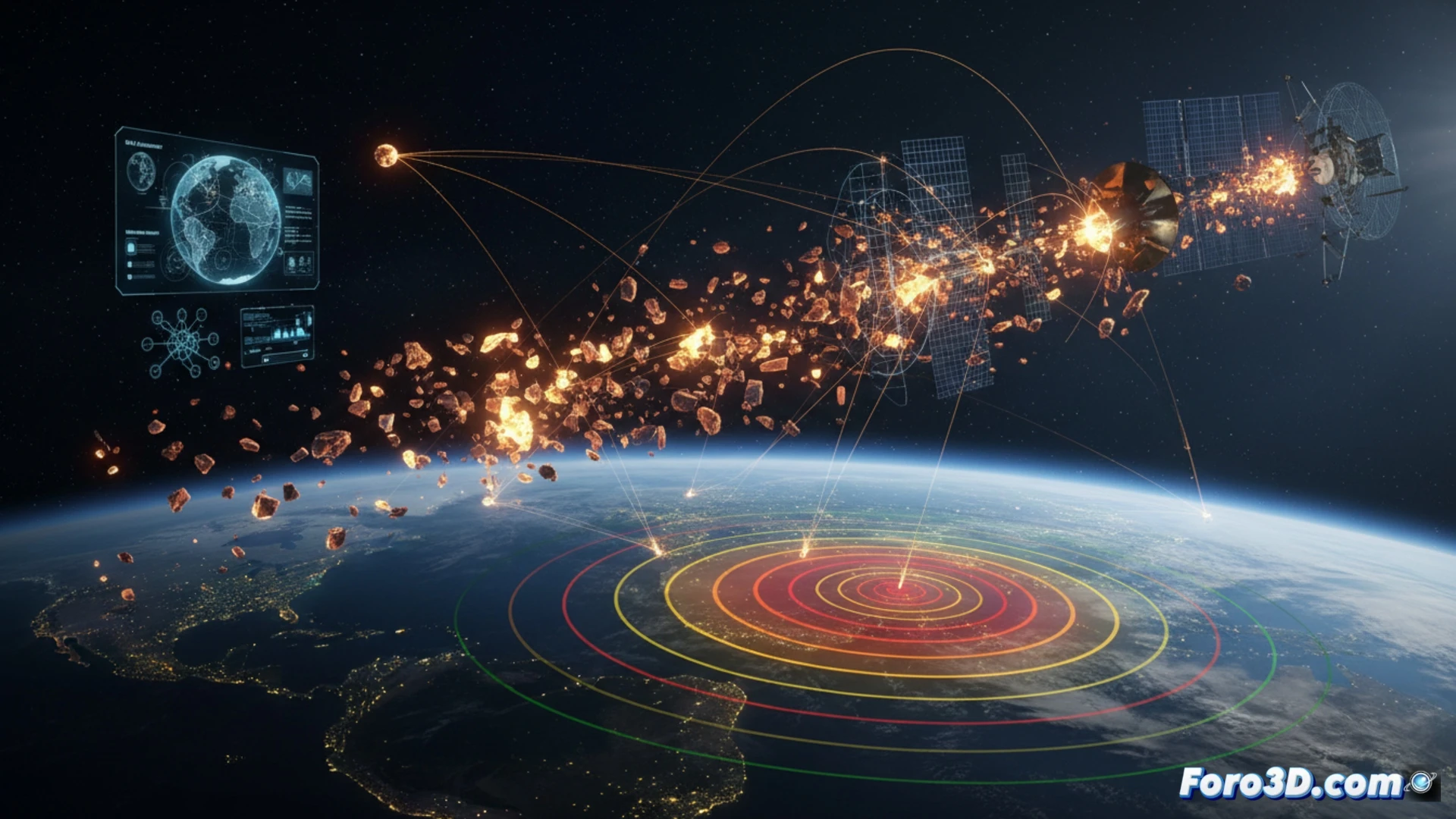
Modeling trajectories and fragmentation in 3D environments 🛰️
The simulation begins with defining the initial orbit and atmospheric parameters. Orbital propagation algorithms, such as those based on the SGP4 model, calculate the descent trajectory. The next step is fragmentation simulation, where thermal and aerodynamic loads are applied to the object. The 3D software discretizes the model into thousands of fragments, each with individual physical properties (mass, density, shape). This allows predicting the dispersion of debris over the Earth's surface, generating heat maps of impact probability. Examples like the uncontrolled reentry of the Tiangong-1 satellite in 2018 validate the accuracy of these models by predicting the fall corridor in the Pacific Ocean.
Damage visualization and disaster response 💥
3D visualization not only shows the impact but simulates the structural consequences. Through finite element analysis (FEA) integrated into the 3D environment, the kinetic energy of fragments and their ability to penetrate roofs, damage gas pipelines, or collapse buildings are evaluated. These simulations allow civil protection teams to design evacuation zones and protocols for closing critical infrastructure (nuclear plants, airports). Virtual reality (VR) applied to these scenarios improves emergency personnel training, reducing reaction time in the event of a real orbital debris incident.
How can 3D simulation of orbital debris accurately predict the impact of space junk on active satellite constellations and help design prevention protocols that mitigate the risk of cascade collisions?
(PS: Simulating catastrophes is fun until the computer crashes and you are the catastrophe.)