The energy transition has driven the use of hydrogen as a clean fuel, but its storage in ports presents lethal risks. An accidental deflagration in a container terminal not only releases a supersonic pressure wave but also generates incandescent metal fragments. Modeling this phenomenon in 3D allows safety engineers to predict structural collapse zones and design more effective containment barriers before a real catastrophe occurs.
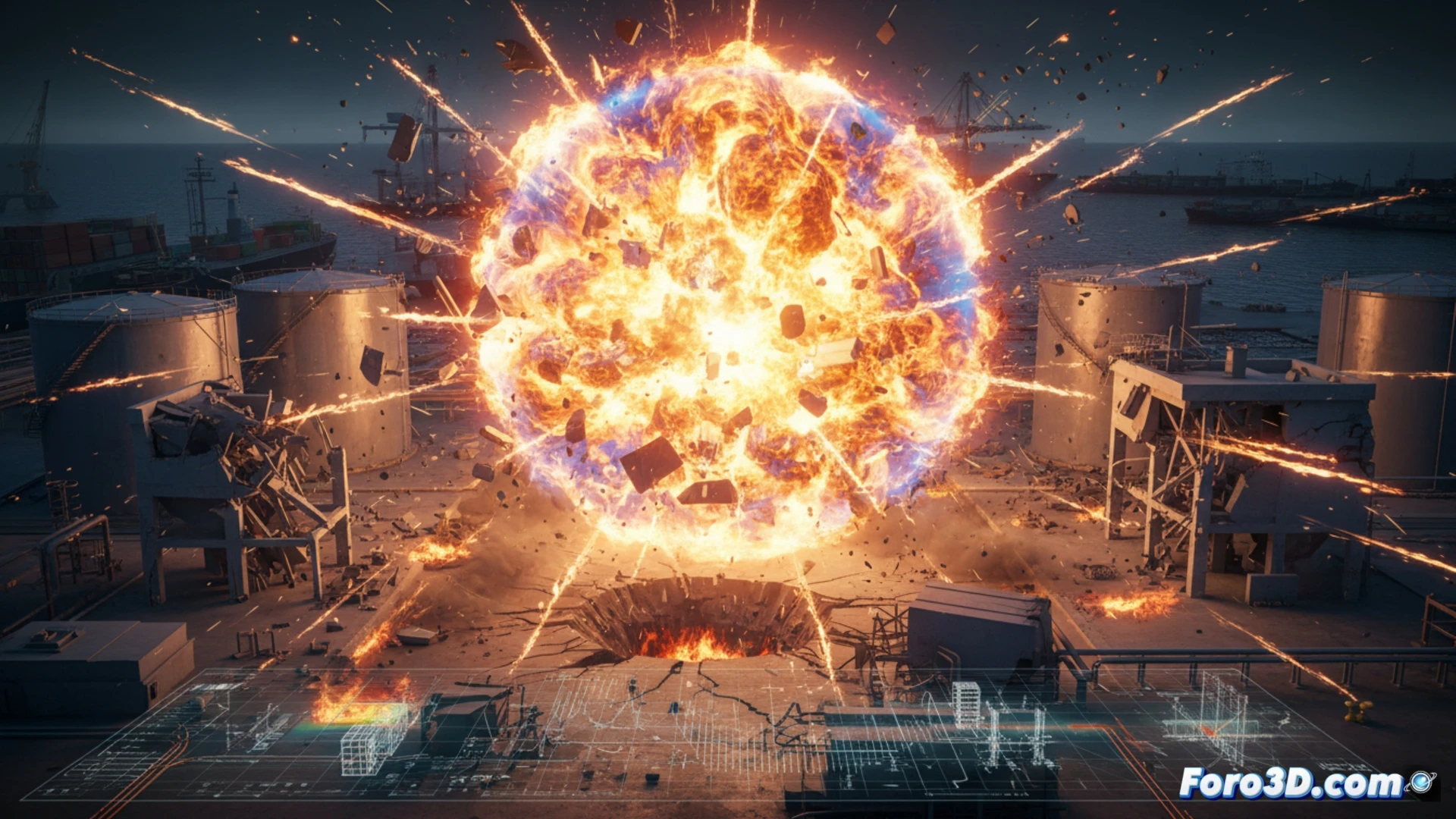
CFD Modeling and Real-Time Explosion Dynamics 🔥
To simulate the deflagration, we use computational fluid dynamics (CFD) solvers such as OpenFOAM or Ansys Fluent, configuring unstructured meshes that capture the geometry of gantry cranes and silos. The chemical kinetics of hydrogen are resolved with laminar flame models, while the propagation of the blast wave is coupled to an explosion dynamics solver (Euler-Lagrange). Results show that, in an accidental scenario with continuous leakage, the gas cloud reaches the flammability limit in 1.2 seconds, generating an overpressure of 8 bar within a 15-meter radius. In contrast, a controlled deflagration with forced ventilation reduces the maximum pressure to 1.5 bar, limiting damage to superficial concrete damage.
Visual Lessons for Disaster Prevention ⚠️
The visual comparison between both scenarios reveals a critical fact: in the accidental simulation, jets of unburned hydrogen travel at 340 m/s, igniting structures 50 meters from the source. However, the 3D model also demonstrates that installing metal deflector panels reduces fragmentation by 60%. These findings not only improve port evacuation protocols but also transform simulation into a forensic tool to redefine building codes in high-energy-risk zones.
How can 3D simulation of a hydrogen deflagration in port environments predict the propagation of the pressure wave and thermal radiation to optimize the design of storage infrastructure and mitigate the risks of chain explosions?
(PS: Simulating catastrophes is fun until the computer melts down and you are the catastrophe.)