Every year, stampedes at religious festivals, concerts, and stadiums leave dozens of victims. The problem is not panic, but the physics of the crowd: the pressure exerted by hundreds of bodies can reach lethal levels in seconds. Thanks to 3D modeling of autonomous agents, it is now possible to recreate these chaos scenarios to identify choke points and design efficient evacuation routes, transforming disaster prevention into an exact science.
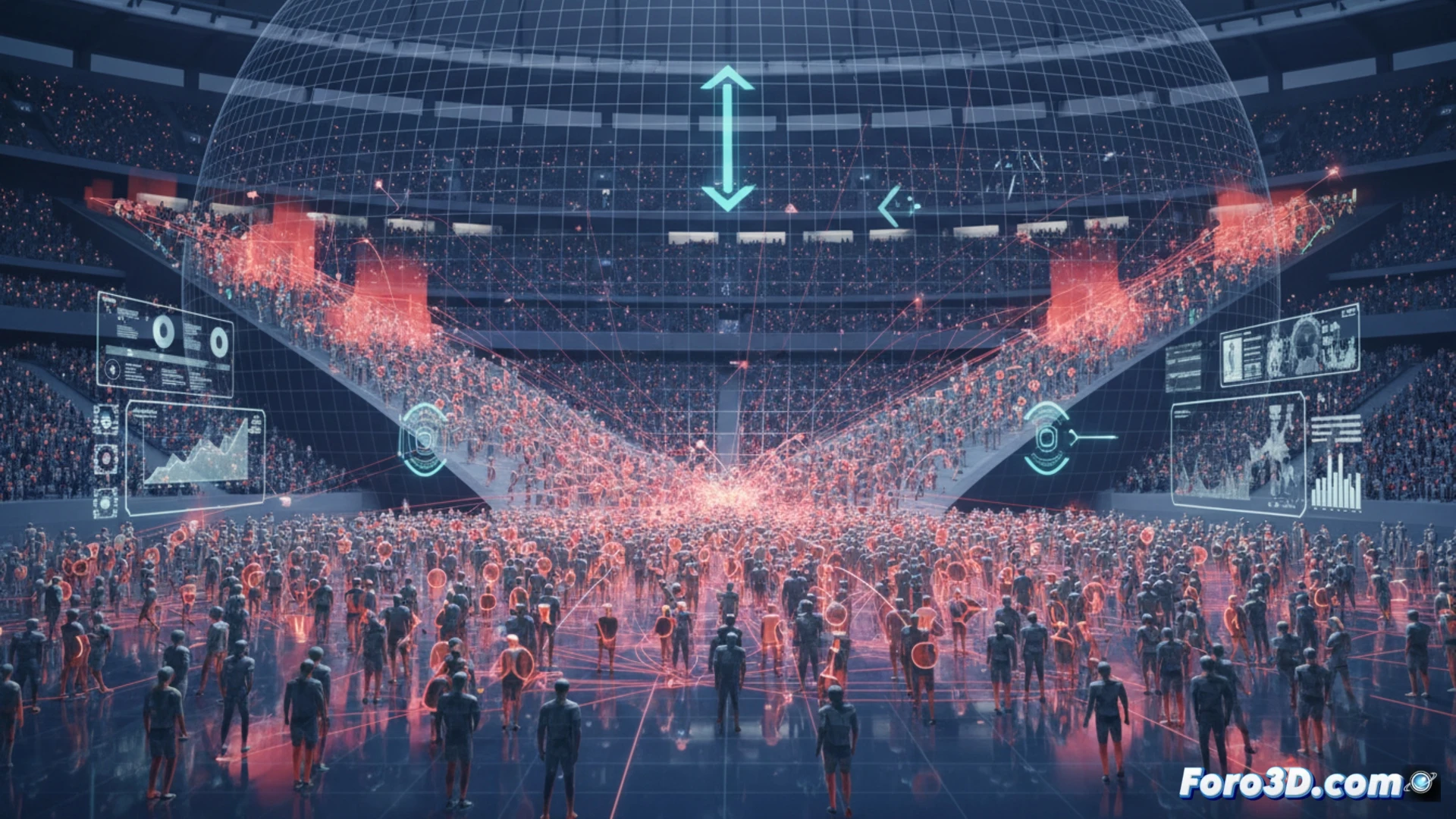
Particle algorithms and critical pressure points 🧠
At the heart of these simulations lies the self-propelled particle model. Each virtual agent has individual parameters such as maximum speed, personal radius, and reaction time. The 3D environment is divided into density cells; when a threshold of 6 people per square meter is exceeded, the system activates compression alerts. Tools like the Helbing model or the Social Force Model calculate lateral and frontal pushing forces. Real-time heat map visualization allows safety engineers to detect bottlenecks before a tragedy occurs, simulating everything from a blocked exit to the domino effect of a mass fall.
Lessons from the stampede: from theory to real life 📉
The 2015 Mecca tragedy or the 2010 Love Parade disaster were not acts of irrational panic, but failures in architectural design and flow. Subsequent 3D simulations showed that simple changes in the placement of barricades or the opening of asymmetric exits reduced pressure by 40%. Today, events like the Hajj use these models to manage human waves. Technology does not eliminate chaos, but it allows us to tame it: every pixel of a simulation is a life not lost.
As the physics of human avalanches demonstrates that collapse is not due to panic, but to unexpected compression pressures, what biomechanical or environmental parameters are key to modeling that critical transition point in a realistic 3D simulation.
(PS: Simulating catastrophes is fun until the computer melts down and you are the catastrophe.)