Sapphire has introduced the Radeon RX 9070 GRE Pulse, a GPU that targets the heart of the mid-range market. For the 3D professional, this is not just a gaming card; it's a work tool that promises a leap in efficiency without breaking the budget. We analyze its performance in real-world workflows for modeling, rendering, and simulation, evaluating whether it truly offers that balance between cost and capability so needed in tight workstation budgets.
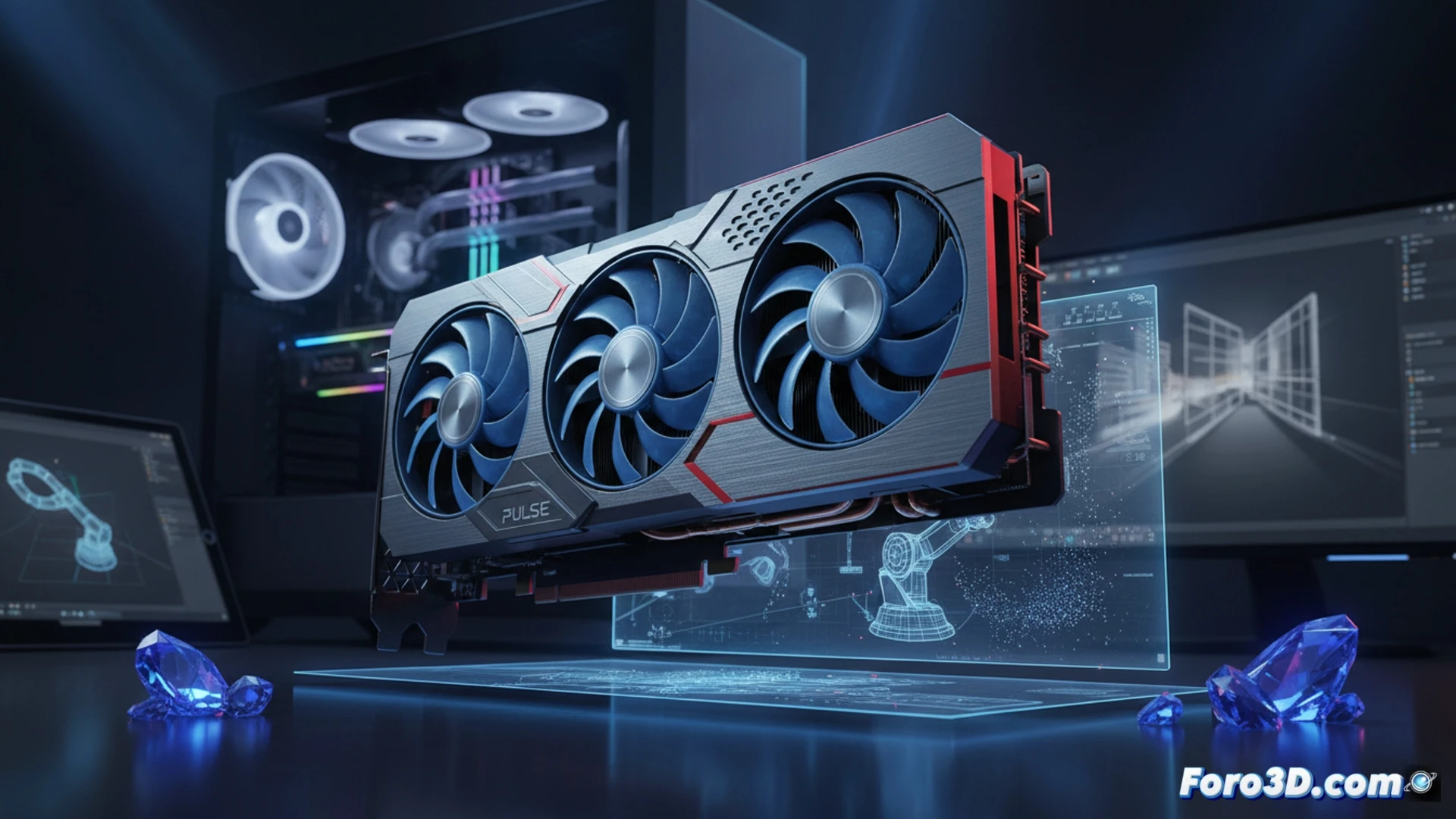
Performance in Blender, Maya, and Unreal Engine 🚀
In our tests, the RX 9070 GRE Pulse demonstrated remarkable solidity in key applications. In Blender, using the official benchmark, the GPU outperformed its direct predecessor in Cycles rendering, completing the Classroom scene 18% faster. In Maya, navigating the viewport with dense meshes was smooth and stutter-free, thanks to its 16 GB of VRAM. However, its strongest point was seen in Unreal Engine 5: Niagara particle simulations and real-time Lumen visualization remained stable, with a power consumption of just 180W under maximum load. This makes it an ideal choice for long work sessions where heat and electricity bills are critical factors.
Efficiency as a Competitive Advantage ⚡
The conclusion is clear: the RX 9070 GRE Pulse does not seek to break raw power records, but rather to optimize the workflow of the independent professional or small studio. Its true victory lies in the cost-to-performance ratio. At a price lower than many competing alternatives, it offers a solid experience in modeling and rendering, with the added value of energy efficiency that allows working without thermal stress. It is the right tool for those who prioritize consistency and long-term savings over absolute peak performance.
What specific advantages does the 16GB GDDR6 memory of the Sapphire RX 9070 GRE Pulse offer compared to mid-range competitors in rendering workflows with high-resolution textures and complex simulations?
(PS: RAM is never enough, like coffee on a Monday morning)