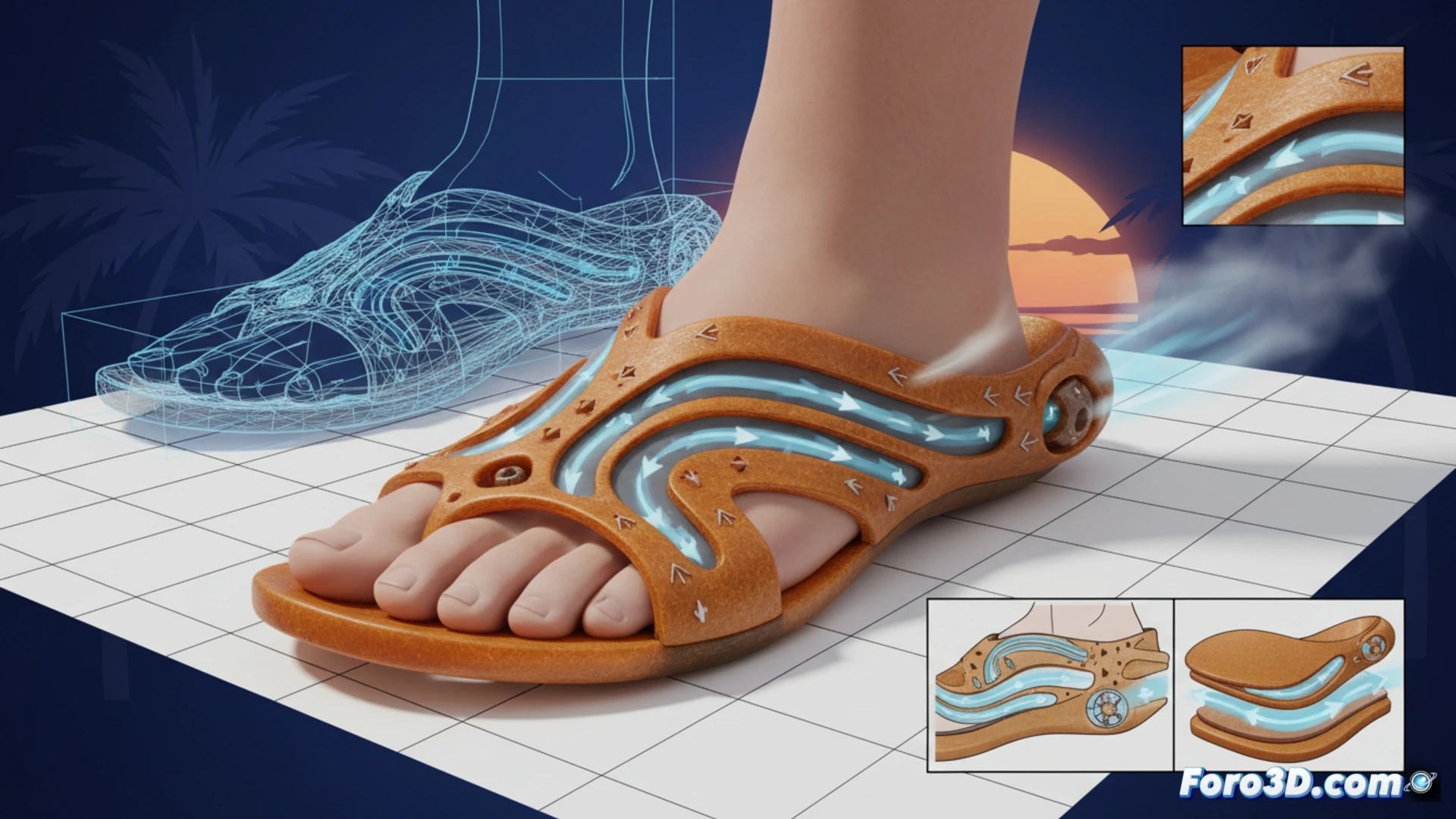
The design of footwear for warm climates finds a new challenge in the barefoot toe sandal: integrating an ultra-thin sole without sacrificing cushioning or ventilation. This tutorial addresses the 3D modeling of a sole that uses the Venturi principle, generating forced airflow that evacuates heat and moisture. We will explore the technical process to create this functional pattern, from the parametric sketch to optimization for additive manufacturing.
Modeling the Venturi Pattern in Rhino and Blender 🧊
To achieve the ultra-thin sole, we start by defining the plantar contour in Rhino 3D using variable density curves. The secret lies in the Venturi pattern: channels that narrow in the central area of the foot (where pressure is greatest) and expand towards the edges. In Blender, we apply a displacement modifier with a smooth noise texture to sculpt these channels, ensuring the narrowest cross-section measures just 2 mm. The geometry is reinforced with an internal lattice of ribs 0.8 mm thick to maintain structural rigidity. To simulate cushioning, we integrate air microcapsules at the pattern's intersection nodes, modeled as hollow spheres 1.5 mm in diameter. The airflow is calculated by orienting the channels towards the toe and heel, creating a Venturi effect that accelerates air passage while walking.
Optimization for Printing and Thermal Comfort 🔥
When exporting the model for 3D printing in flexible TPU, it is crucial to avoid overhang angles greater than 45 degrees for the internal channels. I recommend orienting the sole at a 15-degree angle on the print bed to minimize supports. To validate the airflow, we run a basic CFD simulation in Blender with the FLIP Fluids add-on, setting the step as an alternating pressure of 5 Pa. The results show an air velocity of 0.3 m/s in the channels, sufficient to evaporate sweat. This design not only cools but reduces the sole's weight by 40% compared to a solid one, ideal for those seeking the barefoot feel with technical protection.
When designing an ultra-thin sole for barefoot sandals, how is the Venturi flow principle integrated to improve ventilation and thermal comfort during the summer months without compromising the footwear's structural strength?
(PS: Designing fashion in 3D has the advantage that you never have to sew a button.)