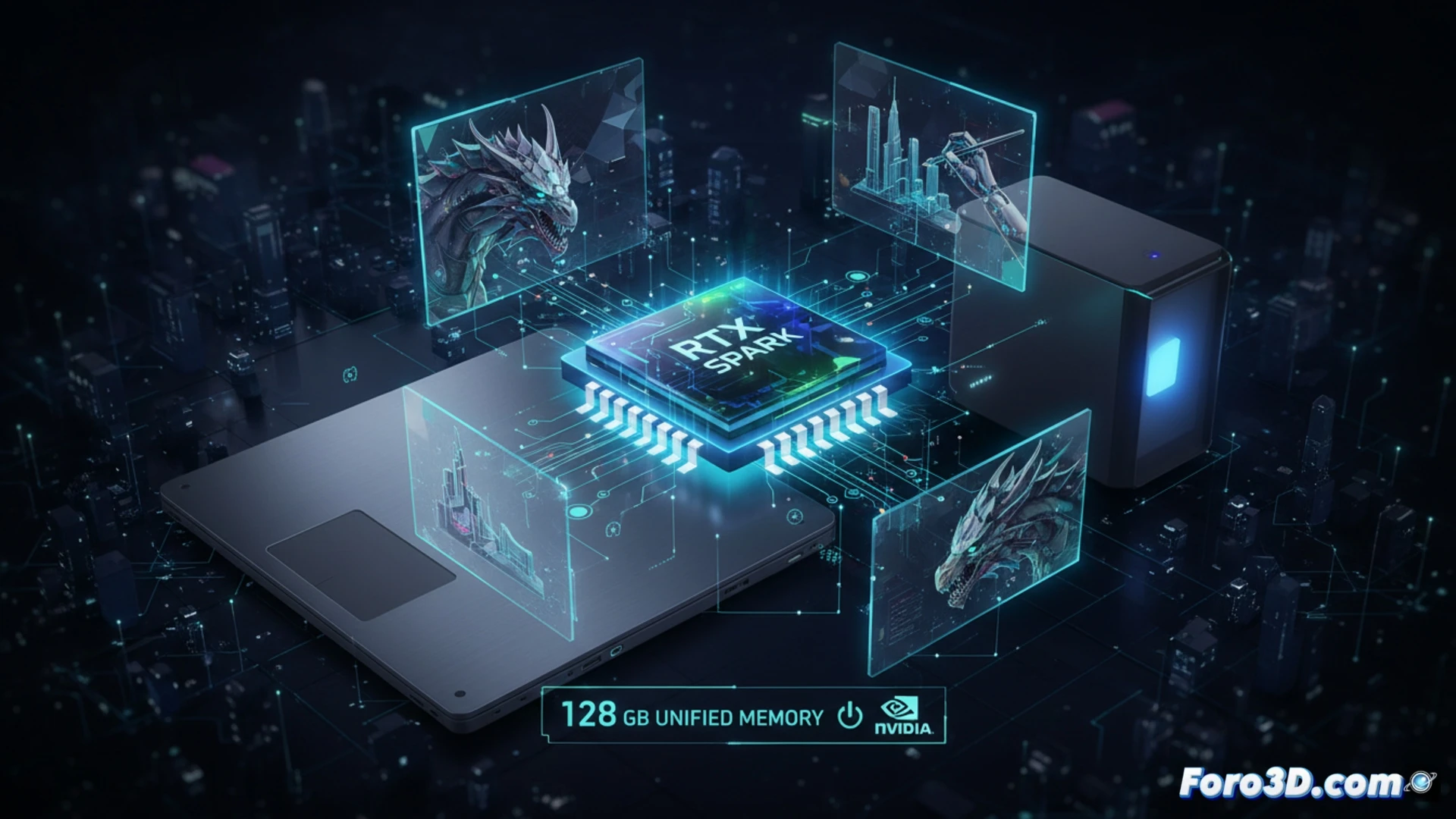
Nvidia has announced the launch of the RTX Spark, a chip designed specifically for laptops and mini-PCs that promises to be the most efficient in its catalog. With the ability to offer up to 128 GB of unified memory and reduced power consumption, this component will allow modeling, rendering, and artificial intelligence tasks to be performed without needing to be connected to the power grid. However, its viability in professional 3D workflows will depend on the adaptation of the Windows ecosystem.
Technical specifications and comparison with current GPUs 🚀
The RTX Spark integrates a unified memory architecture that allows the processor and GPU to access the same 128 GB of RAM, eliminating traditional bottlenecks in data transfer between VRAM and the system. This represents a significant advantage over current GPUs such as the RTX 4060 (12 GB) or RTX 4090 (24 GB), especially in particle simulations or renders with high-resolution textures. However, the bandwidth of this unified memory is often limited compared to dedicated VRAM, which could cause latency in real-time rendering operations. Experts point out that for tasks like complex polygonal modeling in Blender or Cinema 4D, the chip offers performance comparable to a mid-range GPU, but with consumption under 35W, ideal for ultraportable workstations.
Software limitations and the Windows factor ⚠️
Despite its power, the RTX Spark depends on the Windows ecosystem and the optimization of 3D programs. Applications like Autodesk Maya or Houdini require specific drivers to take advantage of unified memory, something not yet guaranteed at launch. Additionally, the lack of native support for CUDA in low-power configurations could limit the acceleration of render engines like Octane or Redshift. For the 3D professional, this means the chip will be ideal for quick sketches and on-site reviews, but not for final productions without prior software adaptation. The promise of powerful performance and energy savings is real, but its success will depend on developers closing the gap between hardware and software.
Could the RTX Spark, being optimized for portable environments, mark a before and after in the viability of complex 3D workflows such as real-time rendering or physical simulations directly from a laptop without the need for external workstations?
(PS: RAM is never enough, like coffees on a Monday morning)