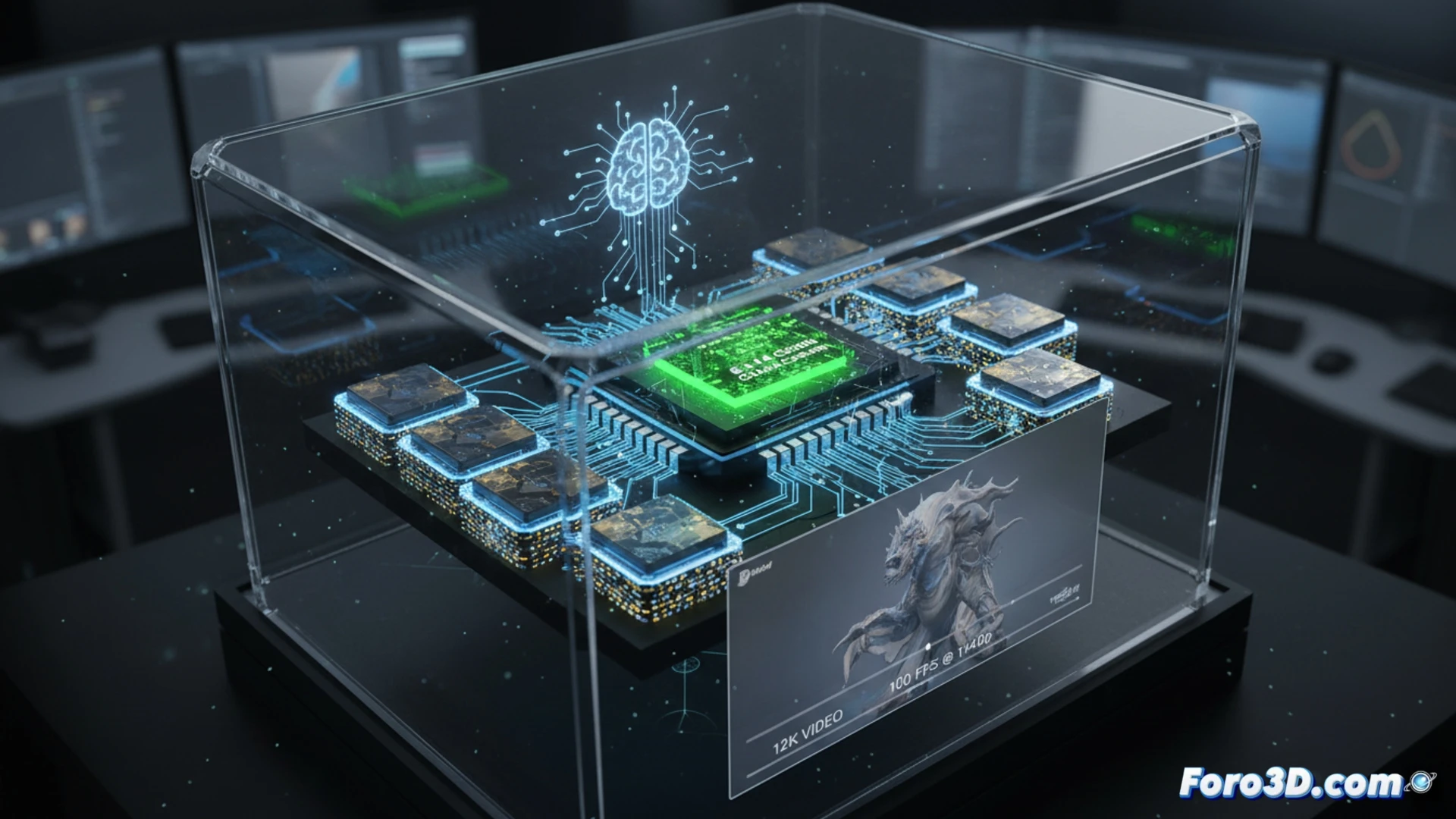
NVIDIA has broken the mold of traditional workstations with the announcement of the RTX Spark processors, based on ARM architecture. This system-on-chip integrates a 20-core CPU with a Blackwell GPU that deploys 6,144 CUDA cores. The promise is clear: run local artificial intelligence, edit 12K video, and exceed 100 FPS in games at 1440p. But for the 3D artist, the question is not whether it can play games, but whether it can reliably render and model.
Viewport, rendering, and simulation performance 🚀
In the viewport of applications like Blender or Autodesk Maya, the Blackwell GPU with 6,144 CUDA cores offers computing density comparable to an RTX 4070, suggesting smooth navigation in complex scenes. However, the bottleneck lies in the 20-core ARM CPU. While Intel and AMD x86 processors excel in physical simulation and mesh subdivision tasks, NVIDIA's ARM architecture could shine in hybrid processes that use the GPU, such as real-time path tracing rendering. 12K video editing is feasible thanks to NVENC decoders, but export will depend on software optimization for ARM. For professional 3D modeling, the lack of native compatibility with many x86 plugins on ARM systems remains a critical barrier, limiting the chip's immediate viability.
Is the RTX Spark a smart investment for the 3D studio? 💡
The transition to ARM is inevitable, but the RTX Spark arrives in an early maturity phase. For a 3D studio relying on render engines like V-Ray or Cycles, compatibility with x86 instructions via emulation can reduce performance by up to 30%. The real advantage lies in energy efficiency and local AI computing, ideal for tasks like denoising or texture generation. However, justifying the cost of specialized equipment is only viable if the workflow is optimized for ARM from the start. For now, the RTX Spark is a promising secondary machine for specific tasks, but not a direct replacement for traditional x86 workstations.
Considering the professional 3D software ecosystem, which has historically been optimized for x86 architecture, how does the transition to ARM in the RTX Spark affect the compatibility and performance of applications like Blender, Autodesk Maya, or Cinema 4D in complex rendering and simulation workflows?
(PS: RAM is never enough, like coffees on a Monday morning) ☕