Breaking a lens in a lithography machine, such as those manufactured by ASML, represents a critical failure in the semiconductor production chain. This optical defect introduces aberrations in the extreme ultraviolet (EUV) light beam, deviating the projection of the circuit pattern onto the silicon wafer. As a result, the lines and spaces defined in the photoresist suffer deformations, generating short circuits or discontinuities in transistors smaller than 5 nanometers. The repair cost can exceed 10 million dollars, but the true impact lies in the yield loss of entire batches of wafers.
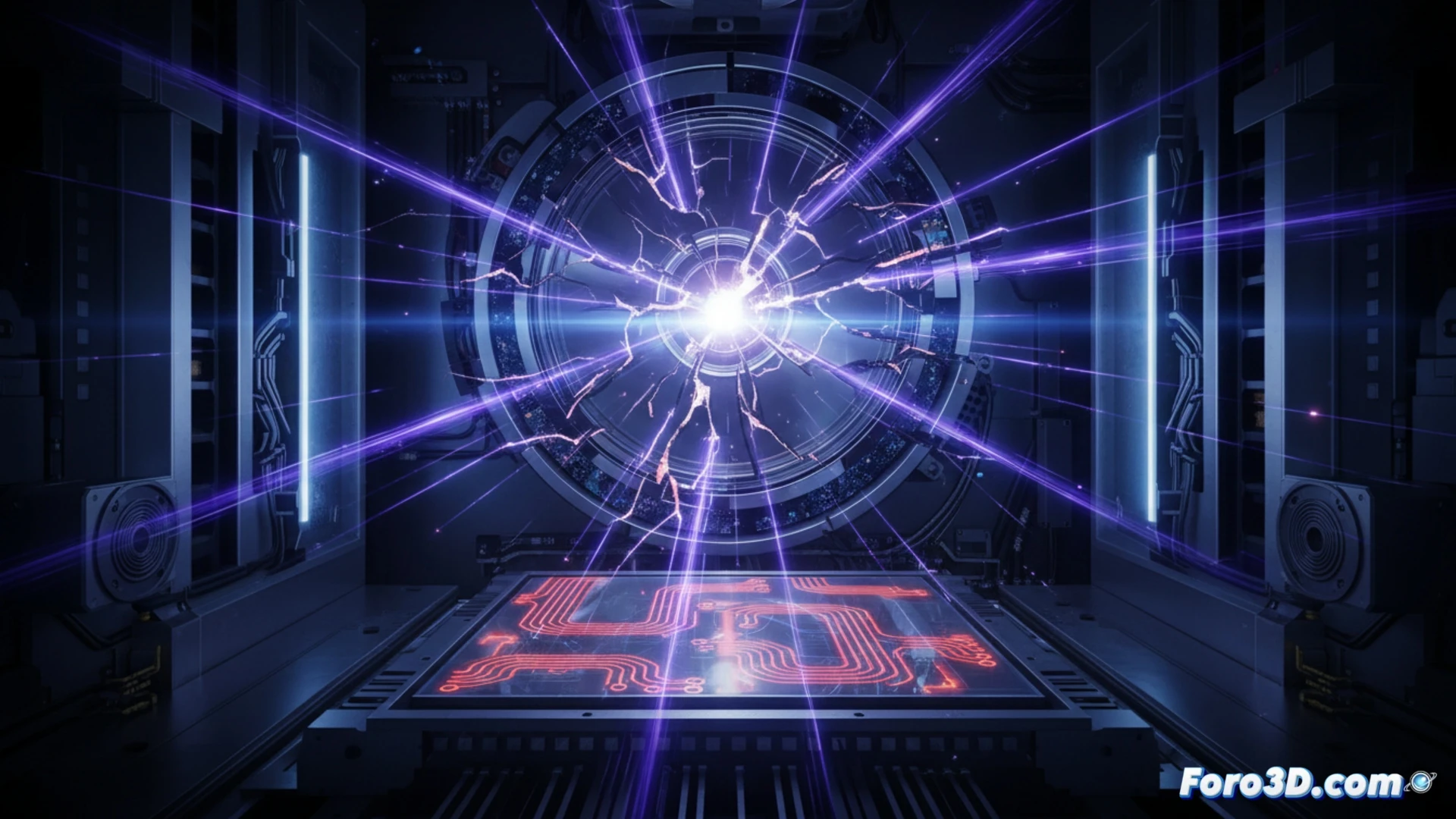
3D Simulation of Optical Aberrations and Defects in Circuit Architecture 🔬
3D modeling allows for accurately replicating the behavior of light passing through a fractured lens. Using ray tracing tools and computer-aided design (CAD) software, it is possible to simulate how a microscopic crack in the lens generates unwanted diffraction patterns. By integrating this data into a digital twin of the wafer, engineers visualize the direct impact on the metallization layer and logic gates. For example, a chipped lens can cause a lateral shift of 0.3 nanometers in the projected image, enough to misalign connection vias in a 3 nm chip, causing current leaks that render the device unusable. This simulation is vital for adjusting focus parameters and deciding whether to halt production or continue with a batch of degraded quality.
Lessons for Microfabrication and the Future of Lithography ⚙️
Breaking a lens is not just a mechanical problem, but a warning about the fragility of manufacturing processes in the era of subnanometer chips. The use of 3D simulations to predict optical failures has become an indispensable practice to reduce silicon and energy waste. As we move towards high numerical aperture lithography (High-NA EUV), the tolerance for error is almost zero. Every crack in a lens reminds us that hardware precision must match the complexity of design software, or else the dream of miniaturization will collide with the reality of applied physics.
Considering the multi-million dollar costs of an EUV lithography lens, what redundancy protocols or modular optical designs are being investigated to minimize downtime in the event of a catastrophic breakage like the one described?
(PS: simulating a 200mm wafer is like making a pizza: everyone wants a slice)