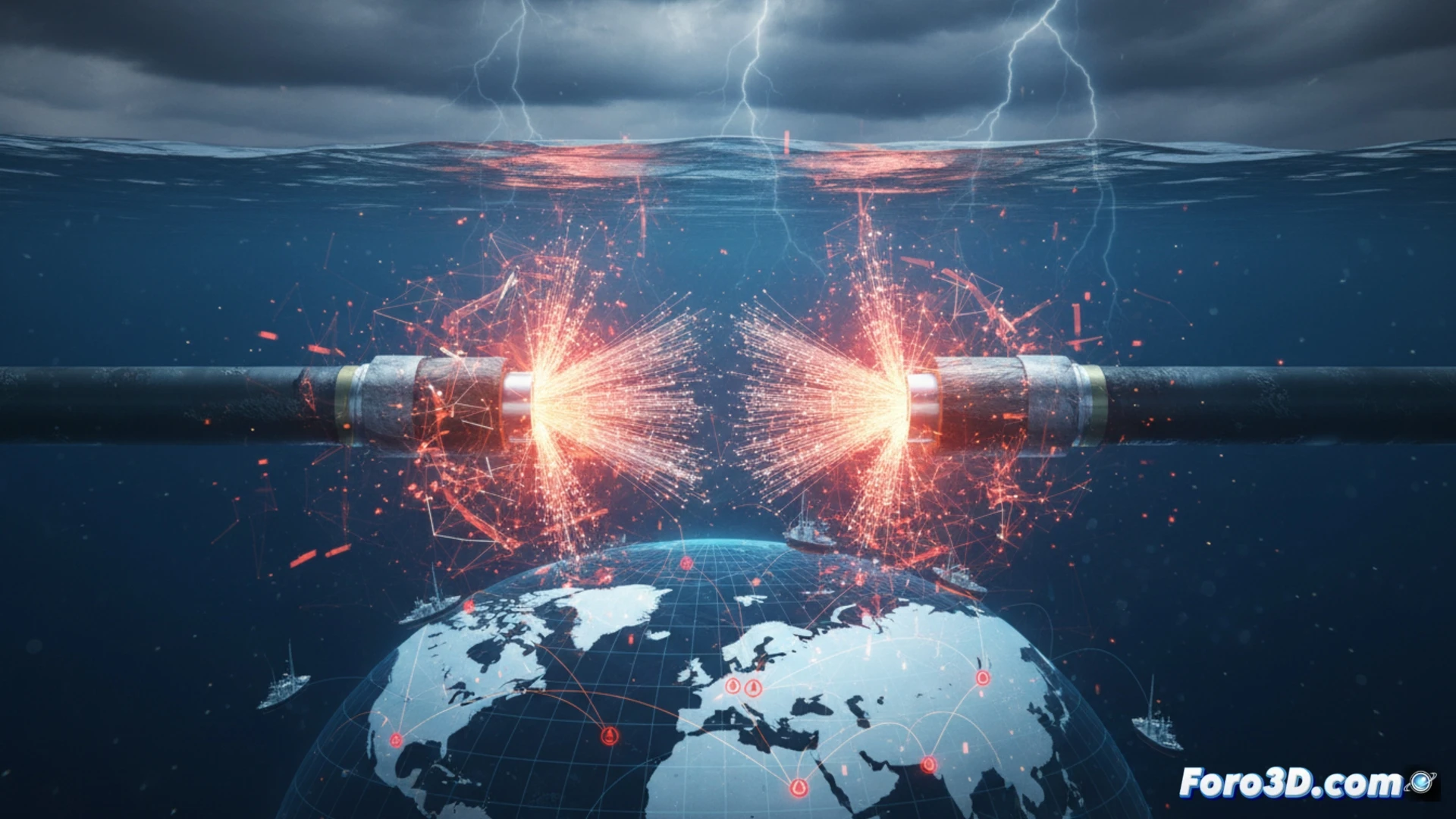
A fault in a submarine cable not only cuts off internet or power, but triggers a global logistical collapse. At Foro3D, we analyze how a fiber optic cable break on the seabed becomes a technical disaster. Thanks to 3D simulation, we can model the fracture, signal loss, and economic impact in real time, offering a critical perspective on the fragility of our invisible infrastructures.
Digital Twin and Seabed Reconstruction 🌊
3D technology allows creating an exact digital twin of the damaged cable and its environment. Using bathymetric data and hydrostatic pressure models, the exact point of the break is virtually reconstructed, whether due to an anchor, landslide, or material fatigue. This visualization allows engineers to simulate mechanical stress and fault propagation without getting wet. Additionally, repair routes can be planned avoiding unstable areas, reducing intervention time from weeks to days and minimizing the impact on global connectivity.
The Hidden Fragility of the Connected World ⚠️
Beyond repair, these simulations force us to reflect on our dependence on critical infrastructures. A single point of failure on the ocean floor can isolate entire countries. Modeling these disasters in 3D is not just a technical exercise, but a visual warning. It reminds us that, beneath the apparent solidity of the digital world, there is a fragile and vulnerable network that deserves to be studied and protected with the most advanced visualization tools.
What 3D simulation parameters would allow more accurately modeling the domino effect of communications and power disruption on global logistics after a submarine cable break?
(PS: Simulating catastrophes is fun until the computer melts down and you are the catastrophe.)