The rupture of an artificial reef not only represents an ecological catastrophe, but also a technical challenge for forensic documentation. When these concrete or steel structures give way under the ocean's pressure, the debris scatters across the seabed, creating a navigation hazard and altering the local habitat. In this article, we analyze how underwater photogrammetry and sonar scanning allow for the 3D reconstruction of the exact moment of collapse and its causes.
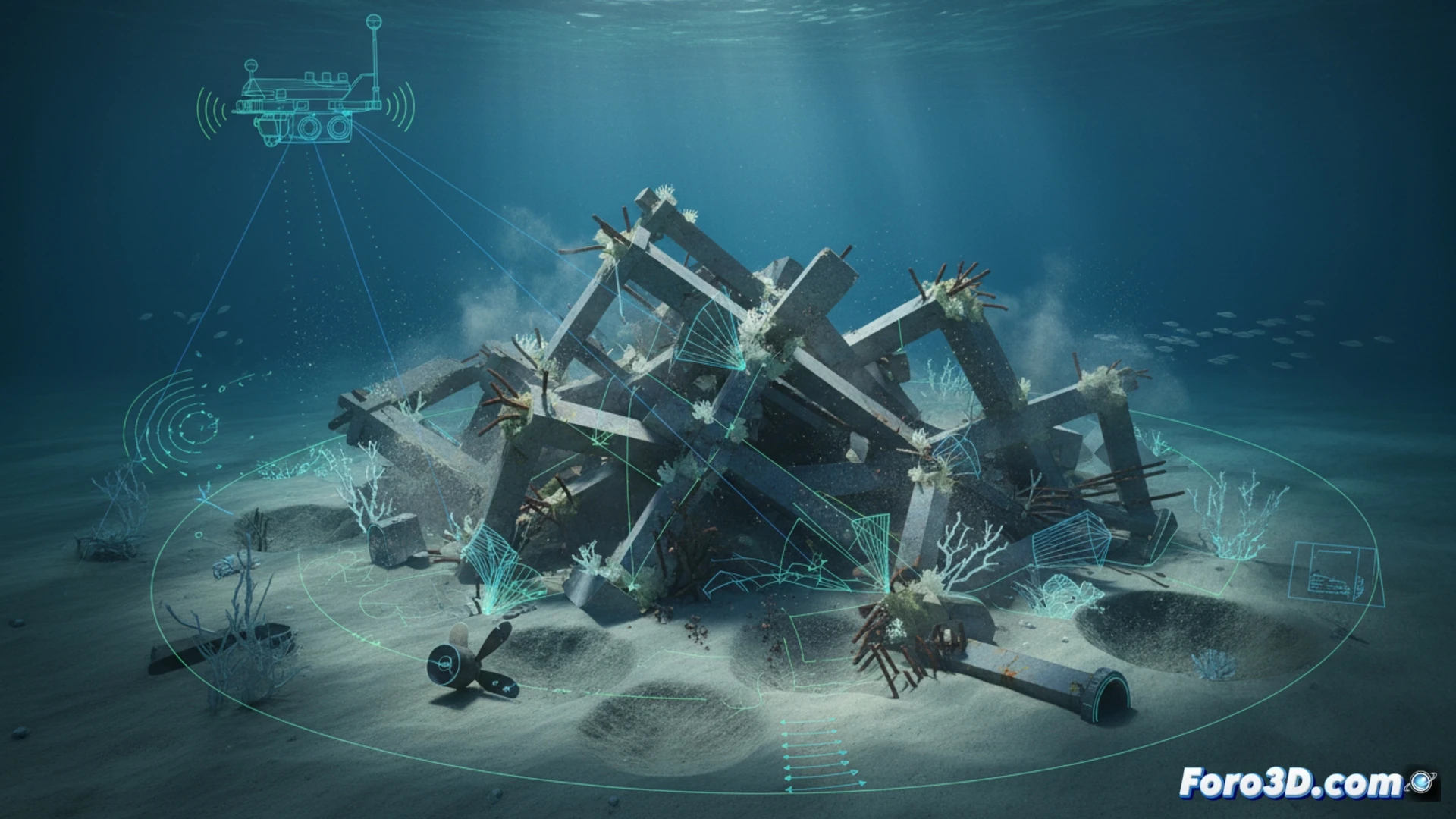
Underwater Photogrammetry and Structural Fatigue Analysis 🌊
To document the rupture, a remotely operated vehicle (ROV) equipped with high-resolution cameras and a side-scan sonar is used. The underwater photogrammetry process generates a point cloud of millions of vertices, where every fracture and displacement is recorded. By overlaying this model with the original reef design, engineers identify failures due to material fatigue, corrosion at joints, or the impact of extreme currents. 3D hydrodynamic simulations allow recreating the collapse scenario, showing how waves or maritime traffic exerted pressure on weak points undetected during the initial construction.
Prevention and Virtual Restoration of the Ecosystem 🐠
Beyond forensic analysis, the 3D model serves as a virtual laboratory for planning restoration. Technicians can simulate the relocation of fallen blocks without disturbing the already established fauna, or design new reefs with geometries that better withstand currents. Visualizing the original state versus the damaged one, with textures of algae and corals, helps authorities decide whether to remove the debris or leave it as a new substrate. The catastrophe thus becomes a digital lesson to prevent future collapses.
Which underwater photogrammetry methodology allows for the most accurate reconstruction of progressive fractures in a collapsed artificial reef for 3D forensic analysis?
(PS: Simulating catastrophes is fun until the computer crashes and you are the catastrophe.)