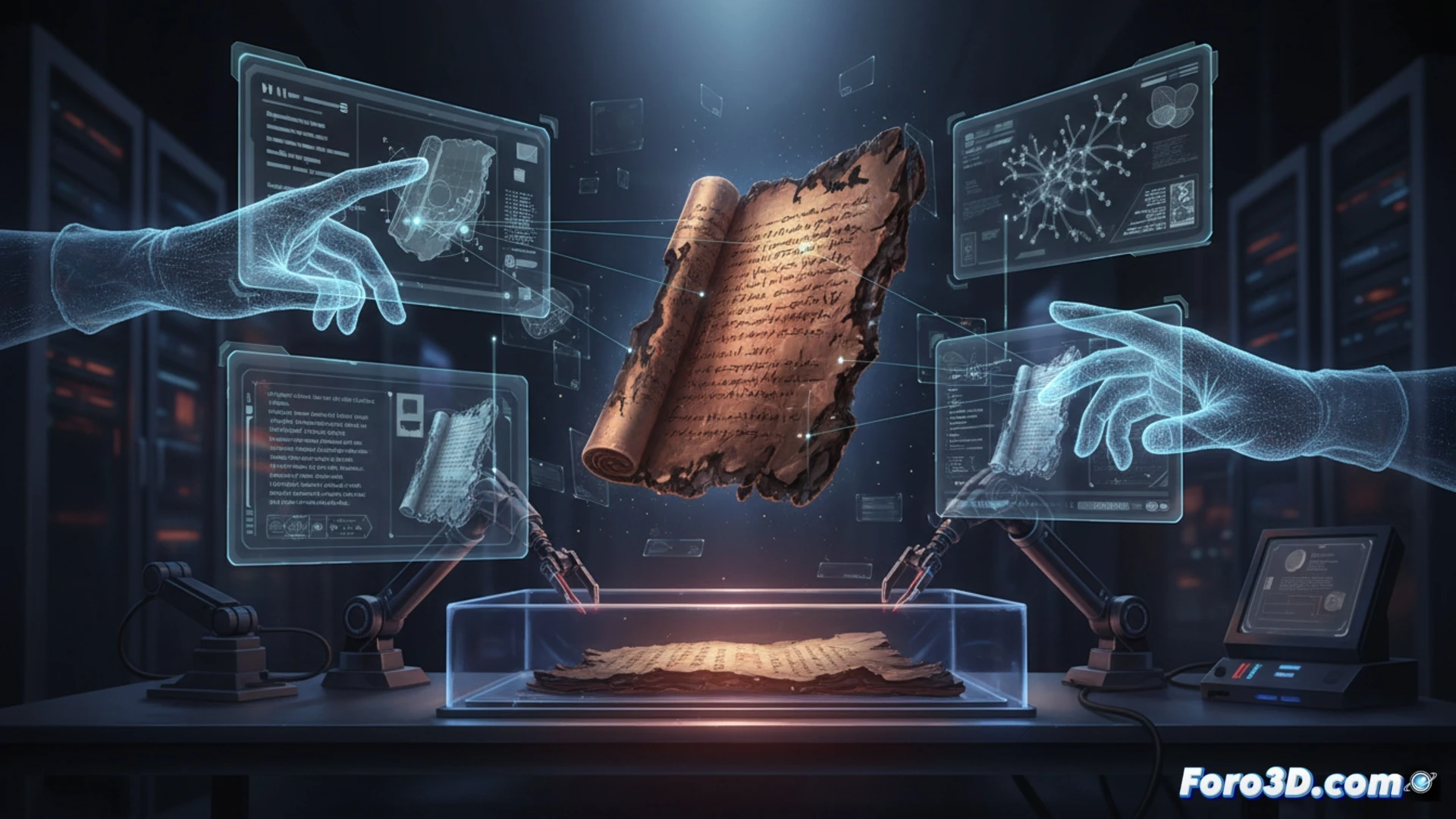
The restoration of historical documents damaged by fire has found a revolutionary ally in 3D technology. When a manuscript is charred, its pages become fragile, curl, and lose legibility. Digitization allows capturing every fold and texture without physical contact, creating a digital twin that can be analyzed and reconstructed virtually, avoiding the risk of disintegration when handling the original.
Photogrammetry and algorithmic reconstruction of pages 🔥
The technical process begins with data acquisition using high dynamic range photogrammetry. Hundreds of macro images of the manuscript are taken from controlled angles, capturing the surface geometry of the char and the deformations of the support. These images are processed in Structure from Motion software to generate a point cloud and a high-resolution polygonal mesh. Subsequently, artificial intelligence-assisted restoration algorithms analyze the illegible areas. These predictive models, trained with historical calligraphy, infer hidden strokes in charred areas, allowing the original text to be digitally reconstructed on the 3D volume.
Interactive preservation without physical contact 🖥️
The final result is an interactive 3D model that researchers can rotate, zoom in on, and examine from any angle. This digital replica eliminates the need to touch the original manuscript, halting its deterioration. Additionally, it enables remote collaboration among global experts, who can study the document virtually. The technology not only restores the content but also democratizes access to a heritage that would otherwise be lost or confined to a conservation chamber.
How can the three-dimensional reconstruction of a charred manuscript overcome the challenge of recovering inks and pigments that have lost their original contrast due to fire exposure?
(PS: Restoring virtually is like being a surgeon, but without blood stains.)