A barely perceptible optical flaw in a night vision scope can be the difference between a successful mission and a deadly ambush. Defective refraction, an error in the bending of light as it passes through the device's lenses, distorts the perception of the terrain and the actual position of targets. In the context of 3D analysis of war conflicts, simulating this defect allows us to visualize how a soldier might aim at a ghost image, compromising the safety of the entire unit in low-light operations.
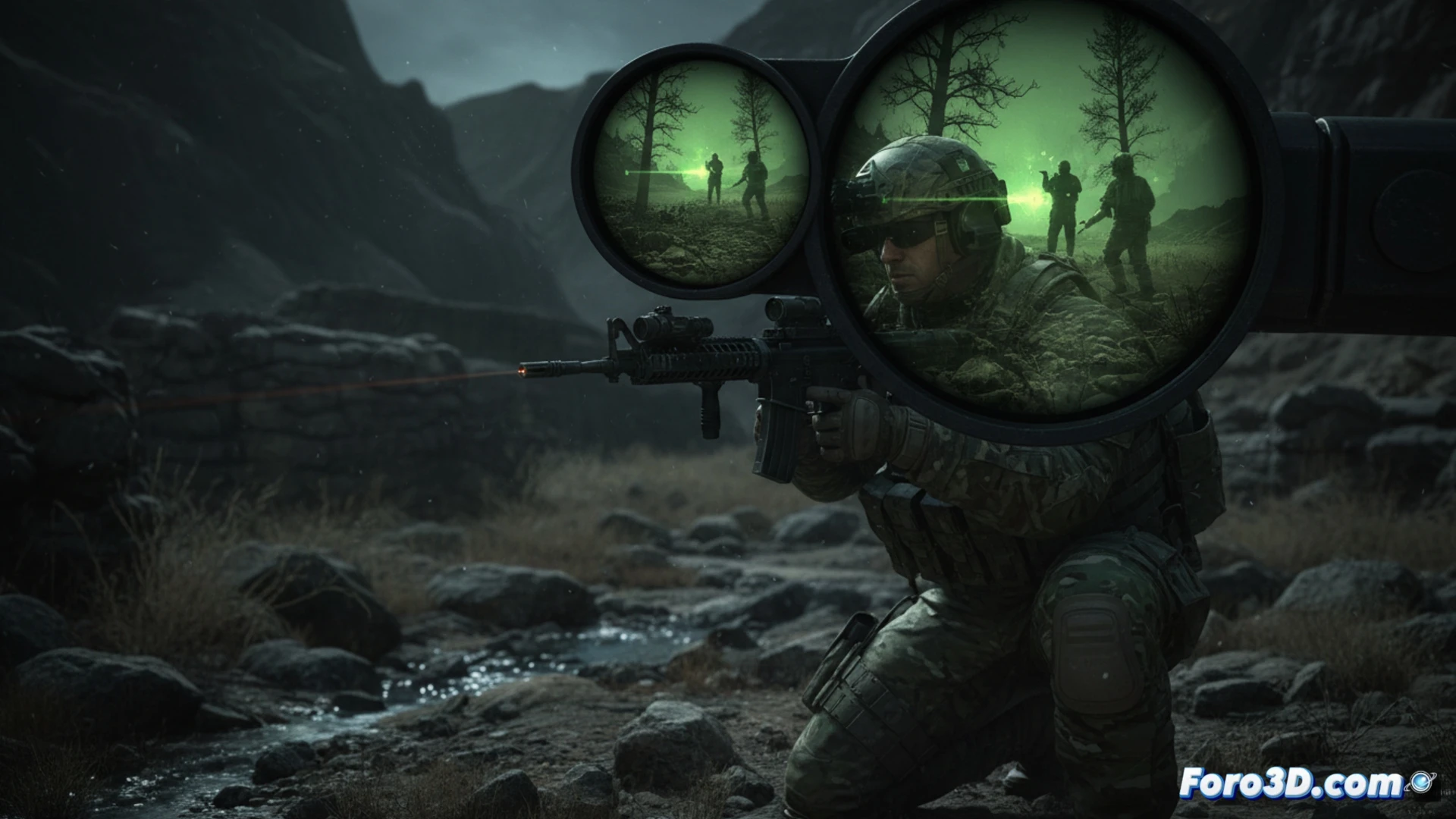
Optical Physics and Simulation of Aiming Error 🎯
Correct refraction depends on the homogeneous refractive index of the lens materials. When there are bubbles, internal stresses, or worn coatings, ambient infrared light is deflected non-uniformly. In a 3D model of a nighttime battlefield, we can apply a distortion map to the virtual camera simulating the scope. This reveals that a 0.5-degree error in peripheral refraction translates to a displacement of up to two meters in the trajectory of a projectile at 300 meters distance. The simulation shows that the center of the image may appear sharp, while the edges exhibit a liquid lens effect, blurring the enemy's silhouette and altering depth perception.
The Cost of Not Seeing Tactical Reality ⚠️
3D technology serves not only to design weaponry but also to expose its vulnerabilities. A scope with defective refraction generates a false sense of security. The operator trusts an image that is not faithful to ballistic reality. In a conflict where every second counts, doubting whether the sight is aligned with the actual target can lead to fatal errors or unnecessary exposure. Analyzing these defects from a technical and visual point of view reminds us that modern warfare depends on the absolute precision of every component, and that an optical failure is a tactical failure of the first order.
Is it possible to model in 3D how a defective refraction in a night vision scope distorts the calculation of ballistic trajectories in low-visibility environments, and how that optical error could lead to a catastrophic tactical failure?
(PS: reconstructing virtually is the first step to reconstructing in reality)