The recreation of an underwater crime scene represents one of the most complex challenges in modern forensic visualization. Unlike a terrestrial scene, the aquatic environment imposes extreme conditions: reduced visibility, dynamic currents, and the fragility of evidence. This article breaks down the technical workflow for generating an accurate 3D model of an underwater crime scene, using photogrammetry, sonar, and game engine modeling, with the goal of preserving the scene for judicial analysis. 🤿
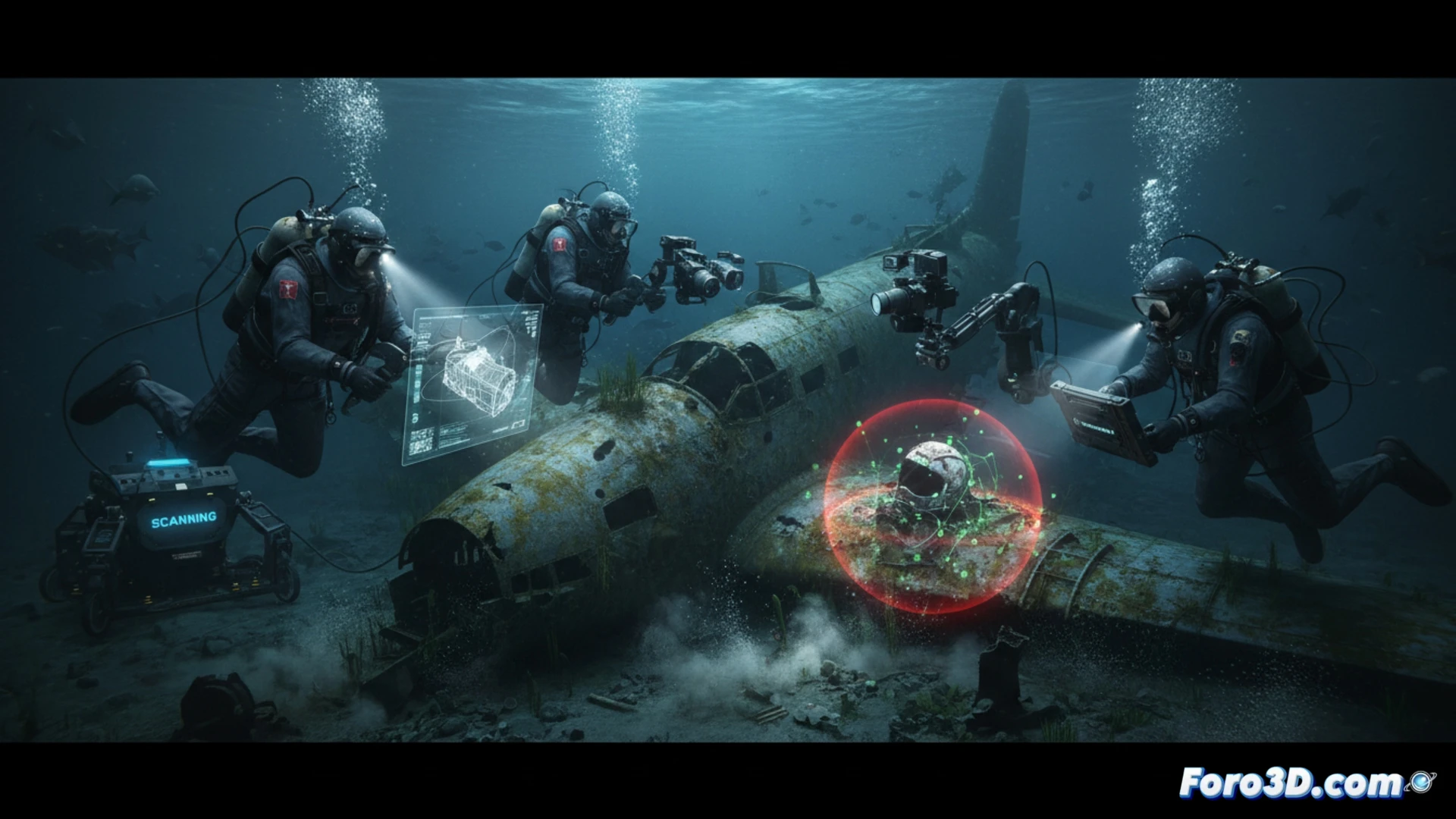
Multisensory Capture and Underwater Data Processing 🌊
Data capture in an underwater crime scene requires a combination of sensors. Underwater photogrammetry, using high-resolution cameras in waterproof housings, is limited by turbidity; here, controlled spectrum LED lighting and the use of polarizing filters are critical to mitigate scattering. For low-visibility areas, side-scan sonar and underwater LiDAR (based on green laser) generate geometric point clouds, albeit with lower color resolution. The greatest technical challenge is motion calibration: currents displace both the operator and objects, so acoustic positioning systems (USBL) and fixed reference markers are employed. Post-processing combines this data in software such as Agisoft Metashape or RealityCapture, where forced alignment of control points is performed to correct drift.
The Dilemma of Preservation vs. Reconstruction ⚖️
Beyond the technique, recreating an underwater crime scene raises an ethical and forensic reflection. The final 3D model is not just a visualization tool; it is evidence in itself. Each data interpolation, each suppression of visual noise or texture restoration, introduces operator bias. The line between faithfully documenting the scene and reconstructing an idealized version for trial is dangerously thin. The true value of this workflow lies in its ability to freeze an ephemeral moment underwater, allowing for repeatable and non-destructive analysis, but always under the warning that technology should not replace the physical chain of custody of the original evidence.
How do optical distortion, color loss, and underwater currents affect the metric accuracy of a forensic 3D model reconstructed from photogrammetry in a submerged environment?
(PS: don't forget to calibrate the laser scanner before documenting the scene... or you might be modeling a ghost)