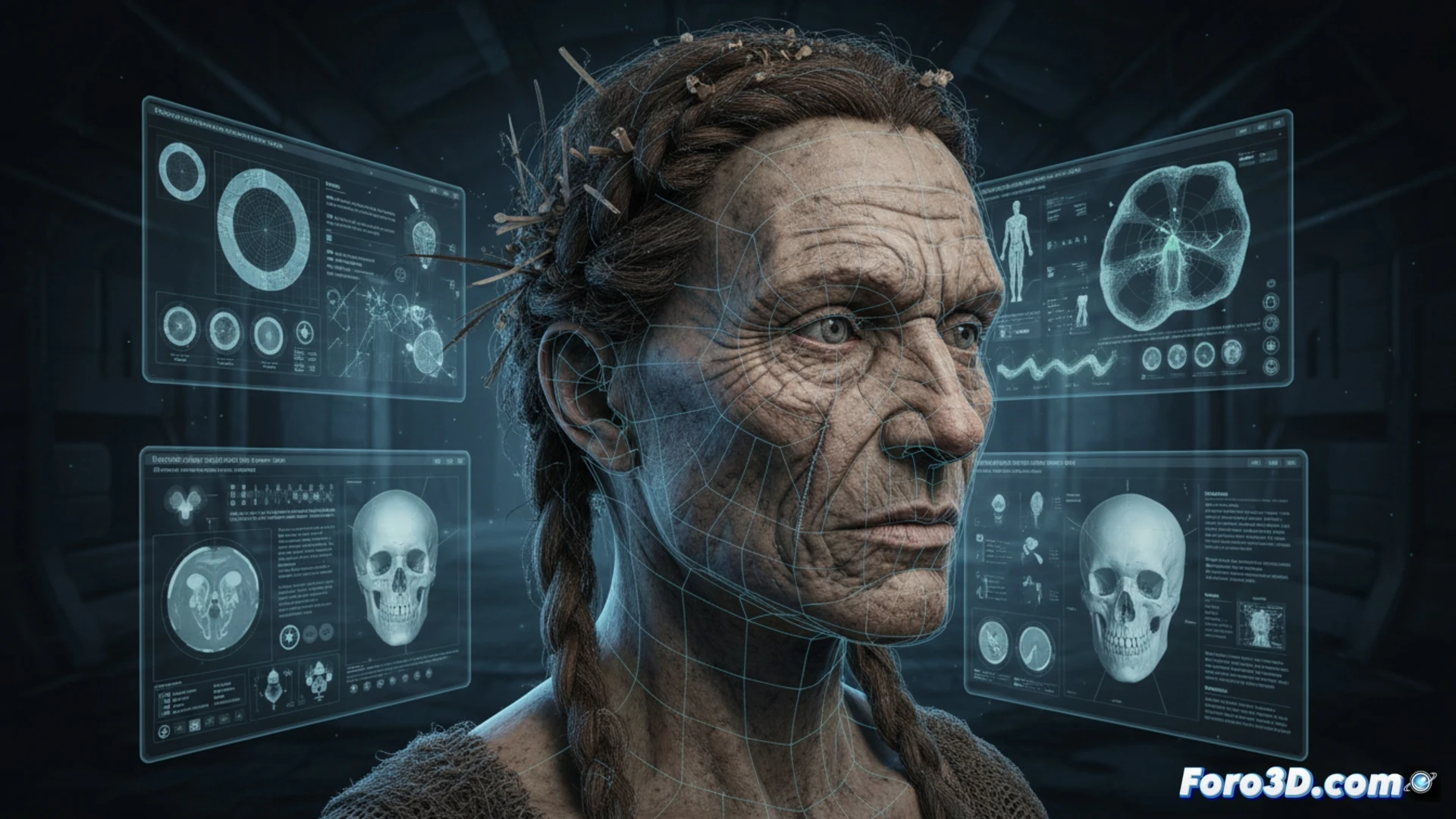
The analysis of mummified human remains has taken a qualitative leap thanks to digital archaeology. The recent craniofacial reconstruction of a bog mummy, dated to the Iron Age, demonstrates how the combination of photogrammetry, computed tomography, and 3D modeling allows us to restore the face of individuals from the past. This process not only has high educational value but also provides precise data on pathologies, traumas, and ethnic traits that the human eye cannot detect in a damaged skull.
From scanner to face: technical workflow 🖥️
The process begins with digitizing the original skull using a high-resolution CT scanner, generating a point cloud that is cleaned in software such as MeshLab or Geomagic. On this base, the digital forensic expert uses standard anatomical references (tissue thickness tables for the European Iron Age population) to place virtual markers at 32 key points on the face. Using digital sculpting tools like ZBrush or Blender, the facial muscles are modeled layer by layer, from the temporalis to the orbicularis oris. Final texturing is done with Substance Painter, applying pigmentation based on melanin analysis of hair and skin preserved in the peat. The result is a high-definition polygonal mesh that allows 360° rotations and dental occlusion studies.
The value of looking into the eyes of the past 👁️
Beyond visual amazement, this technique allows archaeologists to test hypotheses about the individual's lifestyle. In this case, the reconstruction revealed a marked facial asymmetry consistent with blunt force trauma, as well as dental wear from a diet rich in unprocessed cereals. Publishing the 3D model in open repositories like Sketchfab fosters international collaboration and brings heritage closer to a non-specialist audience, demonstrating that technology not only preserves but humanizes history.
As the 3D facial reconstruction of a bog mummy combines forensic data with artistic interpretation, what is the real margin of error that digital archaeologists assume when recreating soft tissues and expressions that no longer exist in the remains?
(PS: If you dig at a site and find a USB drive, don't plug it in: it could be Roman malware.)