The recent news about the instability of a tower has raised alarms in the field of forensic engineering. This phenomenon, which can precede a total collapse, requires a detailed analysis of the current geometry of the structure. Our objective is to apply three-dimensional modeling techniques to dissect the mechanical causes of the failure, virtually recreating the stress state of each load-bearing element.
Parametric analysis of loads and material fatigue 🔧
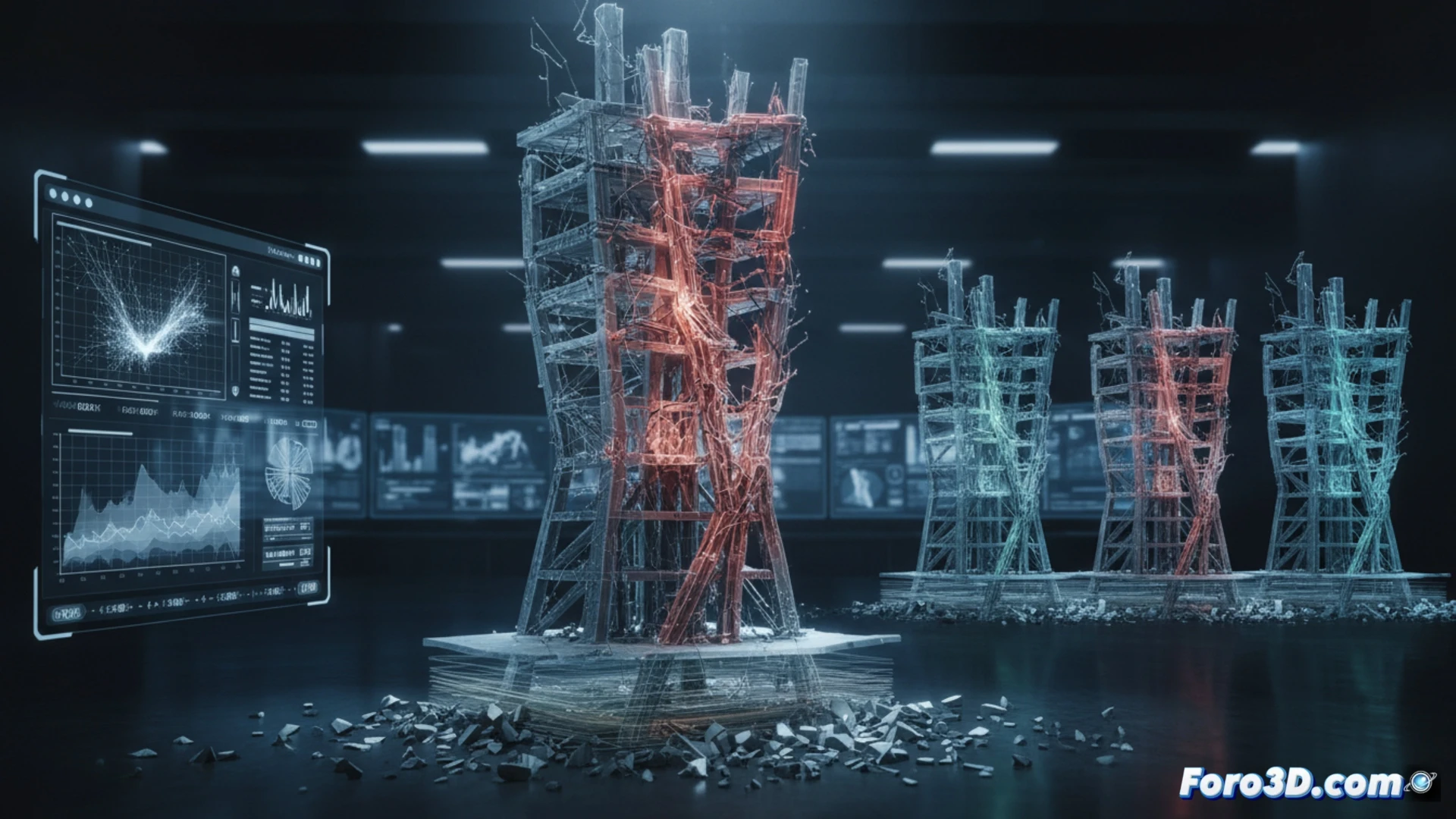
The first step in our workflow is to capture the point cloud of the tower using photogrammetry or laser scanning to generate a mesh faithful to the current deformation. On this base model, we apply a finite element analysis (FEM) to simulate dead, live, and wind loads. The key to the study lies in comparing these calculated stresses with the tolerances of the original design. We detect angular deviations in the joints and areas of stress concentration that indicate steel fatigue or concrete degradation. This mapping of weak points allows us to predict the failure sequence.
Visualization of progressive collapse scenarios 🏗️
Once the critical points are identified, we proceed to simulate the progressive collapse. Using rigid and soft body dynamics, we can visualize how the failure of a single strut triggers a chain reaction. These animations not only serve to assess the imminent risk but are vital for designing reinforcement strategies. The final model allows us to propose bracing or load redistribution without physically intervening in the structure, optimizing safety before instability leads to a catastrophe.
How can the progression of a tower collapse be modeled using 3D laser scanning data to differentiate between structural causes and external events in a forensic reconstruction?
(PS: Simulating a collapse is easy. The hard part is keeping the program from crashing.)