The tragedy of Commercial Jet 815, where the aircraft disintegrated mid-flight over the Pacific Ocean, left a puzzle of debris scattered over an area of more than 50 square kilometers. The absence of witnesses and the complexity of ocean currents demand an advanced forensic methodology. 3D reconstruction emerges as the definitive tool to understand the fatal sequence, combining data from black boxes, radar records, and material fatigue models.
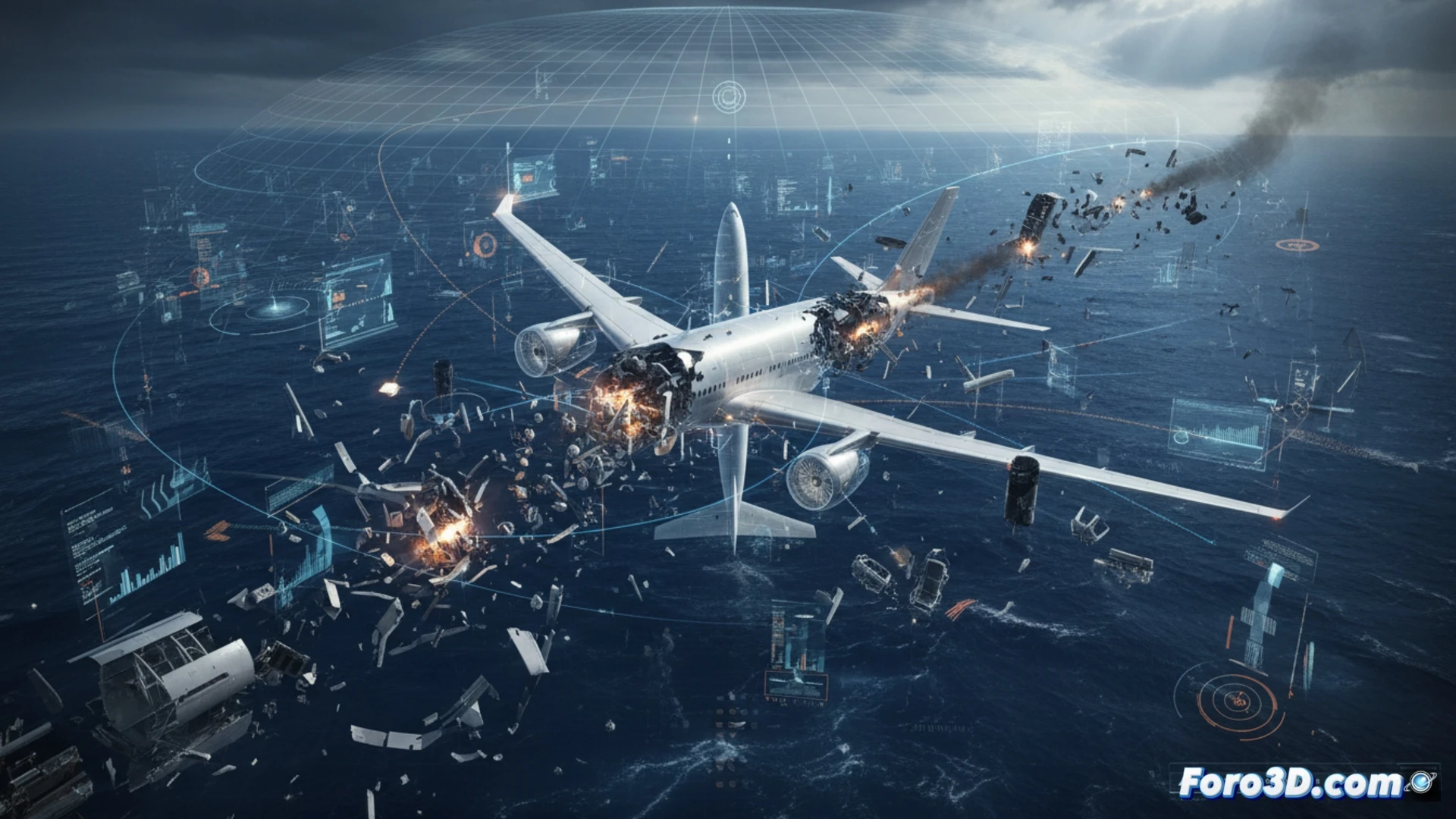
Trajectory Simulation, Structural Fatigue, and Debris Dispersion ✈️
The technical process begins with ingesting flight parameters from the FDR (Flight Data Recorder) and the coordinates of primary radar echoes. With this data, the precise trajectory of Flight 815 is modeled, including the 12-degree deviation from the planned route. Subsequently, a finite element analysis (FEM) is applied to the fuselage and wings to simulate the catastrophic failure. The 3D model integrates meteorological variables such as reported wind shear and atmospheric pressure. Finally, a computational fluid dynamics (CFD) simulation engine calculates the dispersion of fragments, generating a predictive heat map that is contrasted with the actual location of recovered debris, validating the hypothesis of structural failure due to fatigue.
Visualization as a Tool for Prevention and Outreach 🔍
Beyond the judicial investigation, this 3D recreation serves a crucial educational function. By visualizing the impact of material fatigue under extreme conditions, inspection protocols in the aviation industry are reinforced. For the public, the simulation breaks down the complexity of the accident into a clear visual narrative, dismantling conspiracy theories and promoting a data-driven safety culture. The virtual scene becomes an accessible laboratory for understanding how a small structural defect can trigger a tragedy of colossal proportions.
How can the 3D reconstruction of the fracture pattern and fragment dispersion of Flight 815 help determine the exact sequence of structural failures during the in-flight disintegration over the ocean?
(PS: Simulating catastrophes is fun until the computer crashes and you are the catastrophe.)