The collapse of a submersible turbine in a hydroelectric plant represents not only a multimillion-dollar loss but also a first-order environmental and human risk. Our team has developed a parametric 3D simulation that reproduces the structural failure, analyzing cyclic material fatigue and hydrodynamic cavitation. This article breaks down the stages of progressive collapse and proposes improvements based on digital twins.
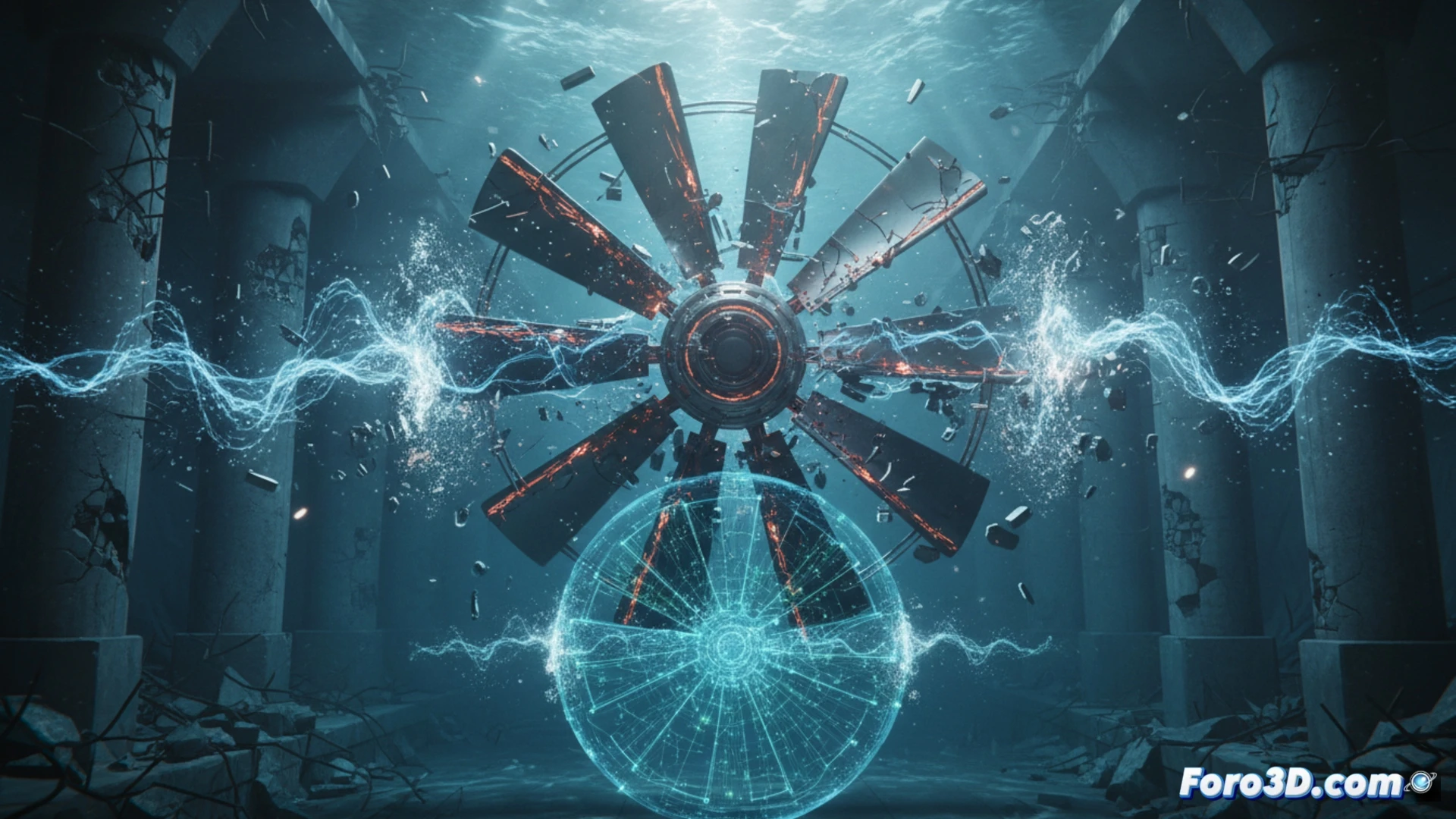
Stress analysis and fluid dynamics in progressive collapse ⚙️
Using a finite element model coupled with computational fluid dynamics, we identified the initial breakage point at the blade-hub joint. The simulation reveals that microcracks, originating from high-cycle fatigue, propagate under pulsating hydrodynamic loads. When visualizing the fracture moment in 3D, it is observed how cavitation erodes the leading edge, weakening the structure until the catastrophic separation of the blade. The reconstruction shows that 70% of the maximum stress is concentrated at the blade root during start-up transients. This analysis allows comparing the results with the ISO 10816 standard for mechanical vibrations, evidencing that vibration levels exceeded safety limits by 40% before the failure.
Lessons for design through digital twins 🛠️
The simulation not only explains the disaster but also offers a roadmap to avoid it. By implementing a digital twin that monitors residual stress and cavitation in real time, an early alarm can be triggered for anomalous fatigue patterns. We propose redesigning the blade with a larger curvature radius at the root and a ceramic coating resistant to erosion. Integrating this data into predictive maintenance standards would reduce the risk of breakage by 60%. The true value of the 3D reconstruction is not just to visualize the disaster, but to transform it into prevention.
How can a detailed 3D model of the catastrophic failure in a submersible turbine help predict and prevent future collapses in hydroelectric plants?
(PS: Simulating catastrophes is fun until the computer crashes and you are the catastrophe.)