The term Aerial Clearance Error describes a critical failure in flight operations, whether in firefighting, cargo drops, or tactical maneuvers. This incident, involving a large-tonnage aircraft, resulted in a devastating impact on the terrain and surrounding infrastructure. Our analysis focuses on the three-dimensional reconstruction of the accident to determine the exact causes of human or mechanical error.
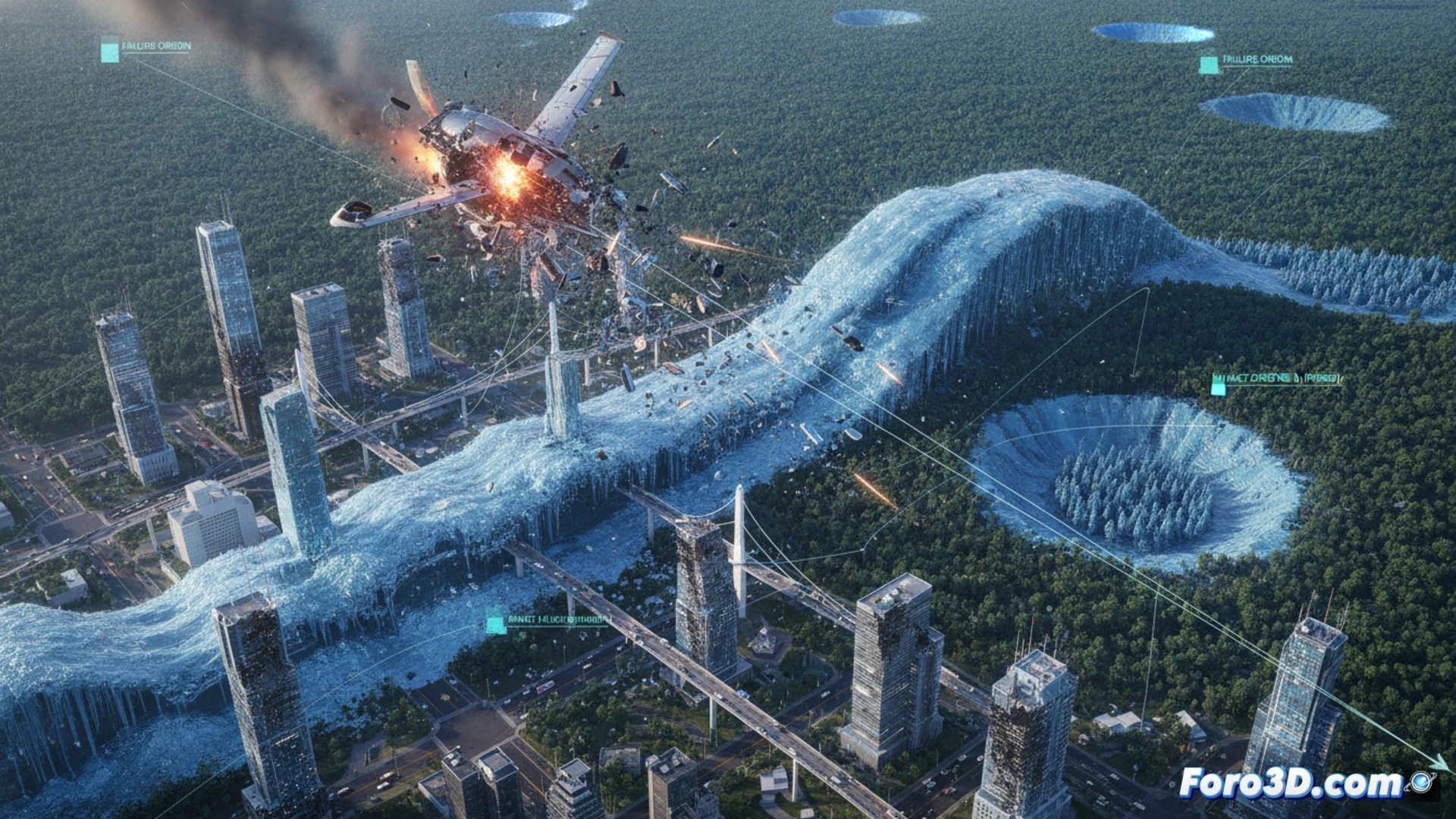
Modeling Trajectories and Operational Failures ✈️
The 3D simulation begins with the precise modeling of the aircraft, including its aerodynamic profile and control systems. The flight sequence is recreated from the takeoff point to the critical moment, plotting speed and altitude vectors. The model reveals a deviation from the planned trajectory, caused by a misinterpretation of wind conditions or a failure in proximity sensors. By overlaying this data onto the digitized terrain, the exact point of error is visualized, where the aircraft failed to correct its course, resulting in an impact against a wooded area and a high-voltage power line.
Prevention and Response to Aerial Disasters 🚨
This model not only explains the past but also serves as a didactic tool for the future. By analyzing the debris dispersion and the pattern of damage on the ground, rescue teams can optimize their search protocols. The visualization of the error allows pilots and controllers to identify blind spots in navigation, improving early warning systems and emergency procedures to prevent a simple aerial clearance error from turning into a catastrophe.
How can the 3D reconstruction of an aerial clearance error reveal undetected impact patterns in fire spread or material dispersion in catastrophic zones.
(PS: Simulating catastrophes is fun until the computer crashes and you are the catastrophe.)