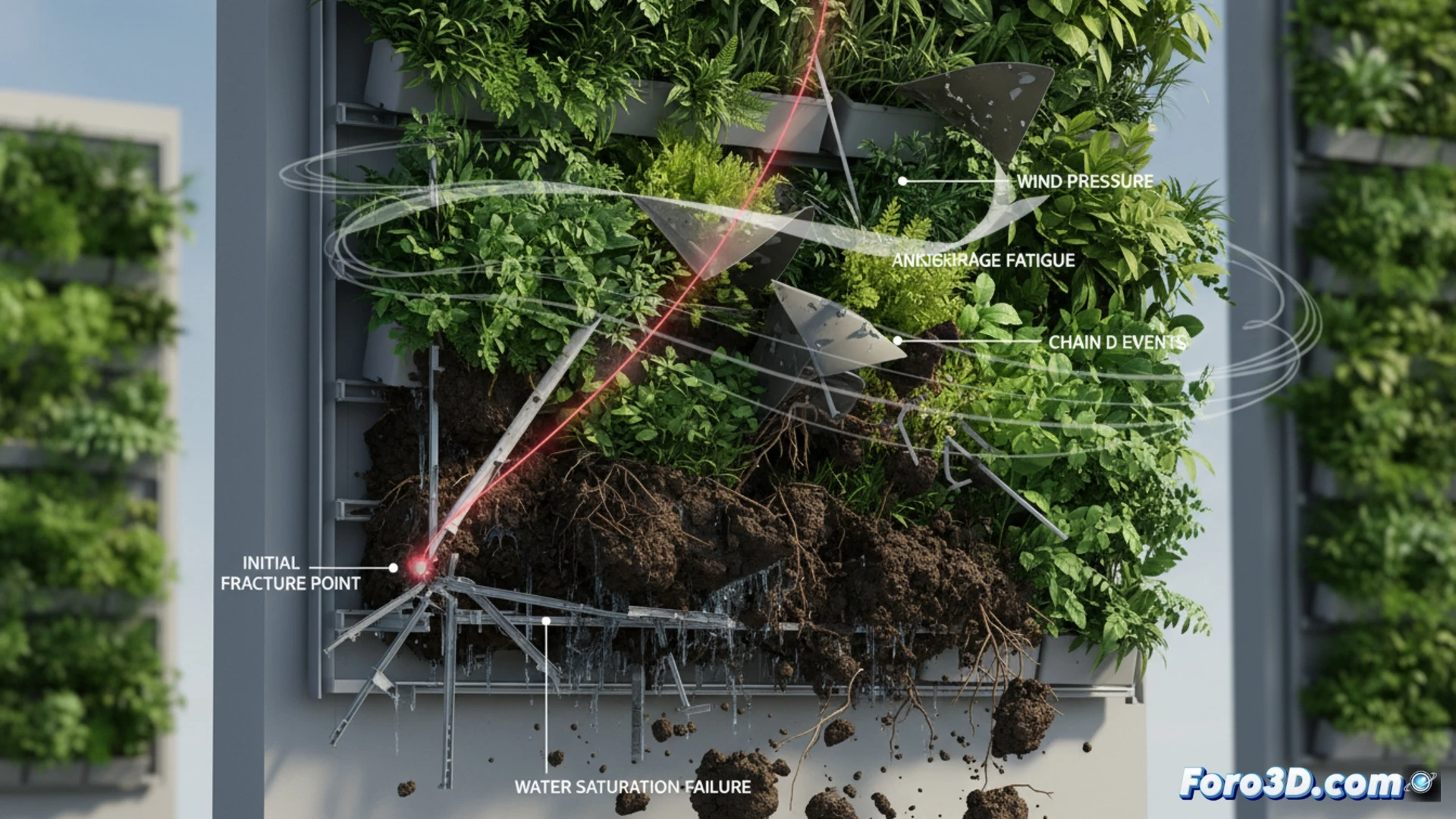
The sudden collapse of a green wall not only poses a risk to pedestrian safety but also reveals hidden failures in green infrastructure engineering. This article breaks down the phenomenon through 3D simulation, analyzing the variables that precipitated the collapse: substrate water saturation, anchor system fatigue, and wind pressure. Through virtual reconstruction, we identify the exact point of fracture initiation and the chain of events leading to the total collapse.
Parametric modeling and simulation of critical loads 🧱
To recreate the pre-collapse scenario, the structure was modeled with a finite element mesh representing the wall profile, organic substrate, and root network. Progressive humidity conditions were applied until reaching 95% saturation, reducing substrate cohesion by 40%. Simultaneously, a 90 km/h wind gust was simulated, generating a torsional moment on the upper panel. The simulation identified that the failure was not instantaneous: it began with a micro-crack in the lower right anchor, propagating in cascade over 2.3 seconds until complete collapse. The comparative visualization shows the stable state versus the collapse, with a heat map indicating the zones of maximum accumulated stress.
Lessons for resilient design of green infrastructure 🌿
The 3D simulation not only documents the disaster but also allows for proposing concrete corrective measures. For example, including humidity sensors in the substrate and an additional drainage system would have delayed critical saturation. Furthermore, the model suggests reinforcing perimeter anchors with stainless steel expansion bolts, capable of supporting up to 3 times the standard load. These visualizations become pedagogical tools for architects and engineers, demonstrating that catastrophe prevention in green walls begins with a detailed digital analysis of their weak points.
Which technical parameters of the internal structure of the green wall are critical to model in 3D to identify the causes of sudden collapse and prevent future failures?
(PS: Simulating catastrophes is fun until the computer crashes and you are the catastrophe.)