The fall of a large-format billboard during a storm is not just an accident, but a structural failure that can be prevented. This article analyzes the incident from the perspective of 3D simulation, breaking down the collapse sequence under wind gusts. Using dynamic models and material fatigue analysis, we identify the critical stress points that gave way, offering a forensic visualization of the disaster to improve urban safety protocols in adverse weather conditions.
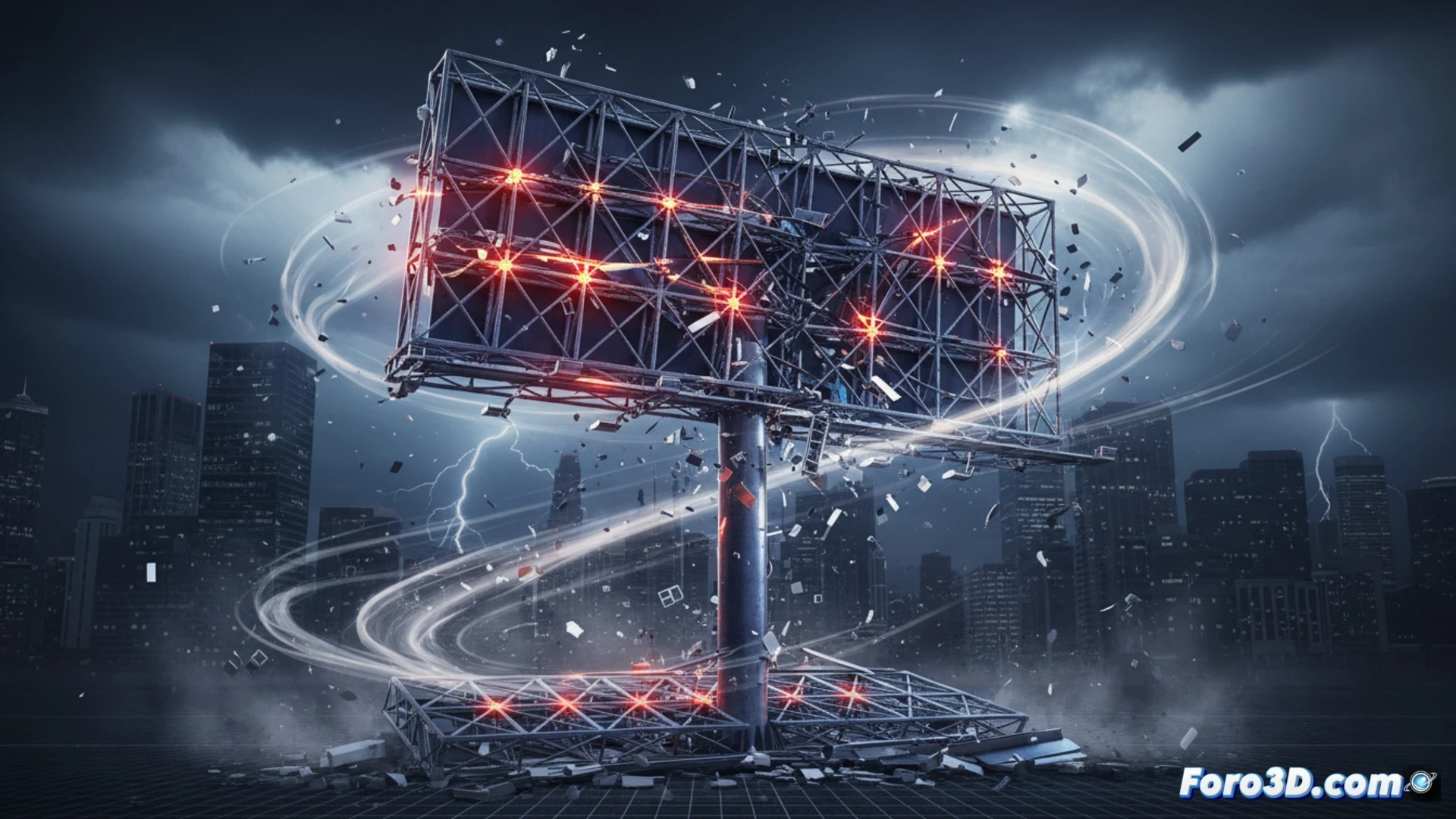
Simulation of wind loads and structural fatigue in the 3D model 🌪️
For the technical reconstruction, the billboard structure was modeled in finite element software, applying real wind gust profiles recorded during the event. The simulation revealed that the welded joints on the main supports experienced a concentration of cyclic stresses exceeding the steel's yield limit. Fatigue analysis identified pre-existing microcracks in the base anchors, likely originating from constant vibrations. Under the peak gust, these cracks propagated a brittle fracture in less than 0.3 seconds, causing the instantaneous collapse of the main beam and the panel's downfall. The 3D visualization of the process allows observing how the dynamic load exceeded the system's damping capacity.
Lessons for urban safety in advertising infrastructure 🏙️
The simulation demonstrates that current inspection protocols underestimate the effect of repetitive wind loads. The 3D model not only confirms the cause of the collapse but also proposes a redesign: increasing thickness at critical joints and adding diagonal reinforcements to distribute stress. For city managers, this visualization is a didactic tool that justifies the need for stricter regulations in areas exposed to gusts, prioritizing pedestrian safety over advertising visibility. Prevention begins by anticipating the disaster in the virtual realm.
What structural factors and extreme wind conditions must be modeled in 3D to accurately predict the failure point of a large-format billboard during a storm?
(PS: Simulating catastrophes is fun until the computer crashes and you are the catastrophe.)