Last Tuesday, an incident in a robotic distribution facility challenged the coordination of autonomous systems. An automated guided vehicle collided with a mobile rack during a crossing maneuver. The impact caused the load to overturn and structural damage to the storage aisle. 3D simulation now allows us to break down every millisecond of the incident to understand the root causes of the systemic failure.
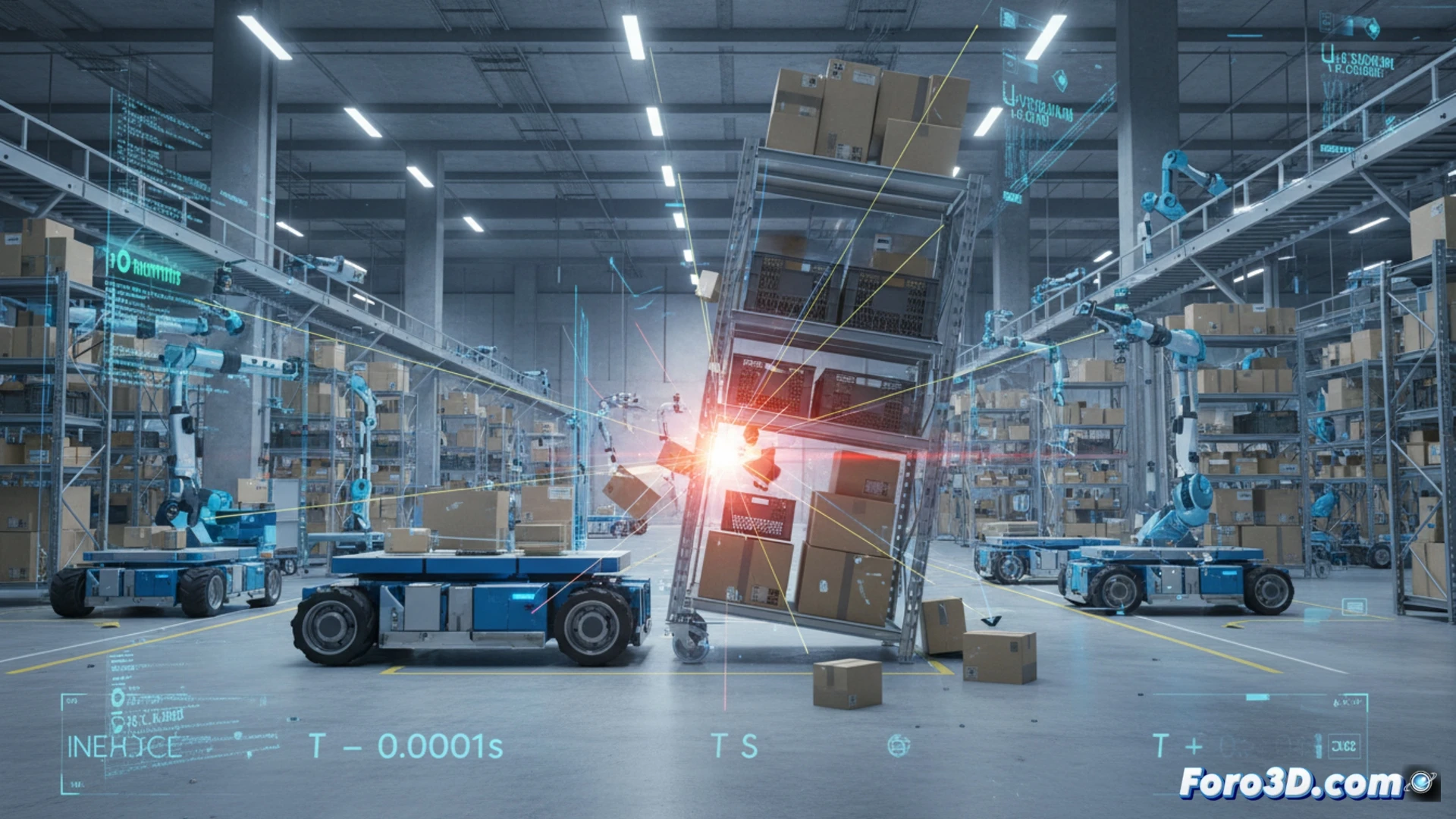
Technical analysis of the accident and trajectory simulation 🚧
The volumetric reconstruction reveals that the AGV followed an optimal route according to its path planner, but did not detect the rack moving from a side aisle. The digital twin shows a critical blind spot in the front LiDAR sensor, located at 15 degrees from the forward axis. The flow simulation shows that the mobile rack was in a buffer zone not registered in the dynamic map. The 3D model allows visualizing the kinematic sequence of the collision, from the approach to the collapse of the load, identifying a 200 ms delay in communication between the fleet management system and the floor controller.
Lessons for the digital twin and industrial safety 🛡️
This incident highlights the need to integrate proximity sensors on the sides of mobile racks and to calibrate occupancy maps in real time. The 3D visualization of the accident allows redesigning the facility layout, eliminating blind crossings and establishing priority zones for robots. Implementing an updated digital twin with telemetry data will prevent future collisions and optimize the supply chain. Simulation is today the most effective tool for preventing failures in automated logistics.
Question: What critical lessons about the coordination of autonomous systems and 3D incident reconstruction can be drawn from the collision in the robotic logistics facility to prevent future failures in 3D industrial production?
(PS: at Foro3D we optimize routes like we optimize polygons: until the computer says enough)