Industrial accidents with heavy machinery, such as the one involving a crushing piston, represent a critical challenge for workplace safety. In this technical article, we will analyze how 3D reconstruction allows us to break down the sequence of the incident, modeling the forces involved and the interaction between the operator and the machine. The objective is to identify failure points and propose design improvements to prevent similar tragedies.
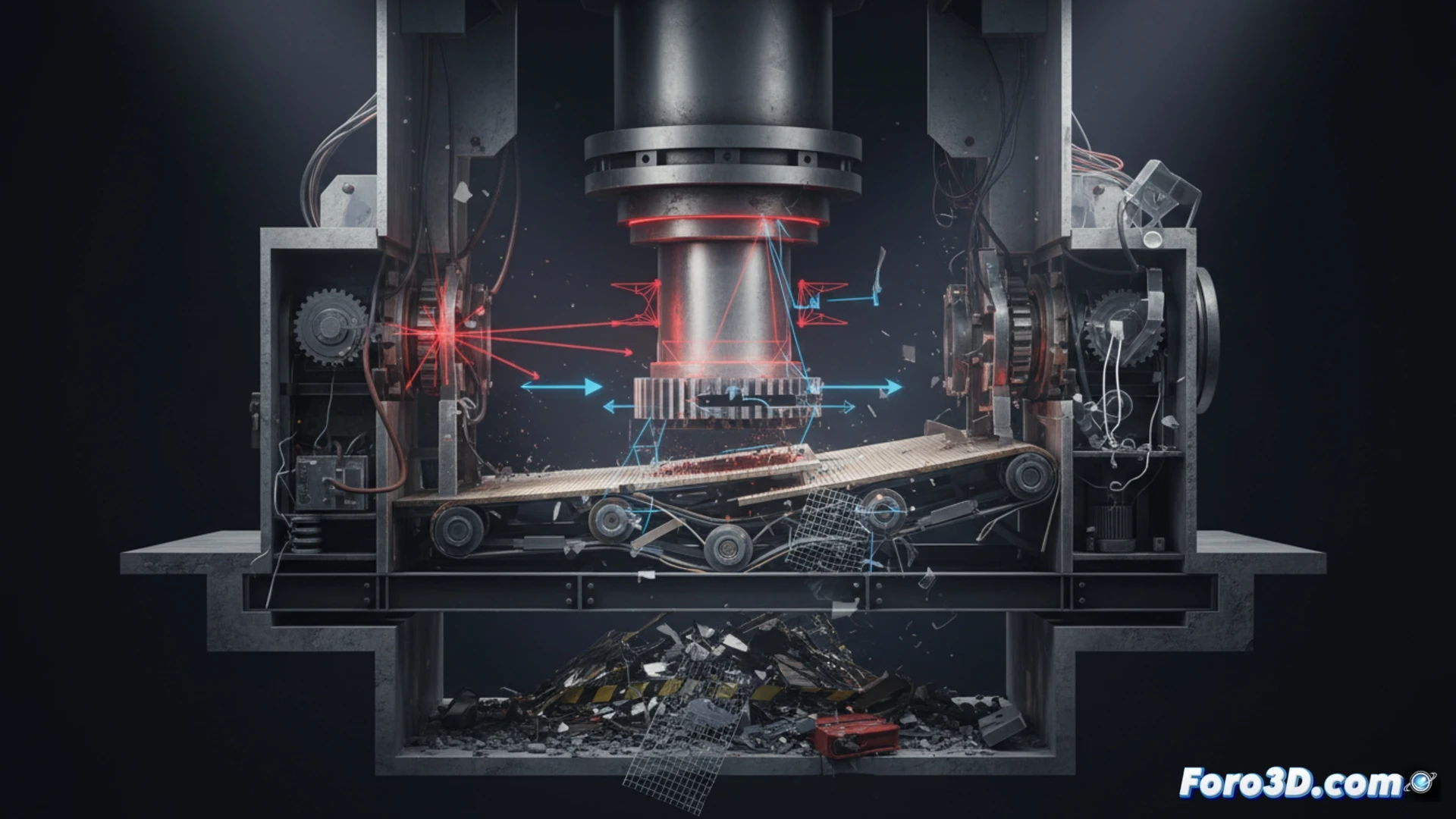
Modeling of piston kinematics and load simulation 🔧
To recreate the accident, the first step is to model the geometry of the piston and its hydraulic system in a CAD environment. Finite element analysis (FEA) allows calculating the stresses on the structure during the crushing cycle. Boundary conditions must be defined: piston descent speed, maximum system pressure, and material strength. By introducing the operator's mass and position in the danger zone, the simulation reveals impact trajectories and deformations suffered. The results show that a delay in the safety interlock system was the determining factor in the collision.
Preventive redesign based on simulated data 🛡️
From the simulation, two critical points are identified: the lack of a presence sensor in the crushing area and the insufficient braking speed of the piston. The technical proposal includes installing a photoelectric light curtain with millisecond response time and a regenerative braking system that stops the piston in less than 10 degrees of motor rotation. The 3D validation of these modifications shows a 95% reduction in kinetic energy transmitted to the operator, demonstrating that simulation is an indispensable tool for preventing industrial incidents.
How can the 3D reconstruction of an industrial accident with a crushing piston be used to determine the exact sequence of mechanical failures and prevent future accidents in heavy machinery?
(PS: Simulating disasters is fun until the computer crashes and you are the disaster.)