The collision between a tram and a car presents complex impact dynamics, where the mass of the railway convoy and the limited emergency braking capacity of the light vehicle determine fatal trajectories. 3D modeling of the scene allows for precise metric determination of contact points, structural deformations, and reaction times, key elements for technical expert analysis.
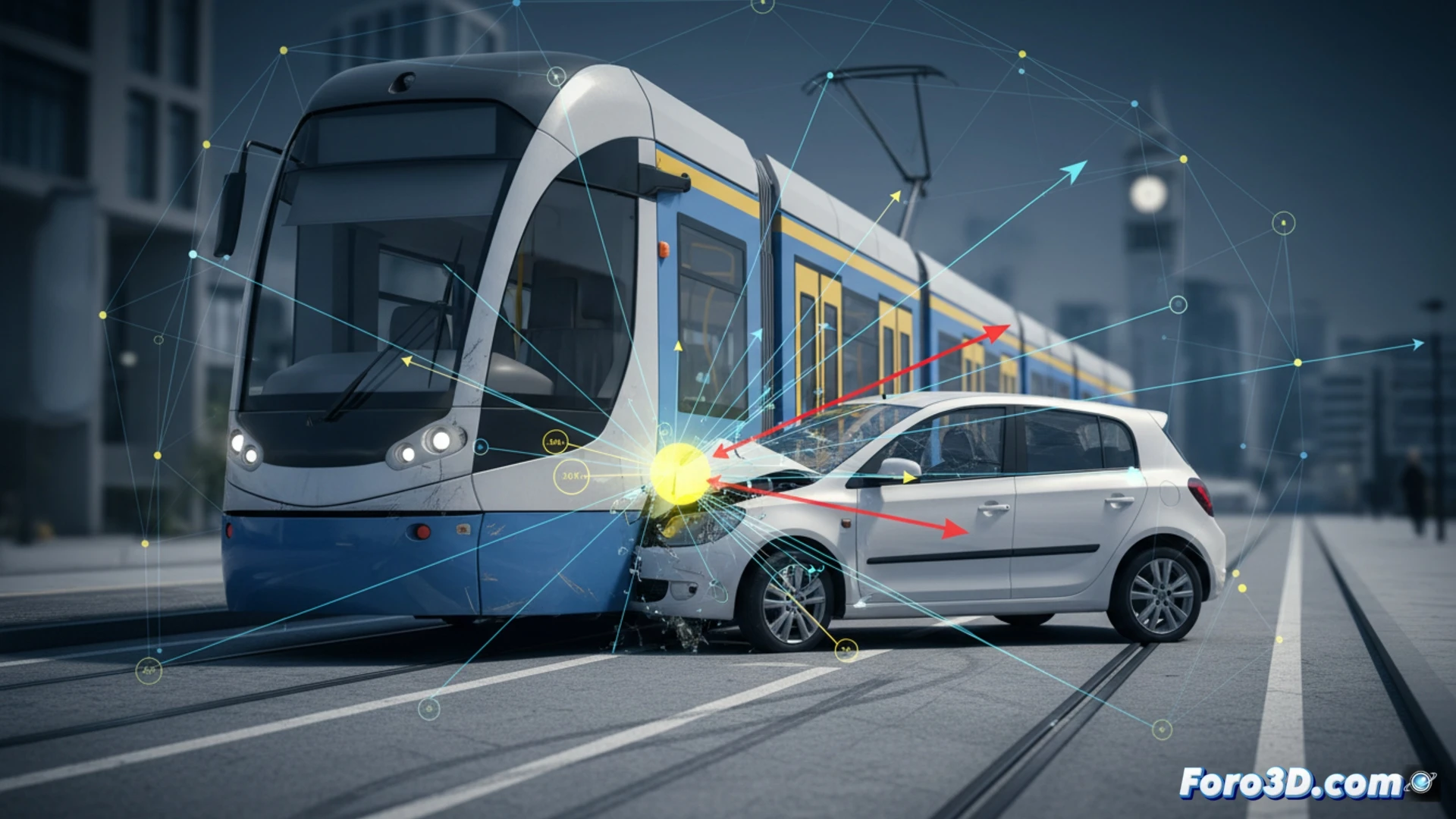
Kinematic analysis using finite element simulation 🚆
To calculate the speed of the tram at the moment of impact, a dynamic model is used that integrates the rail-wheel friction coefficients and the track gradient. The deformation of the light vehicle is reproduced through volumetric meshing, evaluating the energy dissipated in the impact. This process allows determining the angle of incidence of the tram on the side of the car, validating whether the light vehicle driver invaded the safety zone or if there was a failure in traffic light signaling. The results are exported as vector planimetries for judicial reports.
Forensic implications of the digital twin 🔍
The 3D visualization of the chronological sequence of the accident eliminates ambiguities in witness perception. By recreating the visibility cones from the tram driver's cabin, it is possible to assess whether the driver had a real chance of avoiding the impact. This approach not only assigns civil or criminal responsibilities but also serves as a teaching tool to improve safety protocols at urban railway intersections.
As can be distinguished in the 3D reconstruction of a tram hitting a light vehicle, between a structural deformation of the car caused by the direct impact and a secondary deformation caused by the subsequent dragging or displacement of the vehicle on the road.
(PS: In scene analysis, every scale witness is a small anonymous hero.)