Armored vehicle shrapnel is not just a war remnant; it is a physical record of the kinetics of conflict. At Foro3D, we address how high-resolution photogrammetry allows capturing every crater and deformation in the steel. This process transforms a damaged hull into a precise digital model, where each impact tells a story about the type of munition and the energy released at the moment of the attack.
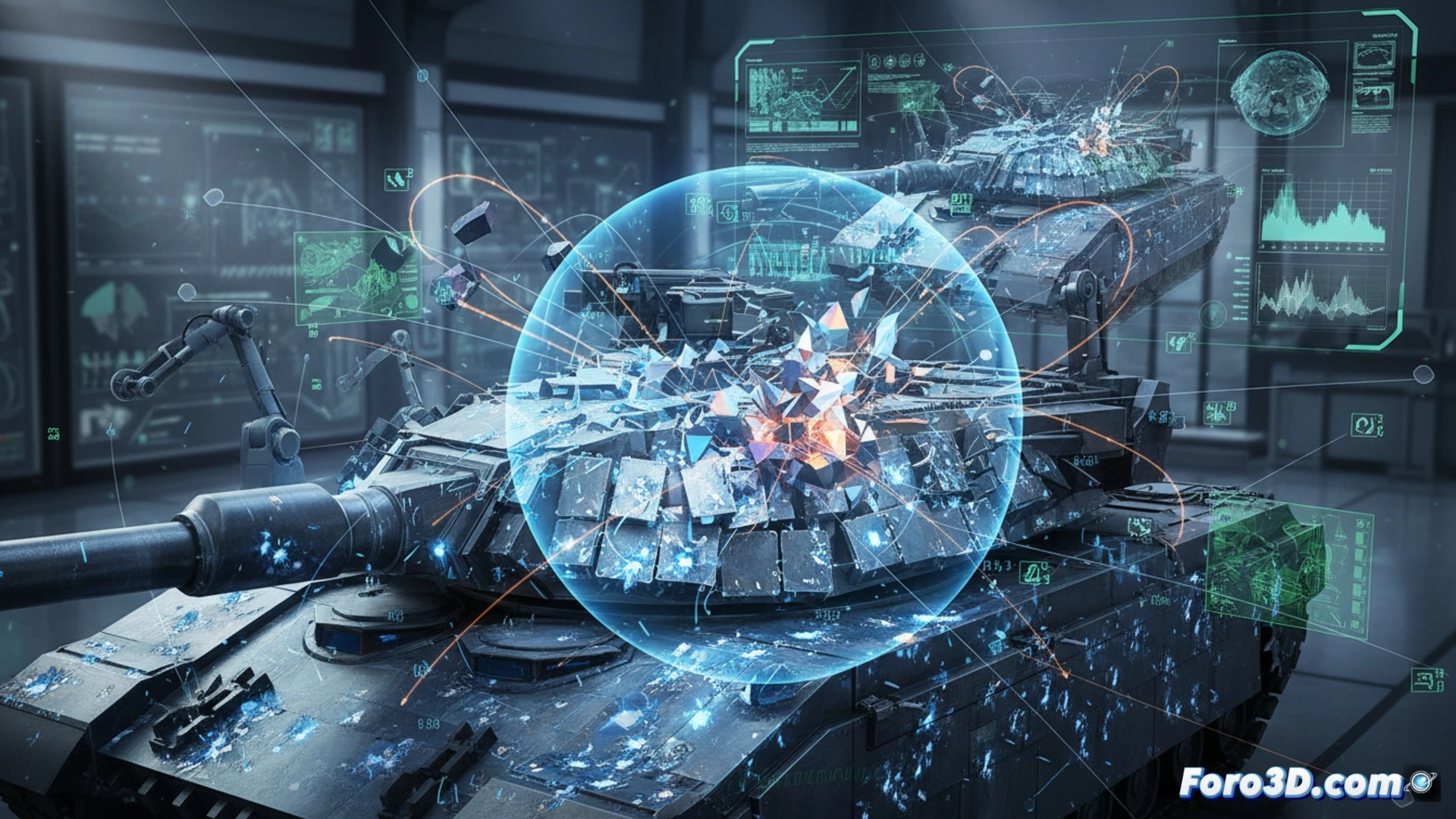
Technical Workflow: Scanning and Ballistic Simulation 🔧
The process begins with data acquisition using structured light scanners or drones equipped with high dynamic range cameras. Subsequently, a polygonal mesh of the armor is generated, paying special attention to areas of penetration and spalling. 3D forensic analysis involves projecting virtual vectors from the edges of the entry holes to calculate the angle of attack. By combining this data with fragmentation simulations, we can determine whether the attack came from a fragmentation grenade, an IED, or an anti-tank missile, discriminating between primary and secondary impacts.
The Hidden Truth in Deformations 🔍
Beyond the metrics, this analysis reveals human vulnerability. A shrapnel pattern on the side of a troop transport not only indicates the direction of enemy fire but also allows conflict researchers to reconstruct the tactical sequence. Each dent is a silent witness that, modeled in 3D, offers an objective perspective for human rights reports or damage audits in war zones, where geometric precision is the only irrefutable evidence.
How can 3D scanning of armored vehicle shrapnel fragments reveal the trajectory and velocity of the impacting projectile beyond what surface damage shows?
(PS: 3D conflict simulation will never replace peace, but it helps to understand the magnitude) 🕊️