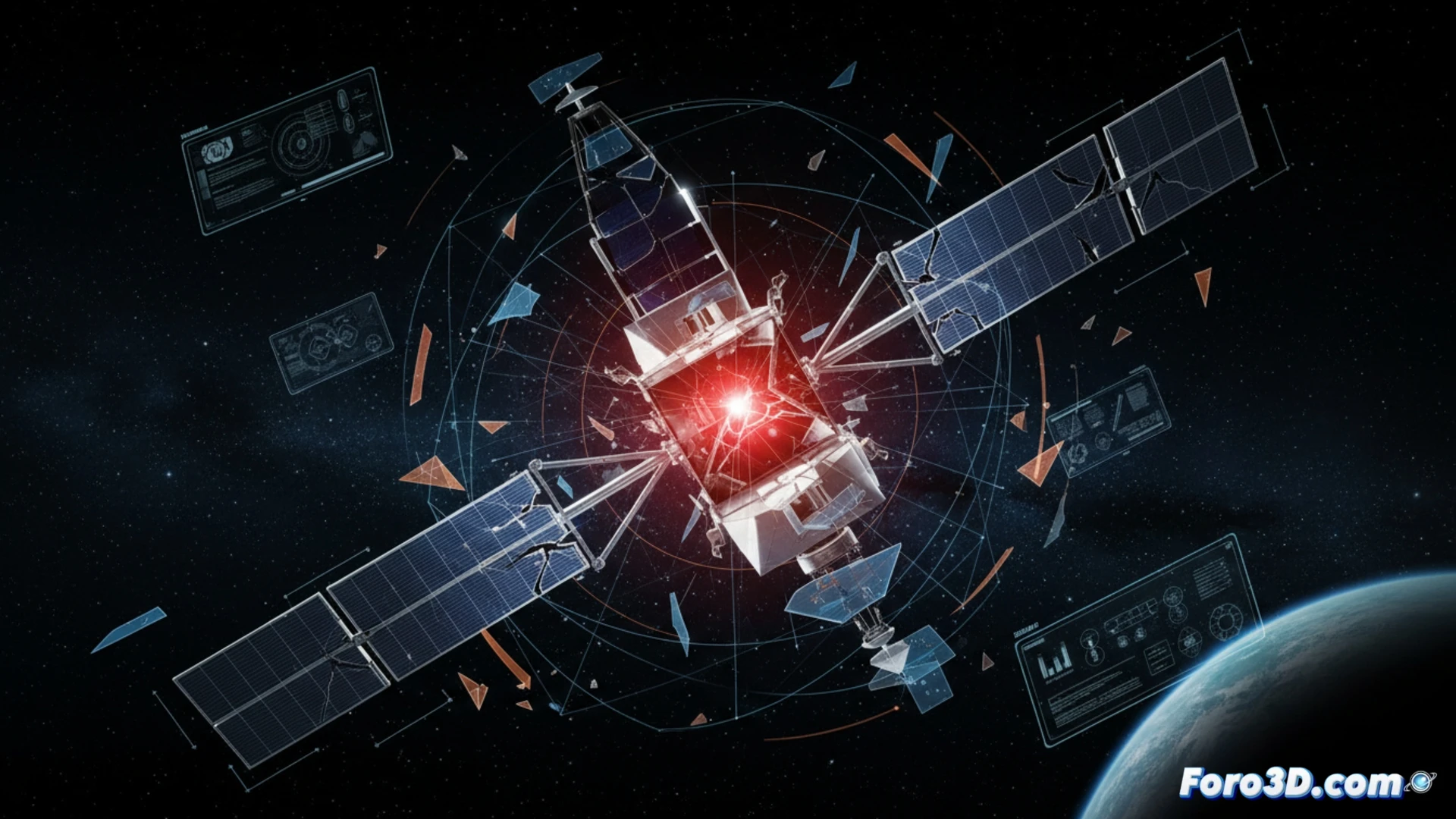
A satellite assembly failure, whether due to incorrect welding, a miscalculated torque, or a misaligned part, can trigger a space catastrophe costing millions. Modern forensic engineering uses 3D modeling to dissect these events. Through virtual recreation of the assembly process, analysts can identify the exact point of failure, visualizing how a small deviation in assembly causes cumulative stresses that lead to structural collapse in orbit.
Digital twins and structural stress analysis 🛰️
Finite element analysis (FEA) applied to digital twins of the satellite allows engineers to subject the 3D model to the extreme conditions of launch and space vacuum. By loading the model with G-forces and acoustic vibrations, the software calculates stress concentration points. In the case of an assembly failure, the simulation reveals how a loose bolt or a misaligned seal generates micro-cracks that propagate. The technical animation, in slow motion, shows the exact sequence of deformation, allowing quality teams to trace the error back to the specific workstation in the cleanroom.
Prevention through human error simulation 🔧
The true value of these tools is not just post-disaster investigation, but prevention. By introducing hypothetical failures into the 3D model (such as insufficient torque or particle contamination), teams can predict failure modes before they occur. This transforms technical animation into a visual procedure manual. If the digital twin shows that a 10% deviation in solar panel assembly leads to fatigue failure, the assembly protocol is adjusted immediately, saving the mission before the first component touches the rocket.
What lessons about assembly tolerances and failure detection in complex structures can the 3D reconstruction of a collapsed satellite offer to simulation and additive manufacturing engineers in the aerospace sector?
(PS: Simulating catastrophes is fun until the computer crashes and you are the catastrophe.)