The collision of ships at sea represents one of the most complex catastrophic events to model due to the interaction of oceanic and structural variables. Foro3D presents a detailed technical analysis that uses digital twins to reconstruct the impact dynamics, assess hull damage, and simulate sinking or spill containment scenarios. This approach allows for visualizing pre-collision trajectories and rescue zones in real time.
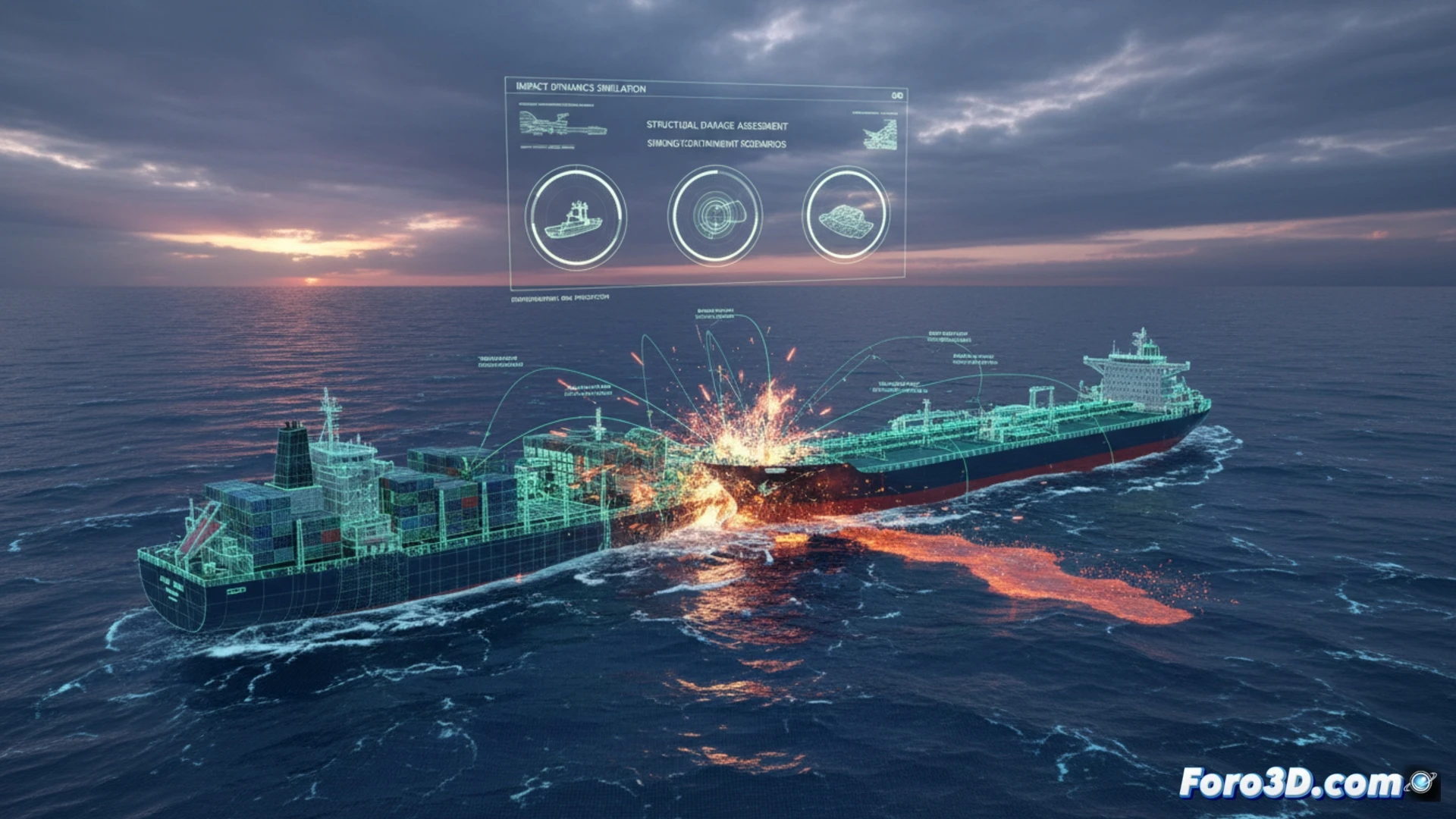
Trajectory simulation and structural damage 🚢
To reconstruct the collision, AIS (Automatic Identification System) data and meteorological records are used. The digital twin of each vessel incorporates mechanical properties of naval steel and compartment distribution. The 3D simulation calculates the kinetic energy transferred in the impact, plate deformation, and risk of double hull rupture. Hydrodynamic models that predict stability after the collision are integrated, allowing for the simulation of progressive flooding or rapid sinking. The visualization includes surface currents to plan evacuation routes and deployment of anti-pollution barriers.
Lessons for naval safety ⚓
The 3D analysis of these incidents reveals common patterns in communication failures and assisted navigation errors. The models allow for testing evasion protocols and early warning systems. Beyond the catastrophe, digital reconstruction offers a didactic tool for crews and designers, transforming a disaster into a virtual laboratory to prevent future tragedies in waters without clear jurisdiction.
Considering the limitations of LIDAR and photogrammetric systems in open sea conditions, such as water reflectivity or the absence of fixed reference points, what technical innovations would allow for accurately capturing the structural deformation of a vessel in the moments following a collision at sea without relying on onboard sensors?
(PS: Simulating catastrophes is fun until the computer crashes and you are the catastrophe.)