The diagnosis of death in charred corpses presents unique challenges for forensic medicine, as extreme heat destroys soft tissues, eliminates skin marks, and can fracture the skeleton. Physical manipulation of the body during traditional autopsy risks detaching bone fragments or contaminating evidence. Faced with this reality, 3D documentation technologies offer a non-invasive workflow that preserves the integrity of the finding from the scene to the laboratory.
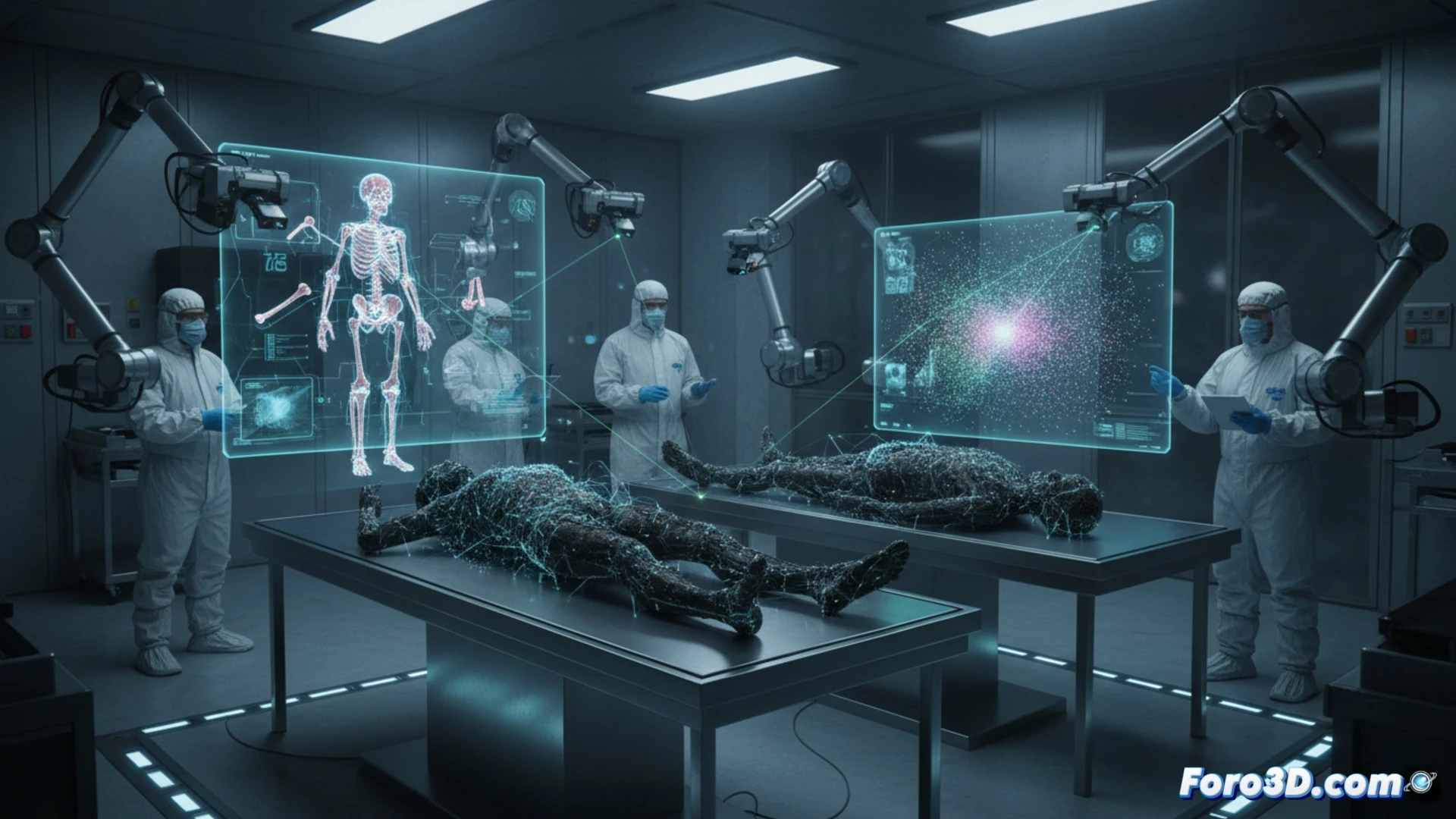
Photogrammetry and laser scanning for non-manipulable evidence 🔥
The process begins with capturing the scene using terrestrial laser scanners, which record the exact position of the corpse in relation to the environment. Subsequently, high-resolution photogrammetry is applied to the charred body, taking between 200 and 400 images from multiple angles to generate a detailed polygonal mesh. This digital twin allows forensic experts to rotate the model, measure fractures, and analyze the position of limbs without physical contact. In practical cases, simulating fire trajectories on these models has helped determine whether the victim was alive or dead before ignition, validating hypotheses about the direction of the flames and structural collapse.
The boundary between virtual evidence and expert testimony ⚖️
Although 3D reconstruction reduces direct manipulation and offers an immutable record for future analysis, its validity in courts still depends on the digital chain of custody and the expertise of the technician processing the data. A poorly calibrated model or one with lighting artifacts can lead to erroneous conclusions about the cause of death. The true advancement lies not in the technology itself, but in integrating these digital twins as a complement to physical autopsy, not as a substitute, maintaining scientific rigor at every step of the forensic pipeline.
How would you integrate this finding into an existing forensic pipeline?