The recreation of a historical battle through 3D technologies has evolved from mere entertainment into a tool for academic analysis. Projects like the virtual reality simulation of the Battle of Waterloo allow historians and enthusiasts to study the field's topography, artillery lines of sight, and infantry movements with millimeter precision. It is not just about spectacular graphics, but about validating tactical hypotheses by simulating physical and meteorological variables.
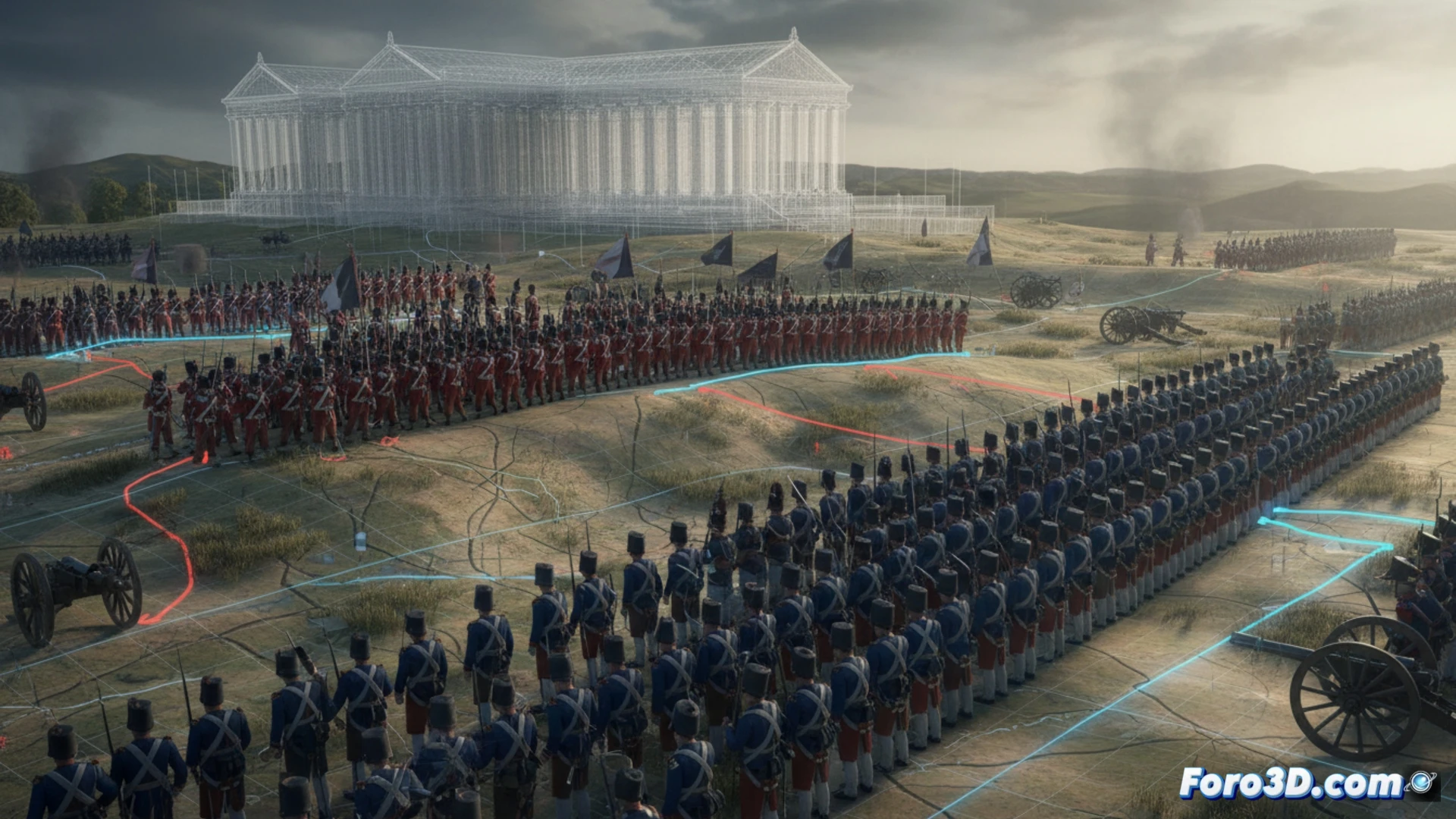
Terrain modeling and applied photogrammetry 🗺️
The first technical step is capturing the current terrain using aerial photogrammetry with drones and LIDAR. However, the real challenge is going back in time: modern constructions, roads, and current vegetation must be removed to reconstruct the original topography of the 19th or 18th century. Data from historical maps and writings of the era are used to adjust the height of crops or the depth of ravines. Once the base model is created, procedural textures are applied that simulate the ground in rainy or muddy conditions, critical factors that determined the success or failure of a cavalry charge. The graphics engine simulates projectile physics and bullet trajectories based on the black powder of the time.
Beyond entertainment: historical memory 🎖️
The value of these recreations transcends aesthetics. They allow the viewer to experience the perspective of the common soldier, seeing the gunpowder smoke and hearing the roar of combat from an immersive point of view. This humanizes casualty statistics and fosters critical awareness of the human cost of strategic decisions. By being able to modify variables, such as the arrival of reinforcements or a change in weather, the user understands the fragility of military plans. It is a powerful educational tool that transforms a paragraph from a textbook into a sensory experience that is not forgotten.
Can a 3D reconstruction of a historical battle achieve a level of precision that allows it to be used as expert evidence in an international military tribunal, or does the inherent subjectivity in the selection of sources and data inevitably limit it to an educational resource?
(PS: at Foro3D we document war damage with the same precision as our meshes: millimeter precision)