Drilling is one of the most critical operations in sectors such as construction, mining, and industrial manufacturing. A small error in angle or depth can lead to everything from structural damage to serious safety risks. Augmented Reality (AR) is revolutionizing this process by overlaying precise technical data directly onto the surface to be drilled, eliminating reliance on paper blueprints or repetitive manual measurements.
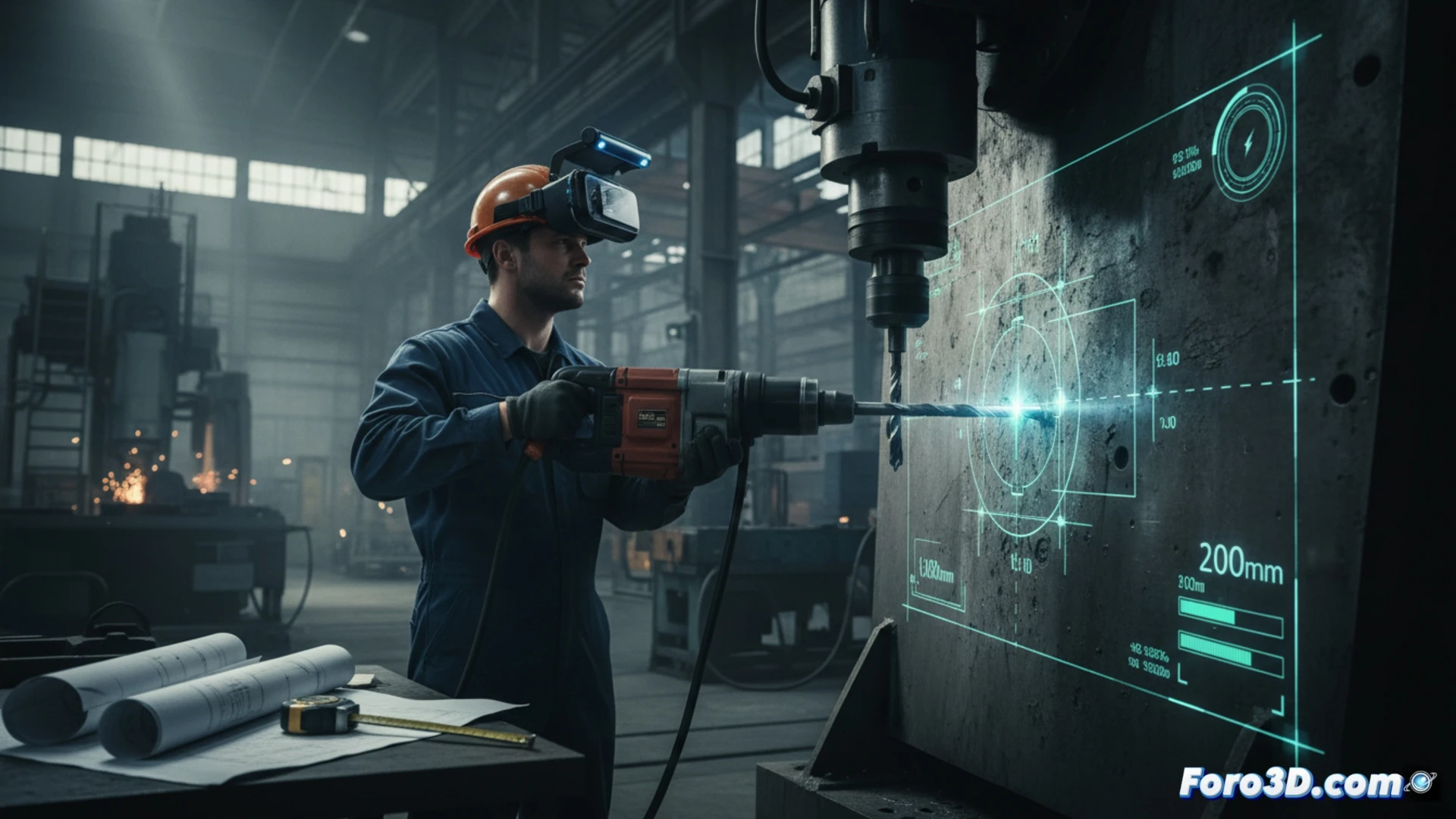
Real-time technical data overlay 🛠️
The system works through AR glasses or tablets that project virtual guides onto the actual material. The operator sees in their field of vision the exact trajectory of the drill bit, the recommended depth, and the entry angle, all synchronized with laser sensors or BIM (Building Information Modeling) models. In mining, companies like Komatsu already integrate AR to mark blasting points in tunnels, reducing deviations to less than 2 degrees. In manufacturing, it is used to drill precision holes in aeronautical components, where an incorrect tolerance renders the part unusable. Calibration is performed in seconds, and data is dynamically updated if the operator changes position, ensuring the information always matches the real geometry of the object.
Safety and efficiency as pillars of change ⚙️
The most tangible benefit is the reduction of human errors, which in manual drilling can reach up to a 15% failure rate in alignment. With AR, that rate drops below 1%. Additionally, downtime is minimized by eliminating the need to consult blueprints or perform checks with levels and squares. In high-risk environments, such as underground mining, AR allows the operator to keep their eyes on the work area instead of looking at an external screen, improving situational awareness and preventing accidents caused by distraction. The technology does not replace the professional, but rather empowers them by offering a layer of critical information precisely when and where it is needed.
Since Augmented Reality projects virtual information directly onto the piece to be drilled, what mechanisms are implemented to compensate for the vibrations and deviations inherent to an industrial drilling tool in real time?
(PS: AR applied to maintenance lets you see where the fault is... before the machine explodes.)