The recovery of latent fingerprints on curved and rough surfaces, such as the grip of a firearm, has historically been a challenge for forensic science. Revealing powder can damage residues or fail to adhere properly, and traditional photography often fails to capture the depth of the papillary ridge. High-detail photogrammetry and 3D scanning offer a non-invasive solution, allowing the tactile trace to be digitally preserved without contaminating the original physical evidence.
Cross Lighting and Relief Reconstruction 🔍
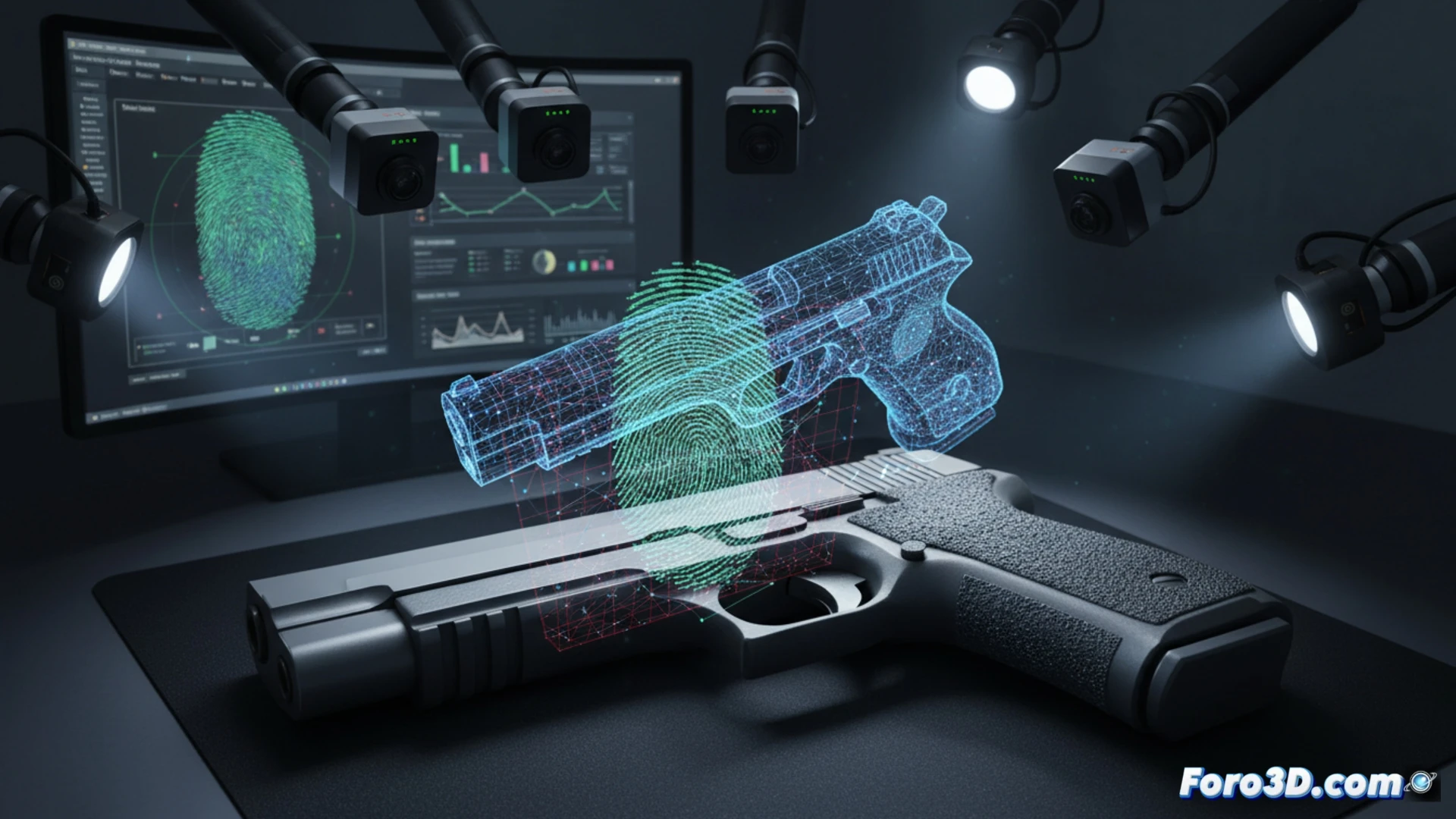
The technical process begins with capturing multiple high-resolution images of the firearm grip under cross-lighting angles (raking light from 45 degrees and diffuse backlighting). This technique highlights the papillary ridges by projecting microscopic shadows into the valleys of the print. Photogrammetry software, such as RealityCapture or Metashape, processes the images to generate a dense point cloud and a high-definition polygonal mesh. The resulting model allows the expert to rotate, zoom, and measure the print in a virtual environment, overcoming the focus and perspective limitations of flat photography.
Immutable Evidence for Trial ⚖️
Beyond simple capture, the 3D model becomes dynamic expert evidence. The judge or jury can explore the weapon digitally, observing the exact location of the tactile trace in relation to the trigger guard or hammer. This visualization eliminates the ambiguity of printed photos and irrefutably demonstrates whether the print corresponds to a shooting grip or accidental handling. The digital file, signed with a cryptographic hash, guarantees the chain of custody and the integrity of the evidence from the scene to the courtroom.
What specific technical challenges does forensic 3D digitization present when attempting to preserve the integrity of a latent tactile trace on the rough, curved surface of a firearm grip, and how does this affect the digital chain of custody?
(PS: In crime scene analysis, every scale marker is a small unsung hero.)