The crime scene holds secrets in every millimeter of the ground. A seemingly trivial bare footprint can be the key to identifying a suspect or reconstructing a victim's trajectory. 3D capture technology, through photogrammetry and LiDAR scanning, has revolutionized forensic analysis by enabling non-invasive documentation of these marks, preserving their original depth and relief for detailed expert study.
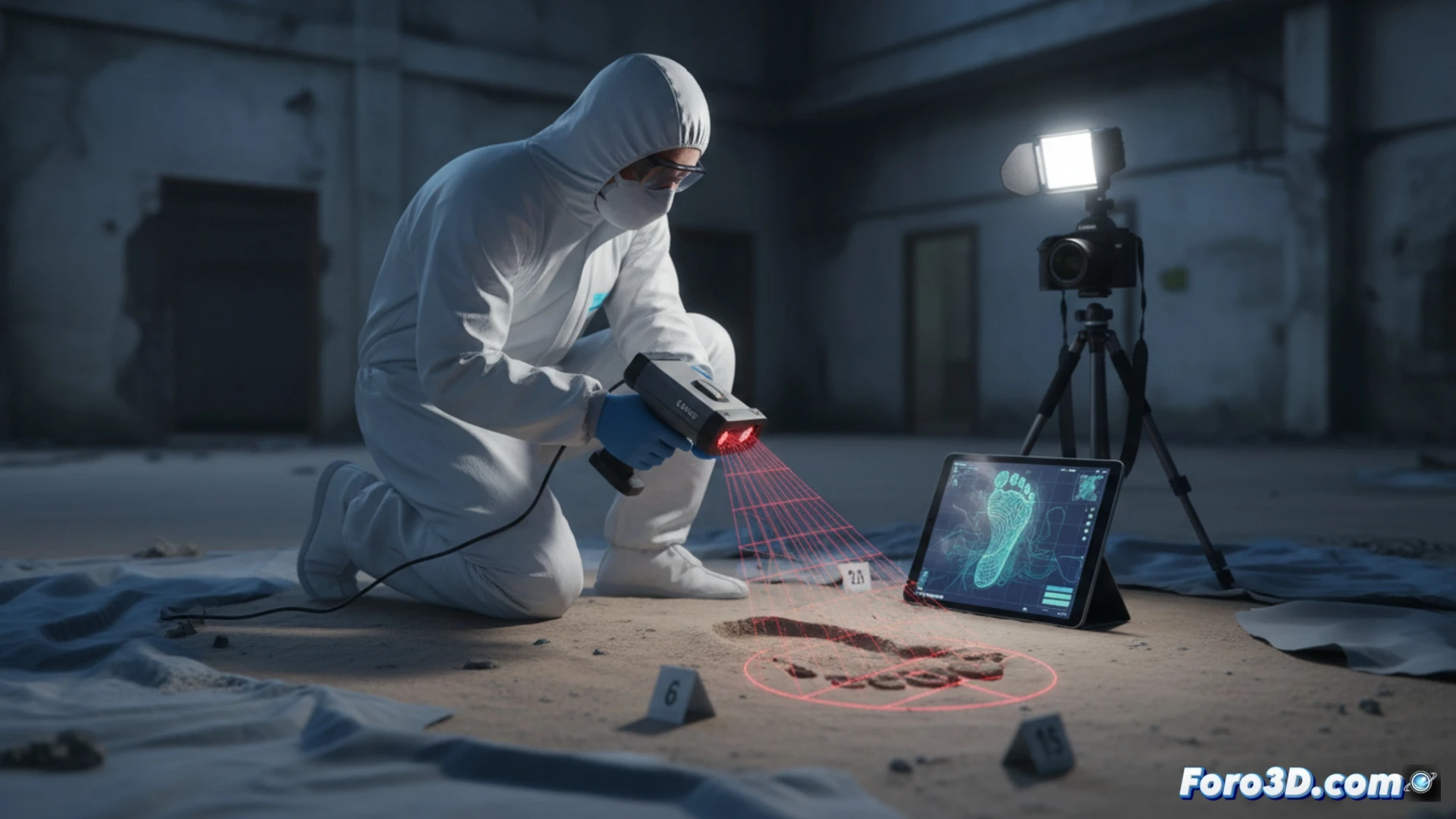
Footprint Capture and Modeling Process 🦶
The protocol begins with stabilizing the ground and placing scale targets. A photographic session is conducted with 80% overlap around the footprint, capturing texture and geometry. Using photogrammetry software such as Agisoft Metashape or RealityCapture, a dense point cloud is generated, followed by a high-resolution polygonal mesh. LiDAR scanning complements the process by recording the overall spatial context, allowing the exact footprint to be located within the scene. The result is a textured 3D model that can be rotated, measured, and compared with casts or databases of dermatoglyphic patterns.
Invisible Evidence Becomes Three-Dimensional 🔍
Beyond simple identification, the 3D model allows for analyzing the biomechanics of barefoot walking. Heel depth, the plantar arch, and differential pressure on the toes reveal whether the person was running, walking slowly, or carrying weight. This visual reconstruction, presented in a courtroom or in an expert report, offers a clear and objective forensic narrative. The footprint is no longer just a stain on the ground, but a digitized testimony of the exact moment of the step.
How can 3D photogrammetry differentiate a recent bare footprint from an old or contaminated one at a crime scene to ensure the accuracy of forensic analysis?
(PS: In scene analysis, every scale marker is a small anonymous hero.)