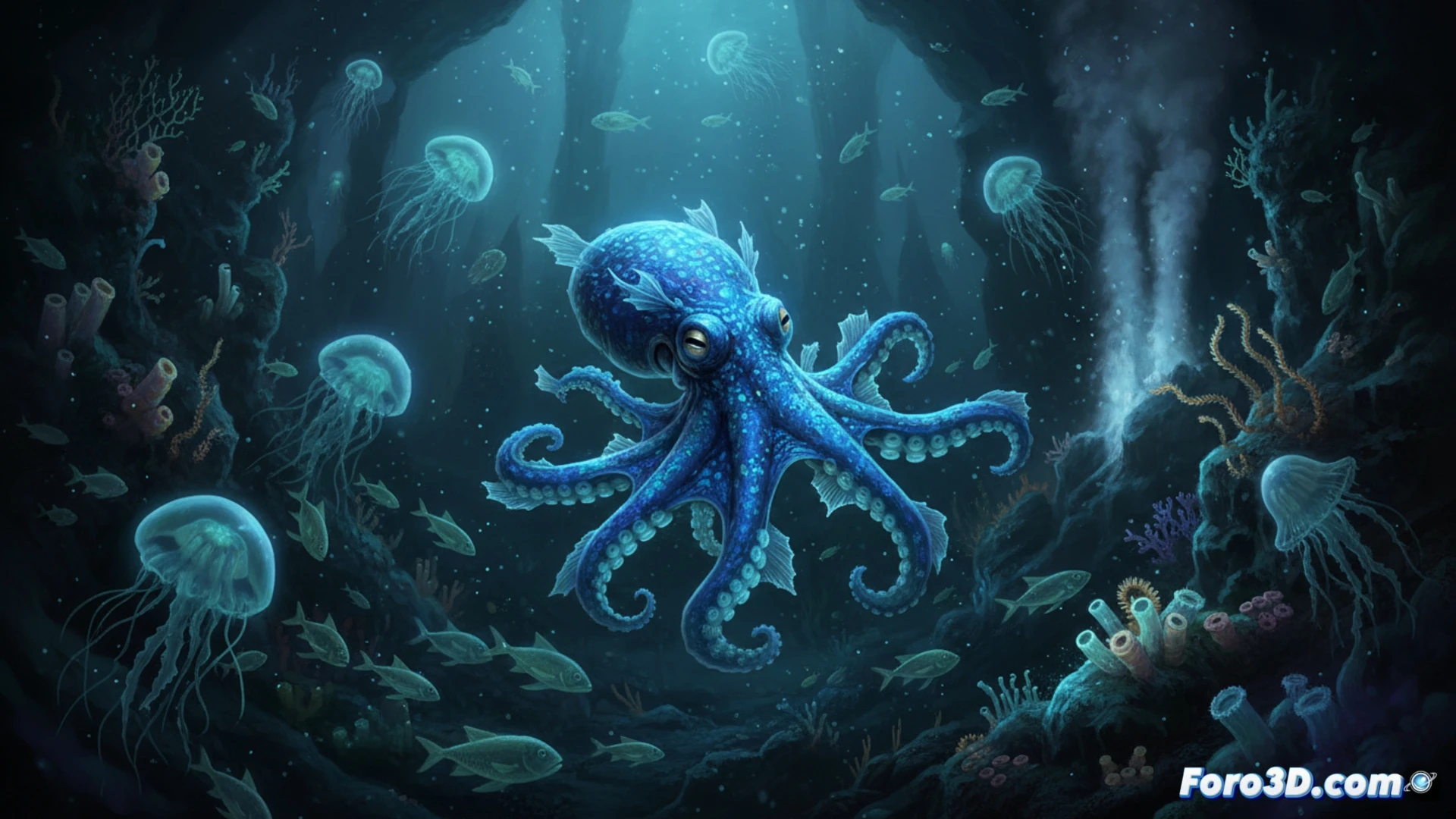
Scientists have identified a new species of octopus in the Pacific Ocean, at a depth of nearly 1,800 meters, near the Galapagos Islands. This cephalopod, the size of the palm of a hand, has a striking blue color and, despite its small size, is already an adult. Its rapid reproduction capability has drawn the attention of the scientific community.
Technological implications of deep-sea adaptation 🐙
The discovery raises questions about biology and adaptation in extreme environments. The species, still without an official name, possesses characteristics that could inspire developments in soft robotics and pressure-resistant materials. Its compact and efficient nervous system is being studied to optimize control algorithms in autonomous underwater vehicles. Researchers are analyzing its metabolism and reproductive cycle to understand how it survives in an environment with limited resources.
The blue octopus that doesn't need Tinder to reproduce quickly 💡
While humans complicate relationships with apps and messages, this octopus has solved the reproduction problem with efficiency worthy of a self-help manual. Nearly two kilometers under the sea, without light or WiFi, this little blue one manages its life cycle as if it had read the performance gurus. Perhaps the real mystery is not how it survives, but why it hasn't launched an online productivity course.