Prosthetic injuries, from pressure ulcers to socket fatigue fractures, represent a constant clinical challenge. The origin is often a biomechanical mismatch between the stump and the device. 3D scanning and additive manufacturing technology offers a precise solution by capturing the exact topography of the tissue, enabling a design that distributes loads evenly and eliminates critical friction points.
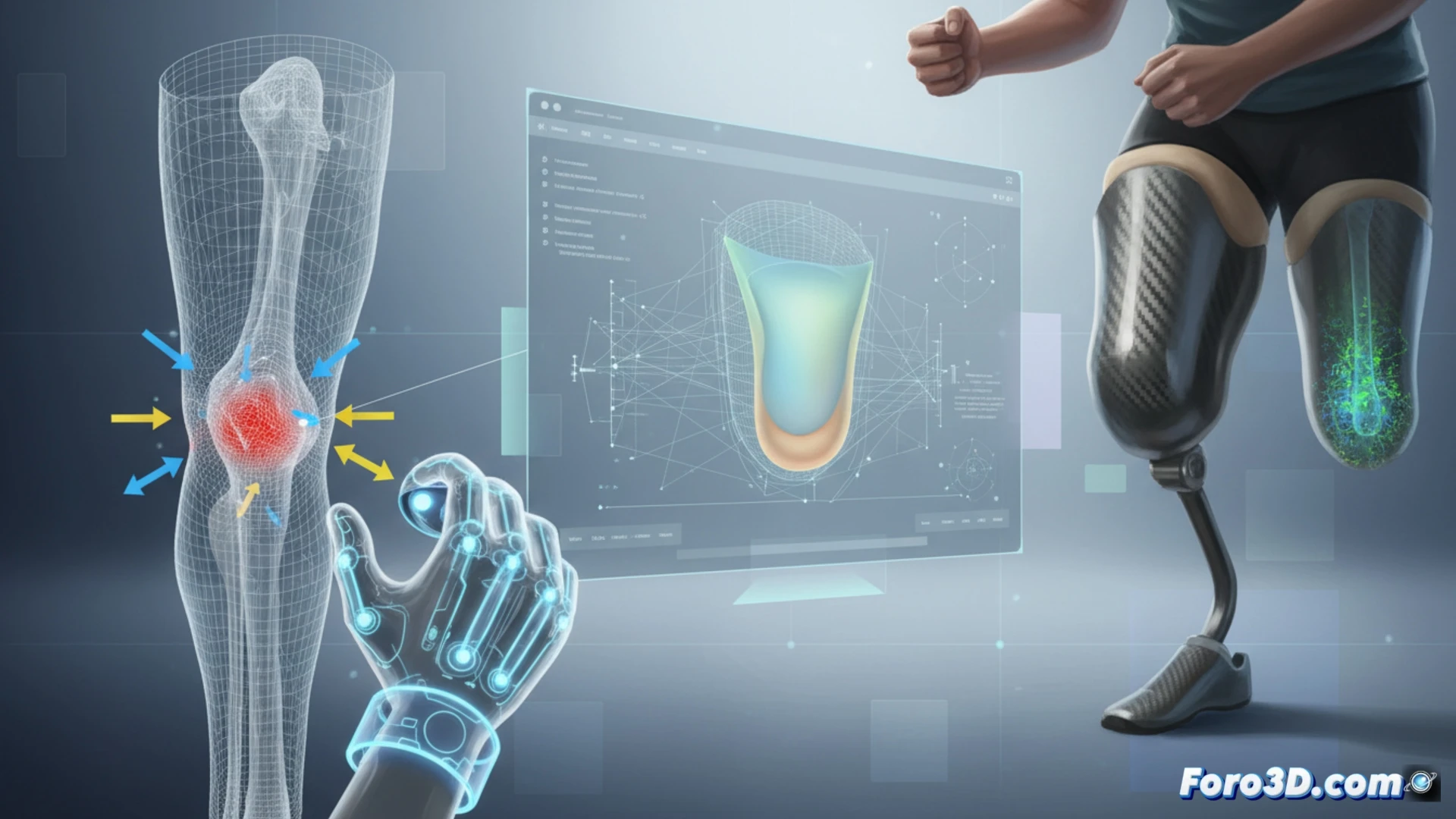
Load simulation and pressure point detection 🦾
The technical process begins with a high-resolution 3D scan of the stump in a residual state and under load. This digital model is imported into parametric design software where finite element analysis (FEA) simulations are applied. The analysis reveals high-pressure zones during the stance or swing phase. With this data, the designer can virtually modify the socket, lightening rigid areas or adding localized reliefs. 3D printing allows test prototypes to be manufactured in hours, not weeks. A common case study is correcting pressure on the tibial crest: after detecting a peak of 120 kPa in simulation, the design is iterated by adding a relief window, reducing pressure to 45 kPa and eliminating the patient's pain.
Rapid iteration as a shield against biomechanical failure ⚙️
The decisive advantage of 3D printing is the ability to iterate without mold costs. If the patient reports discomfort after a week of use, the stump is rescanned to capture volumetric changes and the CAD model is adjusted in minutes. This cycle of trial, error, and correction is unfeasible with traditional methods. In the end, the result is not just a more comfortable prosthesis, but a device that actively prevents tissue degeneration, reducing hospital readmissions and improving the user's quality of life.
How you integrate high-precision 3D scanning and generative design into a prosthetic socket to redistribute biomechanical loads and prevent pressure ulcers and fatigue fractures in highly active patients
(PS: 3D prosthetics are so customized they even have a fingerprint.)