Industrial product design has reached a milestone in miniaturization and durability with this portable sunshade. Weighing only 200 grams, it integrates rods manufactured via 3D printing in carbon fiber and a PTFE membrane canopy. Its mechanism allows opening and closing the structure with a single gesture, making it a perfect study object for CAD modeling and kinematic simulation. We analyze the workflow from concept to virtual prototype, comparing it with conventional sunshades.
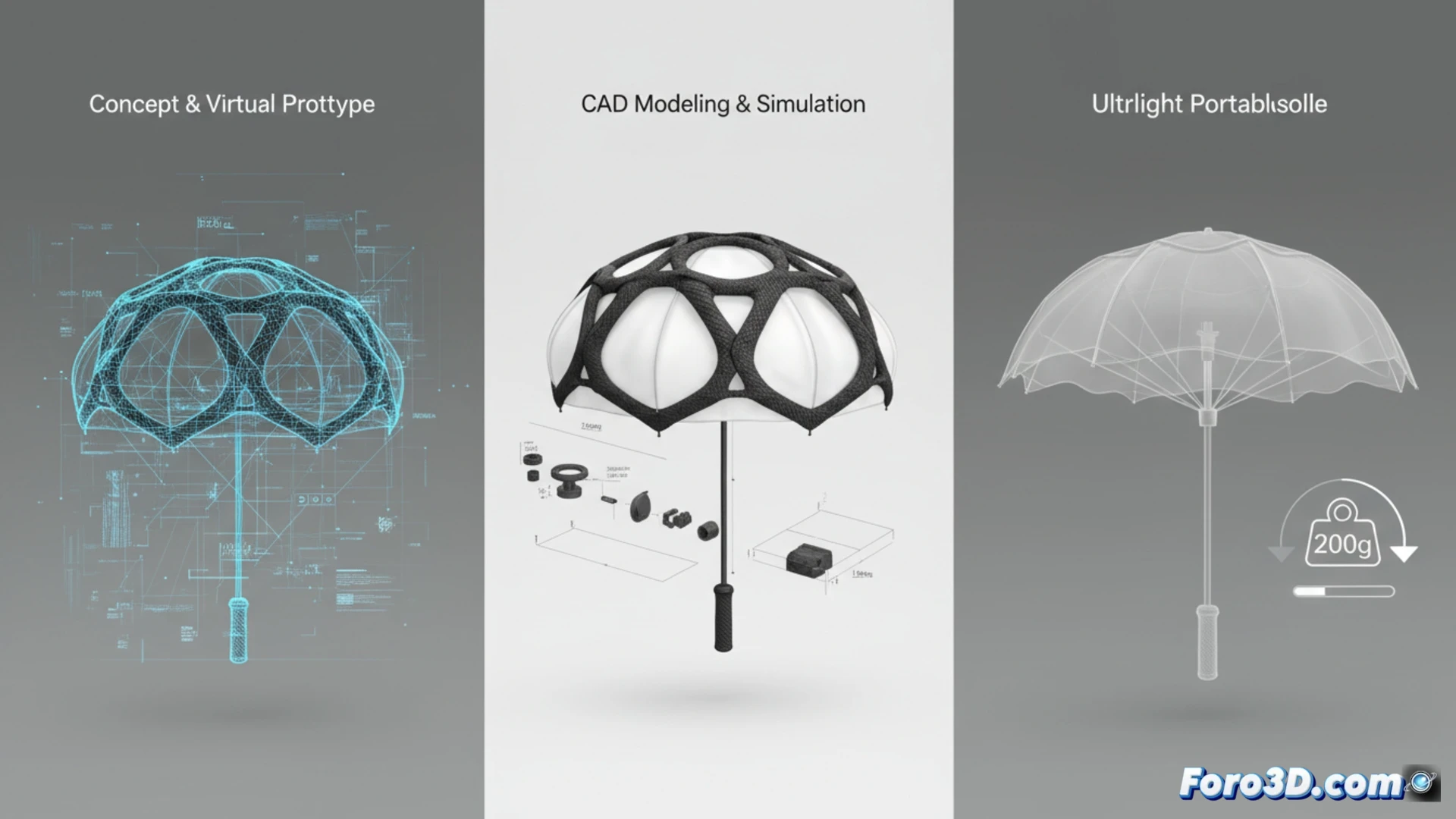
CAD modeling, mechanical simulation, and rendering of the single-gesture mechanism ⚙️
The first step in 3D design is modeling the carbon fiber rods. In parametric CAD software, hollow sections and internal ribs are defined to maximize stiffness with minimal material, replicating the anisotropic properties of the composite material. Finite element analysis (FEA) is critical to validate the synchronized opening mechanism; the sunshade folds and expands through a system of hinges and tensioners that act in unison. For the PTFE canopy, NURBS surface modeling is used to reproduce the actual tension and drape of the membrane. Photorealistic rendering, with HDRI lighting and displacement maps, shows the translucency of the PTFE without visible seams. Topology optimization allows reducing the weight to 200 grams, 60% less than a standard aluminum and polyester sunshade.
Design lessons: portability without sacrificing structural strength 💡
This case demonstrates that 3D printing in carbon fiber is not just a trend, but a viable solution for consumer products demanding lightness and durability. The PTFE canopy, besides being waterproof and UV resistant, allows rendering with realistic dielectric properties. For the 3D designer, the real challenge is not the geometry, but the simulation of the opening gesture: a single movement that must be fluid and reproducible in the virtual model. When compared to conventional sunshades, the advantage in ergonomics and storage is evident, opening the door to new standards in portable furniture.
How topology optimization influences the additive manufacturing of carbon fiber rods to achieve a 200-gram sunshade that withstands wind loads without compromising its ultralightness
(PS: Designing a product in 3D is like being an architect, but without having to worry about the bricks.)