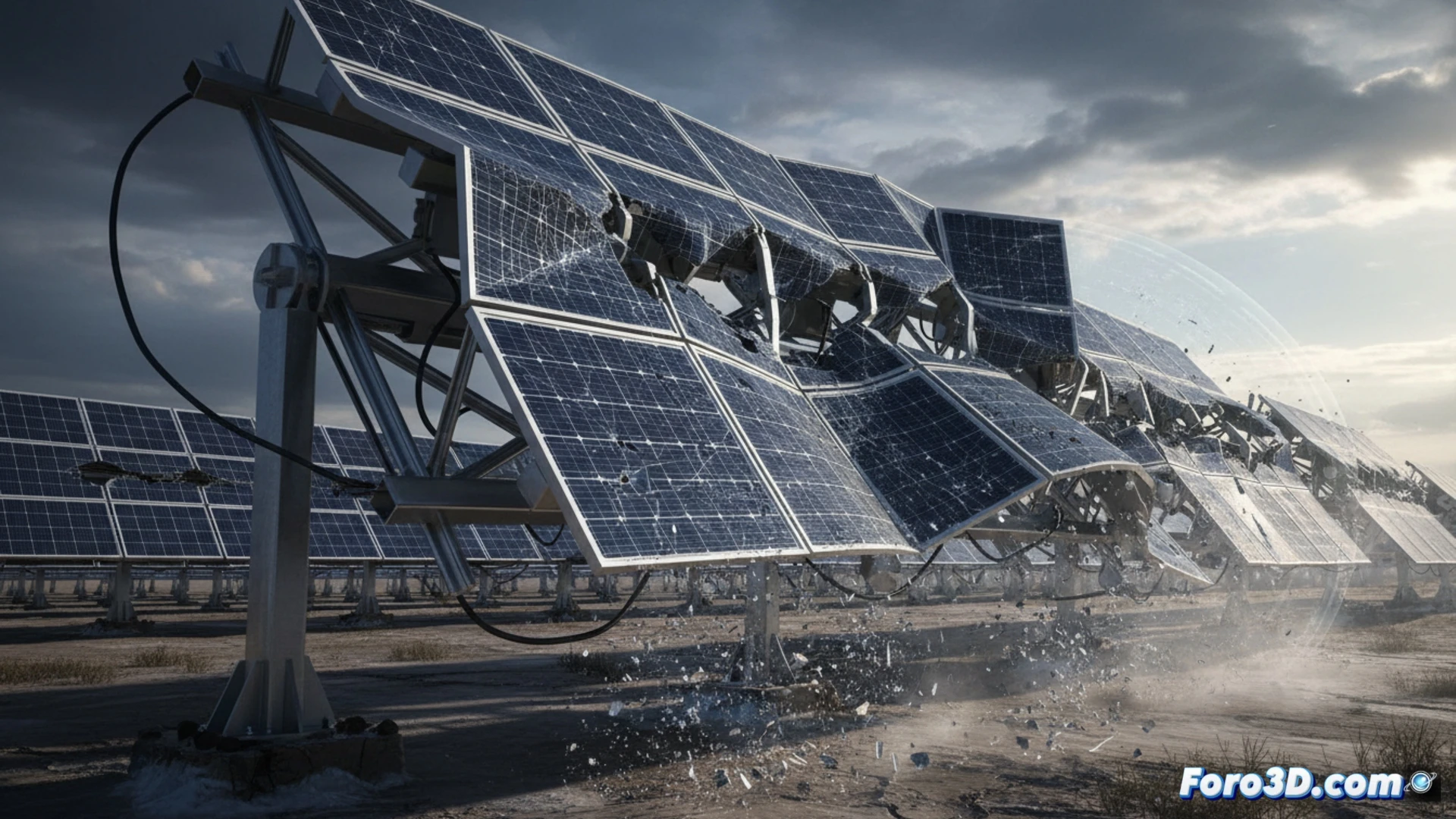
Buckling in photovoltaic structures represents a critical mechanical instability phenomenon that occurs when solar panels and their supports are subjected to extreme compressive loads. Unlike simple bending, buckling causes sudden lateral deformation that compromises the integrity of the module. This failure, often underestimated in initial design, is one of the main causes of premature fatigue in solar plants, manifesting after wind cycles, snow accumulation, or differential thermal expansion.
Technical Analysis of Buckling: From Critical Load to Fatigue from Thermal Cycles 🔬
From the perspective of material fatigue simulation, photovoltaic buckling is modeled using finite element analysis (FEA) in specialized 3D software. The process begins with identifying the Euler critical load applied to the anodized aluminum profiles that make up the support structures. However, the real challenge lies in the combined loads: wind generates fluctuating suction and pressure loads, while snow adds a pure static compressive load. 3D simulations allow visualizing the progression of buckling, showing how stress points concentrate at bolted joints and frame edges. A documented real case in solar plants in regions with high snow loads (such as northern Europe) revealed that buckling occurred not due to static weight, but from accumulated fatigue after cycles of thawing and refreezing, where the thermal expansion of tempered glass induced additional compressive stresses in the supports.
Predictive Prevention: How 3D Modeling Redefines Support Design 🛠️
The true utility of 3D modeling in this niche is not just to visualize collapse, but to predict it before it occurs. By simulating thousands of fatigue cycles, engineers can identify the remaining useful life of a structure before permanent deformation appears. This has led to redesigning supports with diagonal stiffeners and alloys with higher yield strength, avoiding localized buckling at corners. In existing solar plants, reverse simulation allows diagnosing why a specific solar tracker failed, correcting the tilt angle to reduce wind-induced compression. Photovoltaic buckling ceases to be a mystery of failure and becomes a controllable variable through computational simulation.
How can 3D finite element simulation accurately predict the buckling mode in solar panels under wind and snow loads, considering geometric and contact nonlinearities at the joints of the photovoltaic structure?
(PS: Material fatigue is like yours after 10 hours of simulation.)