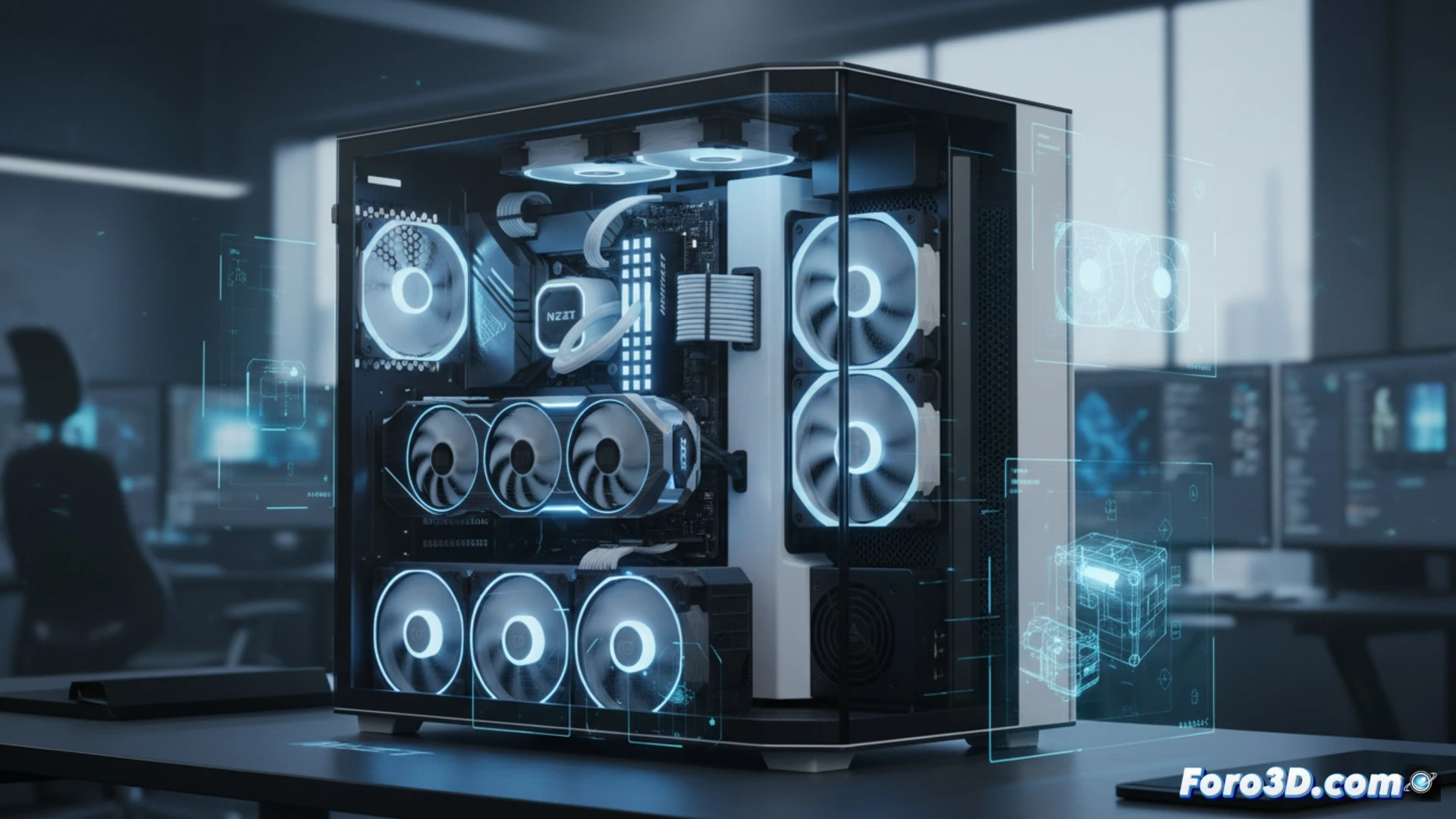
As part of Computex 2026, NZXT has unveiled the H6 series, a PC case that promises to revolutionize cooling for 3D workstations. Its dual-chamber design and curved glass panel not only seek impeccable aesthetics but also optimize airflow for critical components. With a price ranging between €109.90 and €199.90, this tower positions itself as a serious option for modeling and simulation professionals looking to keep their GPUs and CPUs at optimal temperatures during long rendering sessions.
Technical Analysis: Cooling for Sustained Loads 🔥
The dual-chamber architecture of the NZXT H6 physically separates the power supply and hard drives from the main compartment, allowing cool air to flow directly to the motherboard and graphics card without obstructions. This is crucial for 3D users, where a GPU like an RTX 5090 or an AMD Radeon Pro can generate extreme heat during fluid simulations or renders in engines like Blender or V-Ray. The tempered curved glass is not just decorative; mounted at a 45-degree angle, it acts as a natural deflector that directs hot air towards the rear fans. Although the case does not include fans in its base configuration, NZXT has simultaneously launched its new RGB and Ultra RGB fans, offering a static airflow of 2.8 mmH2O, ideal for setting up push-pull configurations on 360 mm radiators. In the €110 to €200 range, it competes directly with the Fractal Design Meshify 2 and the Corsair 5000D, surpassing them in thermal management for prolonged loads, though sacrificing some hard drive space.
Is It Worth It for the 3D Professional? 🎯
For the user building their own workstation, the NZXT H6 represents an almost perfect balance between aesthetics and function. The recommendation is clear: if your workflow involves renders lasting more than 4 continuous hours or particle dynamics simulations, invest in a configuration of three front Ultra RGB fans (120 mm) and a rear exhaust fan. This will keep your CPU and GPU below 75 degrees Celsius even under maximum stress. However, if you work with multiple GPUs for network rendering, the internal space may be tight. In conclusion, NZXT democratizes access to a high-end cooling chassis at a competitive price, allowing 3D creators to assemble cleaner, quieter systems with better thermal performance without breaking the bank.
What is the main thermal advantage offered by the dual-chamber and curved glass design of the NZXT H6 compared to a traditional case for 3D workstations with high-end components?
(PS: If your computer is smoking when you open Blender, you might need more than just a fan and faith)