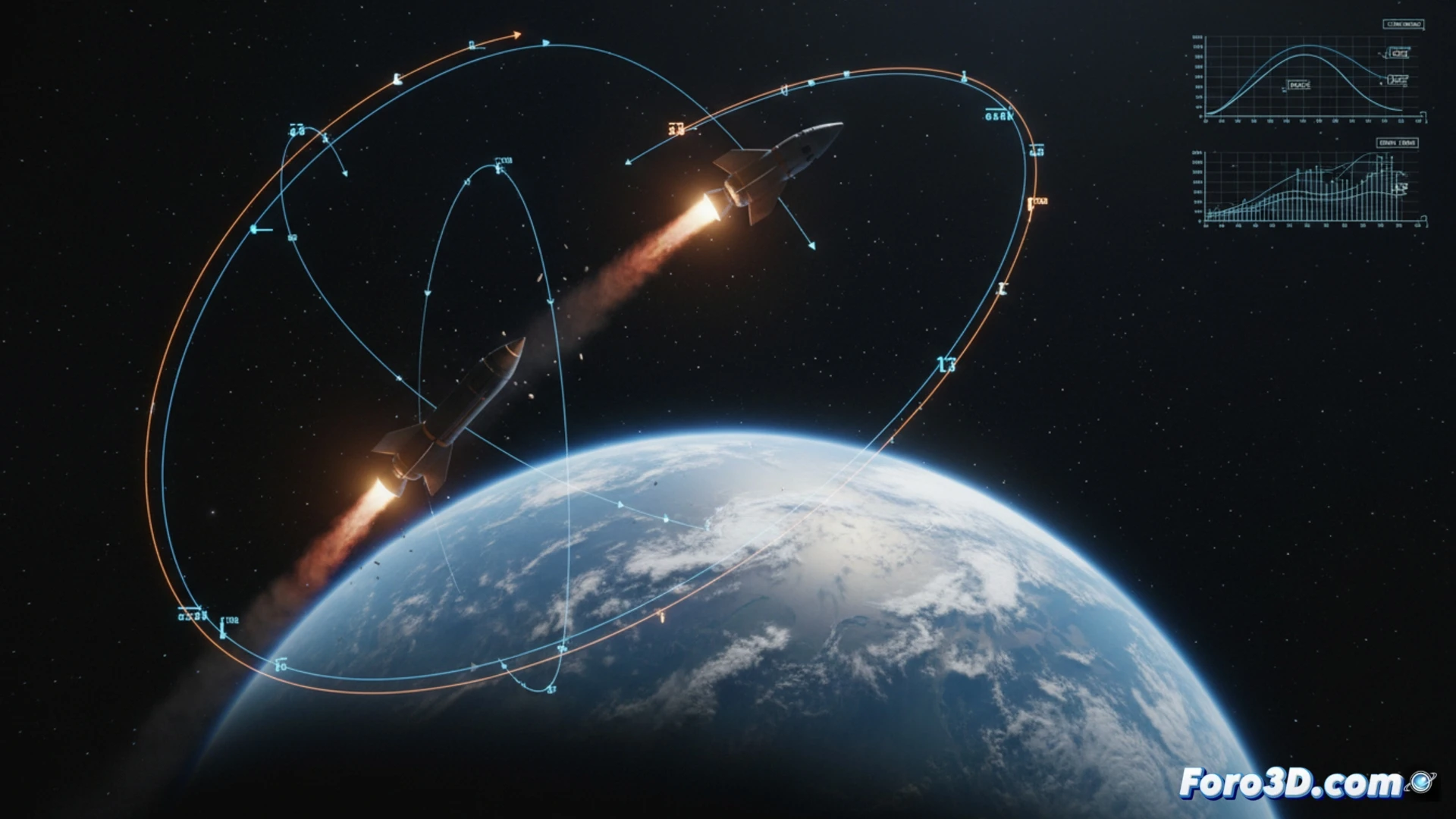
A suborbital separation describes the critical moment when a rocket or spacecraft detaches from its propulsion stage without reaching the necessary orbital velocity. In 3D simulations of virtual trajectories, this event marks a key transition where inertia and gravity dictate a predictable ballistic arc. Unlike a stable orbit, the object returns to the atmosphere after a brief parabolic flight, offering an ideal case study for visualizing flight curves and dynamic forces.
Kinematic modeling of the ballistic phase 🚀
To accurately represent a suborbital separation in a 3D engine, the equation of motion of a projectile under constant gravity and variable atmospheric resistance must be integrated. The initial velocity vector, defined by the separation, traces an incomplete ellipse whose apogee rarely exceeds 100 km in altitude. Software such as Kerbal Space Program or MATLAB with Simulink allows adjusting parameters like launch angle and residual thrust. Visualizing the ballistic path requires cubic spline interpolation to smooth the transition between motor thrust and free fall, facilitating the analysis of impact or reentry points.
Applications in space flight simulations 🌍
Modeling suborbital separations is essential for training launch abort systems and testing guidance algorithms in virtual environments. Companies like SpaceX and Blue Origin use these simulations to rehearse stage separations without real risk. In education, visualizing these trajectories in 3D helps understand why a rocket must reach 7.8 km/s to orbit, while a suborbital flight only requires between 1 and 4 km/s. Precision in modeling defines the difference between a controlled splashdown and a catastrophic failure.
How does 3D fluid dynamics simulation affect the accuracy of modeling stage separation in suborbital trajectories?
(PS: Simulating trajectories is like playing billiards, but without having to clean the table afterwards.)