Robotic courtesy is not a social luxury, but a critical safety protocol in collaborative environments. When a robot fails to yield or ignores a priority command, a robotic courtesy failure occurs. This article analyzes how to model these failures in 3D simulations to predict collisions and risks before implementing physical systems.
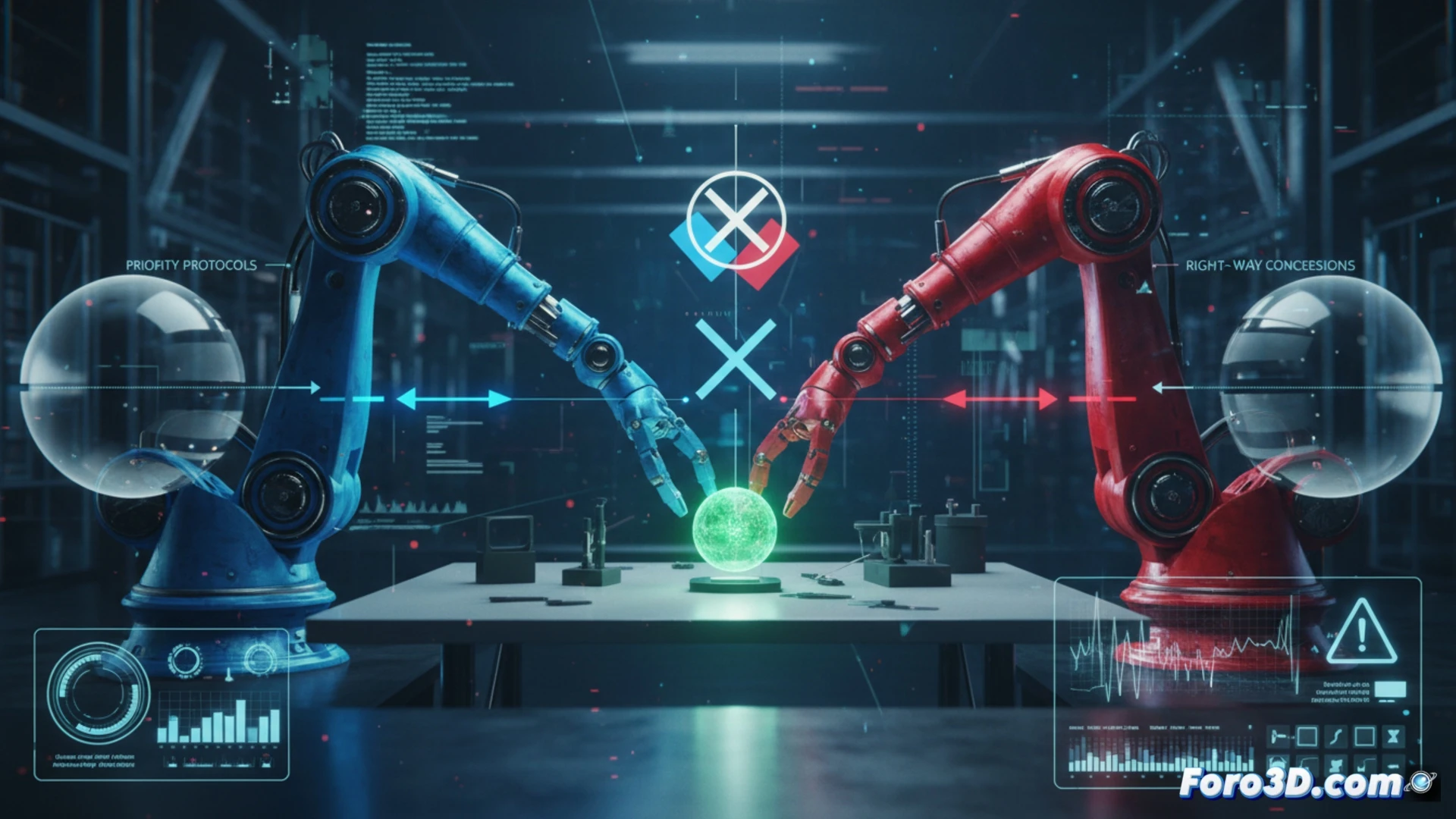
Interaction Protocols and Kinematic Simulation 🤖
In a 3D simulation environment, the courtesy protocol translates into priority algorithms and comfort zones. For example, a robotic arm must stop or modify its trajectory when a human enters its safety radius. A failure occurs when the system ignores the proximity signal or executes an invasive movement. To model this, anomalies are programmed into the controller: intentional delays in detection, omission of the yield rule, or trajectories that invade the operator's space. The simulation allows real-time visualization of how these errors generate virtual collisions, measuring the minimum separation distance and time to impact.
Lessons from the Virtual Anomaly ⚠️
By simulating a robotic courtesy failure, we discover that the problem is not only mechanical but also one of interaction design. A robot that does not yield in the simulation reveals gaps in priority logic or poorly calibrated sensors. Correcting these anomalies in the 3D model before actual deployment reduces accidents and improves operator trust. The failure, then, becomes a learning tool to refine human-robot coexistence protocols.
How can the impact of a failure in the robotic courtesy protocol on the safety and efficiency of a human-robot collaborative environment be modeled and validated in 3D simulations?
(PS: Simulating robots is fun, until they decide not to follow your orders.)