The virtual recreation of bobsleigh tracks has evolved beyond entertainment to become an essential technical tool. Using CAD software (such as SolidWorks or Rhino) for the geometric design of the sled and Computational Fluid Dynamics (CFD) programs like ANSYS Fluent or OpenFOAM, engineers can analyze the interaction between the equipment's aerodynamic profile, the athletes' posture, and the G-forces in banked curves.
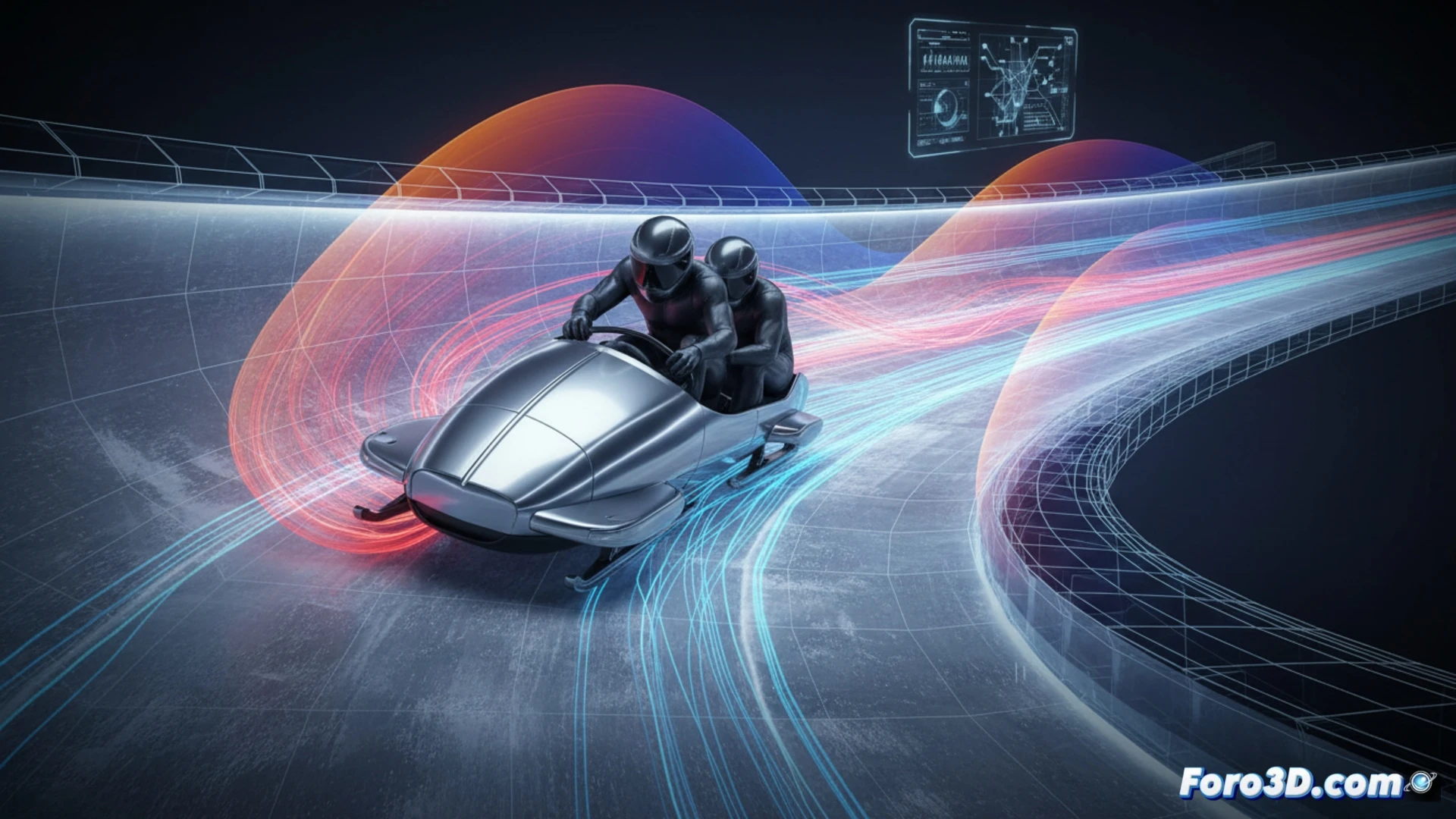
Digital recreation and performance analysis 🛷
The process begins with LiDAR scanning of real tracks to generate high-precision 3D meshes, capturing everything from the radius of the curves to the roughness of the ice. Subsequently, multibody simulation models are integrated to reproduce the sled's inertia and the crew's weight distribution. These environments allow national teams to optimize trajectories in milliseconds, test fairing configurations without manufacturing physical prototypes, and predict performance under changing weather conditions. The validation of these models is carried out by comparing real telemetry data with virtual acceleration curves.
The future of immersive training 🥽
The integration of physical simulation with virtual reality headsets is revolutionizing training. Pilots can experience the vestibular sensation of a full descent without the risk of injury, memorizing braking points and steering angles. However, the true technical challenge remains the calibration of ice friction in the software, a parameter that varies with temperature and separates a useful simulation from a mere visually appealing video game.
How does 3D modeling combined with CFD simulation ensure accuracy in the virtual recreation of bobsleigh tracks to optimize sports performance? 🏆
(PS: at Foro3D we know that a simulated penalty in 3D always goes in... unlike in real life)