Visual realism in representing meat alternatives is a key technical challenge for the food industry. Marbling, or intramuscular fat distribution, defines the texture and juiciness of meat. Digitally recreating it in 3D models of fake meat allows educators and designers to accurately display the appearance of plant-based and cultivated products, facilitating consumer acceptance through photorealistic images.
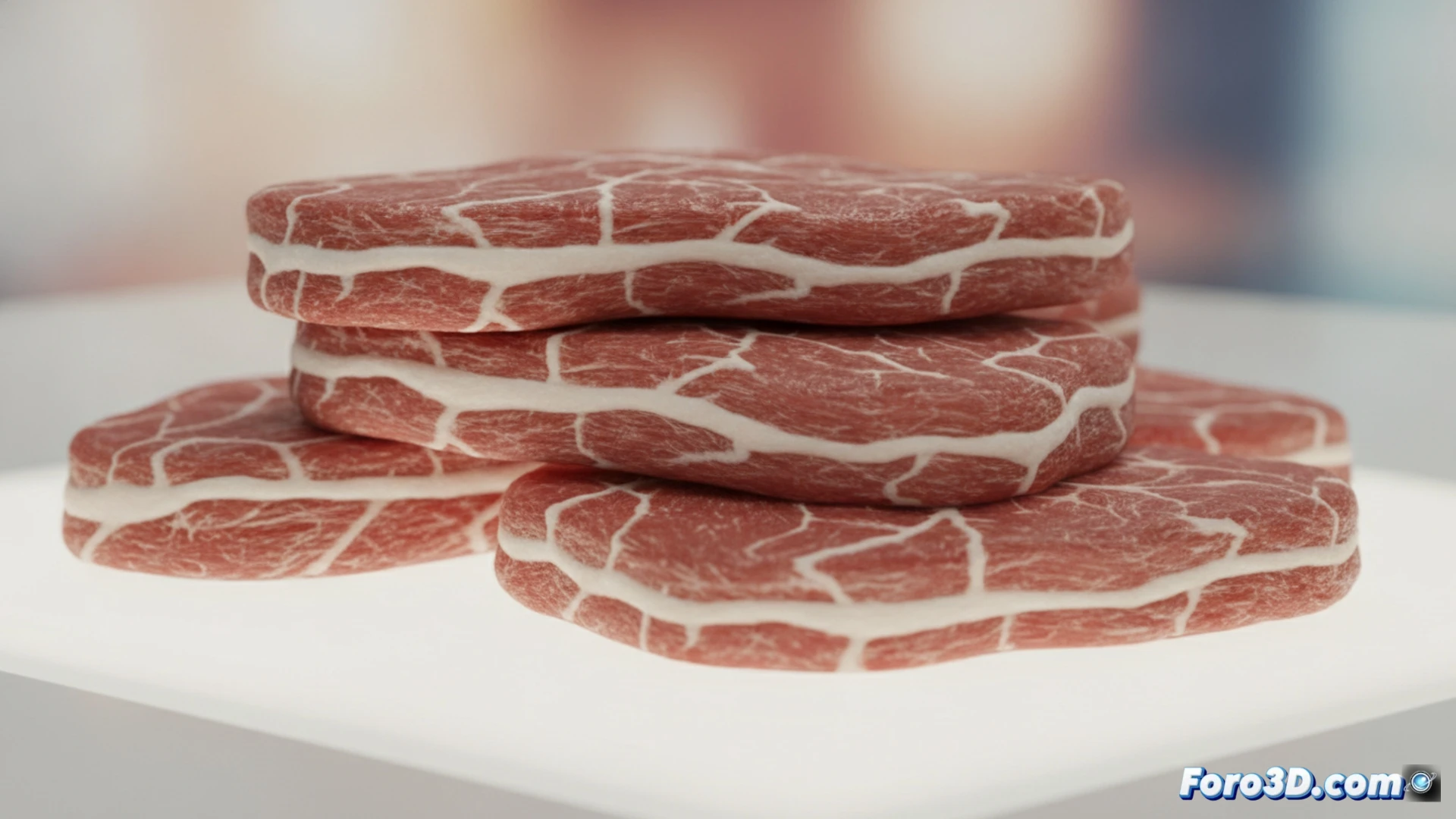
Scanning and texture mapping to simulate muscle fibers 🥩
To achieve believable marbling, high-resolution photogrammetry is used on real cuts of plant-based meat (such as those based on soy or pea protein) and lab-grown meat. The scan captures the arrangement of fat veins and muscle fibers. Subsequently, in software like Blender or Substance Painter, a displacement map is generated that replicates the roughness and indentations of the marbling. The fiber simulation is reinforced with normal maps and ambient occlusion, achieving realistic light interaction on the white fat veins and the reddish tone of the muscle. This technique allows the 3D model to display the texture from any angle, mimicking the appearance of a cooked or raw steak.
Educational impact of photorealistic representations 📚
Food awareness campaigns greatly benefit from these models. By presenting a plant-based burger with marbling identical to animal meat, visual rejection is reduced and the consumption of sustainable alternatives is normalized. 3D modeling also allows animating cross-sections that show the internal structure, explaining how vegetable fats (such as coconut oil) mimic the texture of animal fat. Thus, 3D technology becomes a powerful educational tool to teach about nutrition and sustainability without resorting to real images of animals.
As an expert in 3D texturing, what procedural modeling techniques or physical simulations do you recommend to accurately replicate the irregular distribution of intramuscular fat in plant-based meat cuts, and how does this affect the visual perception of the final product in educational settings?
(PS: modeling an apple in 3D is easy; the hard part is making it not look like a sphere with a red texture)