The nuclear impact, whether from a detonation or an accident, represents one of the most complex catastrophes to visualize due to its invisible and devastating effects. In the world of 3D modeling, accurately recreating the blast wave, particle dispersion, and structural collapse is a technical challenge that combines fluid physics, radioactive particles, and real geospatial data. This article explores how digital simulation tools allow these events to be analyzed for educational and prevention purposes.
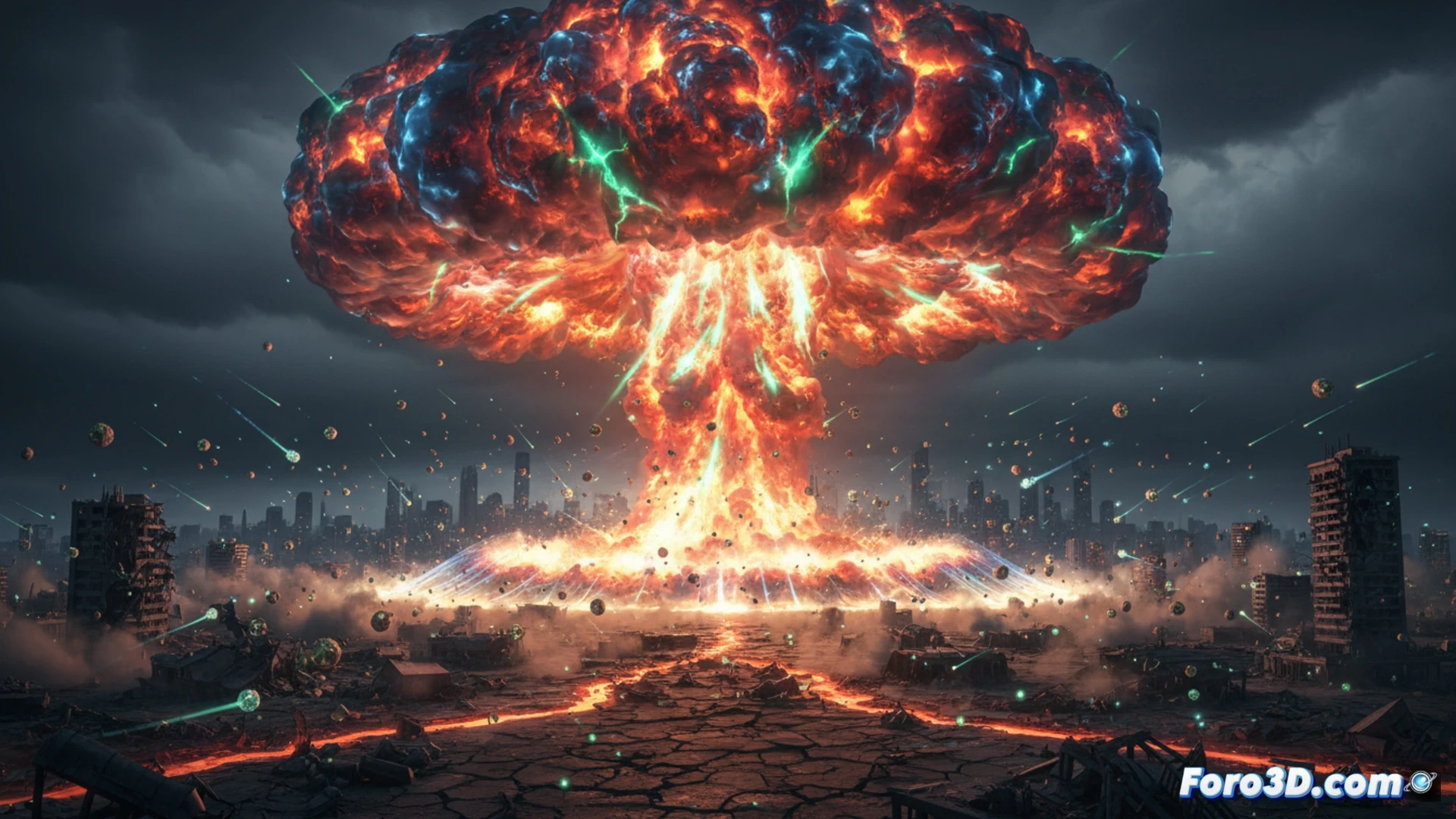
Simulation techniques: from the fireball to radioactive fallout 💥
Modeling a nuclear impact in 3D requires several systems. The initial fireball is recreated using fluid simulations (SPH or Voxel) that calculate the expansion of plasma at high temperatures. The blast wave is represented with dynamic force fields that deform the terrain and structures, using data from real tests such as those in Hiroshima or atmospheric trials. The dispersion of radioactive particles, such as Cesium-137, is simulated with particle systems that obey wind and gravity patterns, based on meteorological models from Fukushima. Tools like Houdini or Blender allow integrating real dose maps to visualize exclusion zones with metric precision.
The value of realistic visualization in public awareness 🧠
Beyond technical realism, these simulations play a crucial educational role. By digitally reconstructing scenarios like Chernobyl or Fukushima, viewers can understand the scale of the disaster without being exposed to danger. The visualization of radioactive dispersion over urban maps helps plan evacuations and understand the persistence of contamination. In a world where nuclear risk remains present, 3D modeling becomes a tool for historical memory and prevention, transforming complex data into images that invite reflection and debate.
How can 3D modeling of nuclear impact balance the technical realism of simulation with its goal of generating public awareness without falling into sensationalism or misinformation?
(PS: Simulating catastrophes is fun until the computer melts down and you are the catastrophe.)