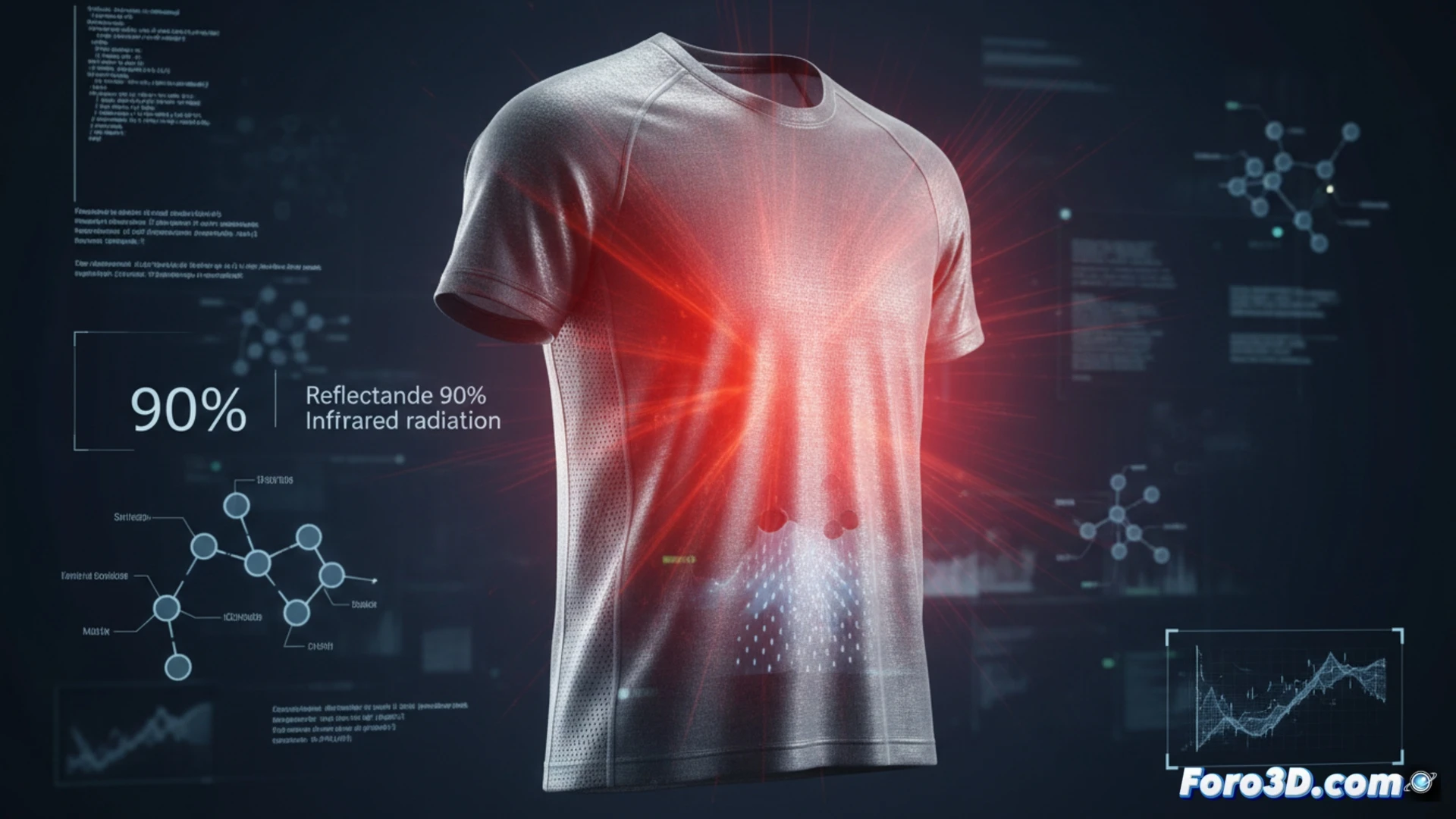
The textile industry is moving towards extreme functionality with the arrival of a shirt made from regenerated cellulose and titanium dioxide nanoparticles, capable of reflecting 90% of infrared radiation. This milestone not only redefines sun protection but also poses a fascinating technical challenge for 3D modeling specialists: how to digitally simulate such specific physical properties as thermal reflectance, breathability, and the drape of a biotechnological fabric before producing a single meter of cloth.
Simulating physical parameters in the digital mesh 🧵
To recreate this shirt in a 3D environment, the first step is to define the behavior of the regenerated cellulose substrate. In software like CLO 3D or Marvelous Designer, an anisotropy map is assigned to control the stiffness and drape of the material, mimicking the lightness of a processed plant fiber. The real complexity arises when integrating the TiO2 nanoparticle layer. Here, shaders based on BRDF (Bidirectional Reflectance Distribution Function) are used to simulate the scattering of infrared light. By adjusting the diffuse reflectance value and the material's refractive index, we can achieve that 90% of the simulated radiation bounces off the virtual surface, validating the thermal performance of the design without needing a physical prototype.
The future of functional textile visualization 🔬
This case demonstrates that 3D modeling is no longer limited to visual aesthetics. The ability to emulate thermal and comfort properties in real-time allows 3D textile designers to iterate on high-performance solutions, such as workwear or smart sportswear. The cellulose and titanium shirt is not just a product; it is confirmation that our digital simulation must embrace materials science to offer representations that are as accurate as they are functional, bridging the gap between the lab and the avatar.
As a 3D modeler, what is the greatest technical challenge when simulating the interaction of infrared nanoparticles with the geometry of a regenerated cellulose fabric to achieve precise reflectance?
(PS: Designing fashion in 3D has the advantage that you never have to sew a button.)