Pressurization rupture is one of the most destructive phenomena in engineering, capable of generating shock waves and lethal projectiles. Modeling this event in 3D allows forensic experts and prevention specialists to analyze the failure sequence without real risks. This article explains the techniques for simulating the bursting of a pressurized tank or pipe, from the sudden release of energy to the dispersion of fragments, using computational fluid dynamics (CFD) and rigid body physics tools.
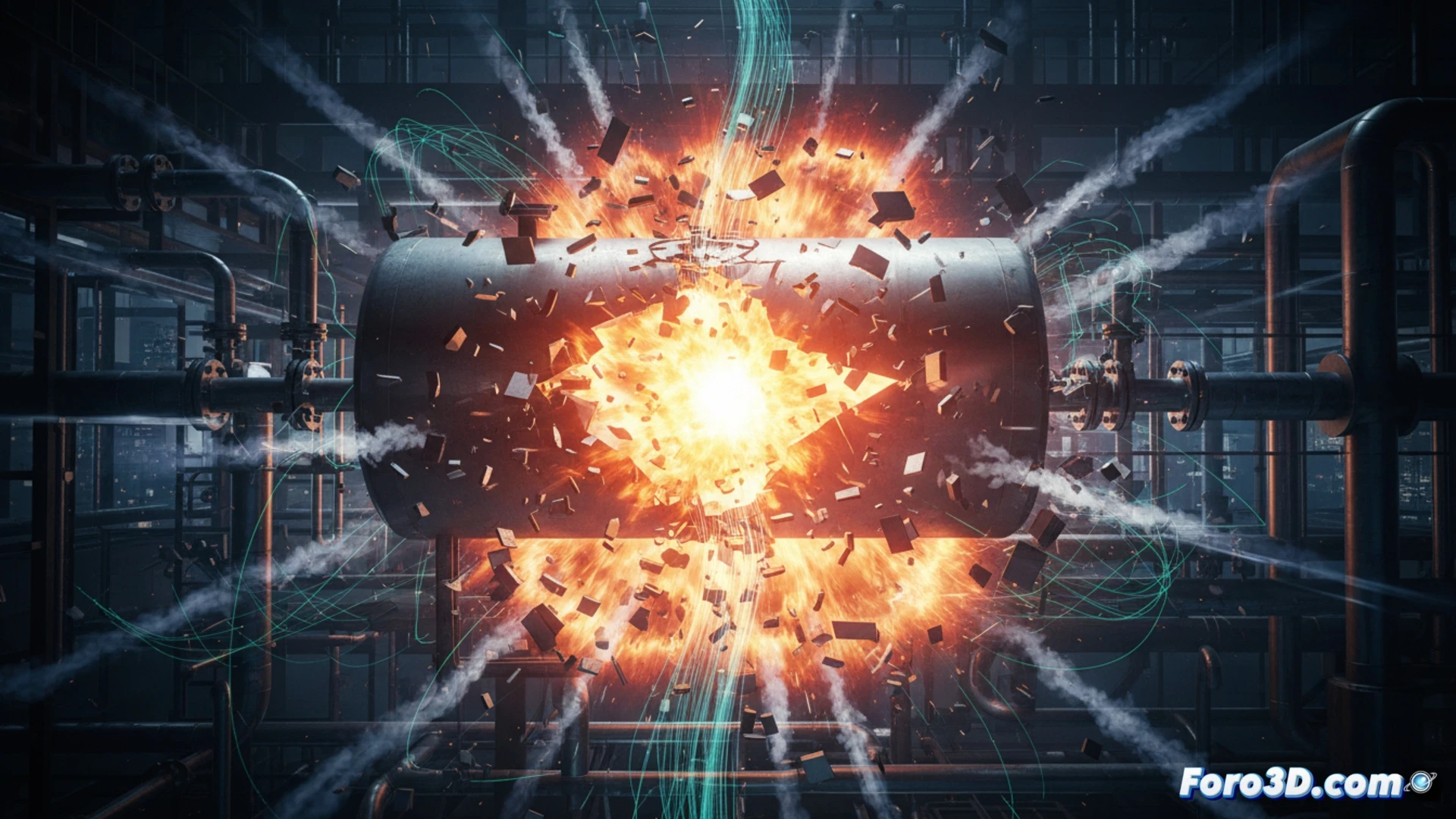
Technical simulation of structural failure and the shock wave 💥
To recreate a pressurization rupture in Blender, start by modeling the container with a high-resolution mesh and assigning a material that withstands stress. An internal pressure field is applied using a particle system or a fluid solver (such as FLIP). By activating the predefined fracture (cell fracture addon) at the critical moment, the container breaks into fragments. The shock wave is simulated with a smoke domain or a force field that pushes debris and deforms nearby objects. In Houdini, the RBD (Rigid Body Dynamics) solver is used combined with a pressure volume that is abruptly released, generating realistic fragmentation velocities. The key parameters are maximum pressure (in Pascals), wall thickness, and material density, which determine the kinetic energy of the projectiles.
Reflection on forensic realism and prevention 🛡️
An accurate simulation is not only visually impressive but also saves lives. By validating the 3D model with real test data (such as rupture pressures and damage radii), engineers can predict safety zones in industrial plants or design more effective relief valves. The key is balancing computational complexity with physical fidelity: a poorly parameterized explosion can underestimate fragmentation or the pressure wave, leading to erroneous conclusions. Pressurization rupture reminds us that chaos has a mathematical logic that, when well understood, protects us from catastrophe.
What physics-based modeling techniques can be implemented to realistically simulate the non-homogeneous fragmentation of composite materials during a pressurization rupture, and how does material anisotropy influence the shock wave trajectory?
(PS: Simulating catastrophes is fun until the computer crashes and you are the catastrophe.)