The reconstruction of crime scenes involving firearms demands millimeter precision, and Gunshot Residue (GSR) analysis is a fundamental pillar. The 3D modeling of these microscopic particles allows experts to visualize the dispersion of gunpowder and metallic fragments in three-dimensional space. This technical article breaks down the process of capturing, simulating, and rendering GSR patterns, integrating LIDAR scan data with ballistic physics algorithms to determine the exact shooter position and projectile trajectory.
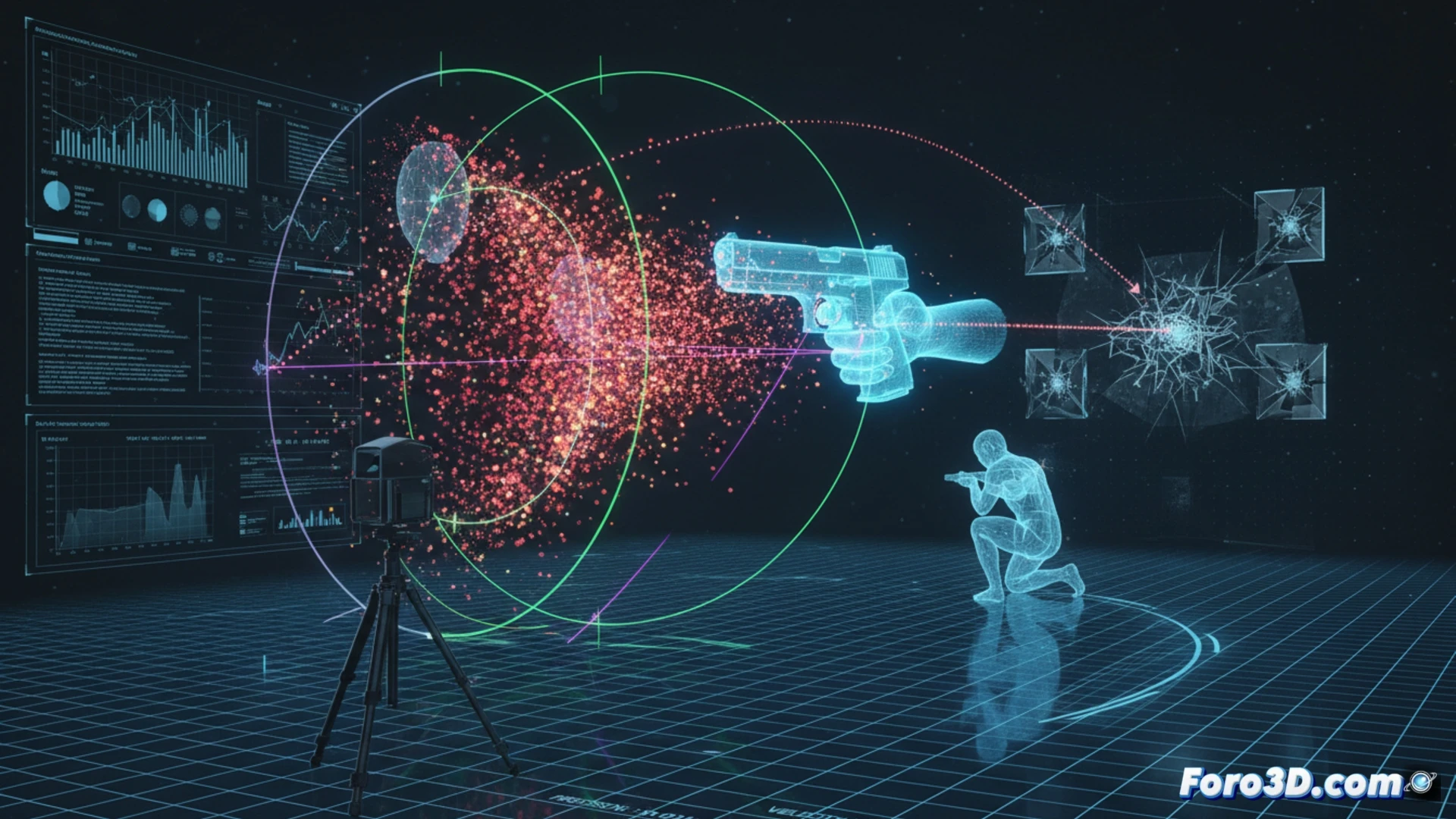
Capture and Ballistic Particle Simulation Pipeline 🔬
The workflow begins with forensic scene scanning using high-resolution photogrammetry or structured light scanners. GSR particles are identified and marked on surfaces such as clothing, skin, or walls, recording their diameter (between 0.5 and 10 microns) and XYZ coordinates. Subsequently, in simulation software like Blender or Maya with custom particle engines, the firing parameters are entered: caliber, distance, elevation angle, and muzzle velocity. The engine calculates the Gaussian dispersion of the particles, adjusting the pattern density based on the distance to the target. The result is a 3D point cloud that replicates the actual GSR distribution, allowing investigators to rotate the virtual scene and trace recoil vectors to infer the shooter's posture.
Expert Visualization and the Evidentiary Value of Technical Data ⚖️
The utility of the 3D GSR model transcends the laboratory. In a courtroom, a judge or jury cannot interpret two-dimensional dispersion maps with the same clarity as an interactive three-dimensional animation. By rendering the particles with metallic textures and dynamic lighting, the expert can demonstrate how the impact pattern deforms when passing through a window or ricocheting off a surface. This visualization eliminates ambiguities in technical testimony, turning abstract chemical data into irrefutable visual evidence. The ethical challenge lies in not embellishing the simulation: each particle must represent real scanned data, not an artistic assumption, to maintain the digital chain of custody and forensic objectivity.
How does the precision of 3D modeling of gunshot residue affect the determination of the distance and angle of a shot in forensic ballistic reconstruction
(PS: don't forget to calibrate the laser scanner before documenting the scene... or you might be modeling a ghost)