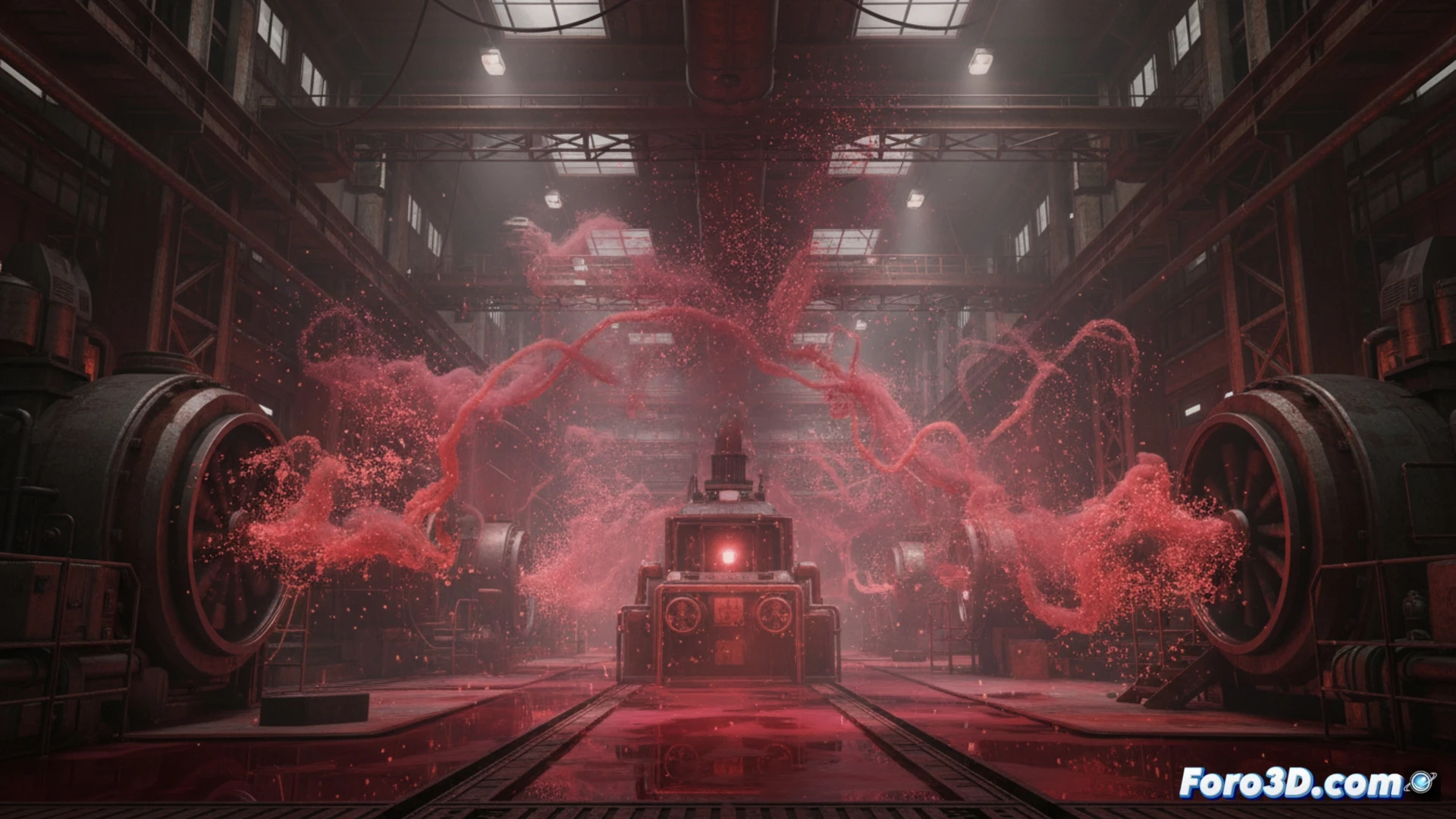
Scientific visualization faces the challenge of representing complex phenomena where the biological and industrial converge. The concept of Industrial Hematic Mist allows us to explore the simulation of suspended particles derived from manufacturing processes, combining real data on aerosols with physical properties of blood components. This technical article details the process for 3D modeling the dispersion of these particles, analyzing their dynamic behavior in a factory environment and their impact on visibility and environmental health.
Simulation Methodology and Physical Parameters 🧪
For the educational animation, we start from scientific data on hematic particle size (between 5 and 10 micrometers) and typical densities of industrial aerosols (1.2 g/cm³). We use a real-time fluid engine (such as Houdini or Unreal Engine) to emulate airflow within an industrial facility. We configure point emitters in heavy machinery areas, adjusting the emission rate to 500 particles per second. The simulation includes turbulence generated by fans and temperature gradients, causing the formation of mist clusters that move in layers. To validate the model, we compare dispersion patterns with field studies on particulate matter pollution, adjusting the medium's viscosity to reflect the electrostatic interaction of blood cells with metallic dust.
Visual Impact and Reflection on the Biological-Industrial Intersection 🌍
The 3D representation of this mist seeks not only technical realism but also to provoke reflection. By visualizing how hematic particles mix with industrial waste, the viewer understands the fragility of biological systems in the face of human activity. The animation reveals high-concentration zones that reduce visibility to less than 2 meters, simulating real occupational hazard conditions. This approach demonstrates that scientific visualization is not mere ornamentation; it is a tool for educating about environmental health, where each particle tells a story of interaction between life and machine.
How to simulate the dispersion of particles in an industrial environment to accurately represent the dynamics of a hematic mist generated by biological and mechanical processes?
(PS: at Foro3D we know that even manta rays have better social bonds than our polygons)