A toxic spill in an underground aquifer is not an accident visible to the naked eye; its advance is silent, hidden beneath layers of rock and soil. When an industrial leak or a tank failure contaminates groundwater, the disaster spreads without affected communities being able to perceive it until it is too late. Three-dimensional modeling of the contaminant plume then becomes the only tool capable of revealing the true magnitude of the catastrophe.
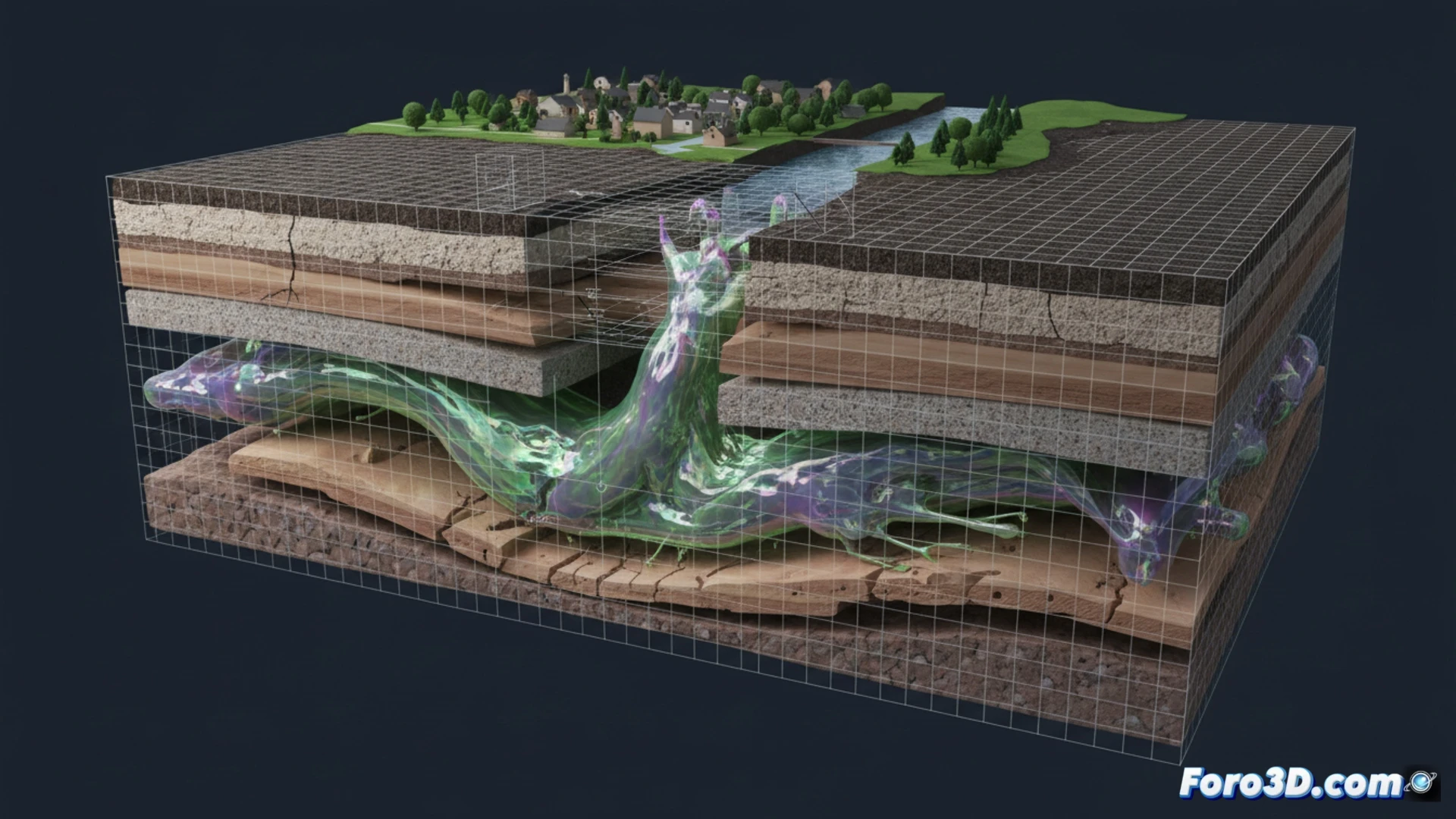
Geological and kinetic simulation of the contaminant plume 🧪
To technically address this disaster, a volumetric model of the subsurface is built, integrating data on permeability, porosity, and local stratigraphy. Using groundwater flow simulation software, the contaminant parameters—density, viscosity, and solubility—are injected. The result is a 3D animation showing how the toxic plume moves through the aquifers, deforming as it encounters geological barriers or highly fractured zones. Layers of concentration density are added, represented with color gradients, and advance velocity vectors are projected. The model allows real-time identification of which nearby supply wells will be affected and within what timeframe, offering a precise risk map for urgent technical decision-making.
Visualizing the invisible to act with awareness 🌍
The ability to observe on a screen how a poison advances beneath our feet transforms the perception of risk. It is no longer a distant rumor or a bureaucratic report; it is a tangible reality demanding immediate action. For local residents, seeing the color of contamination approaching their water well generates an urgency that data on paper fails to convey. This simulation exercise not only helps plan containment barriers or extraction wells but also reminds us that the soil is not an infinite landfill, and that every buried toxic drop returns, sooner or later, to our table.
Is it possible to accurately simulate the chemical behavior and dispersion speed of a toxic spill in a heterogeneous aquifer using exclusively accessible 3D modeling tools for an independent study?
(PS: Simulating disasters is fun until the computer crashes and you are the disaster.)