The massive plastic leak is not just a stain on the water; it is an ecological catastrophe of silent progression. To understand its scope, 3D visualization becomes a crucial tool. This technical article explores how to simulate the dispersion of plastic pollutants in an aquatic ecosystem, using particle systems and temporal analysis to reveal the true horror of an industrial disaster.
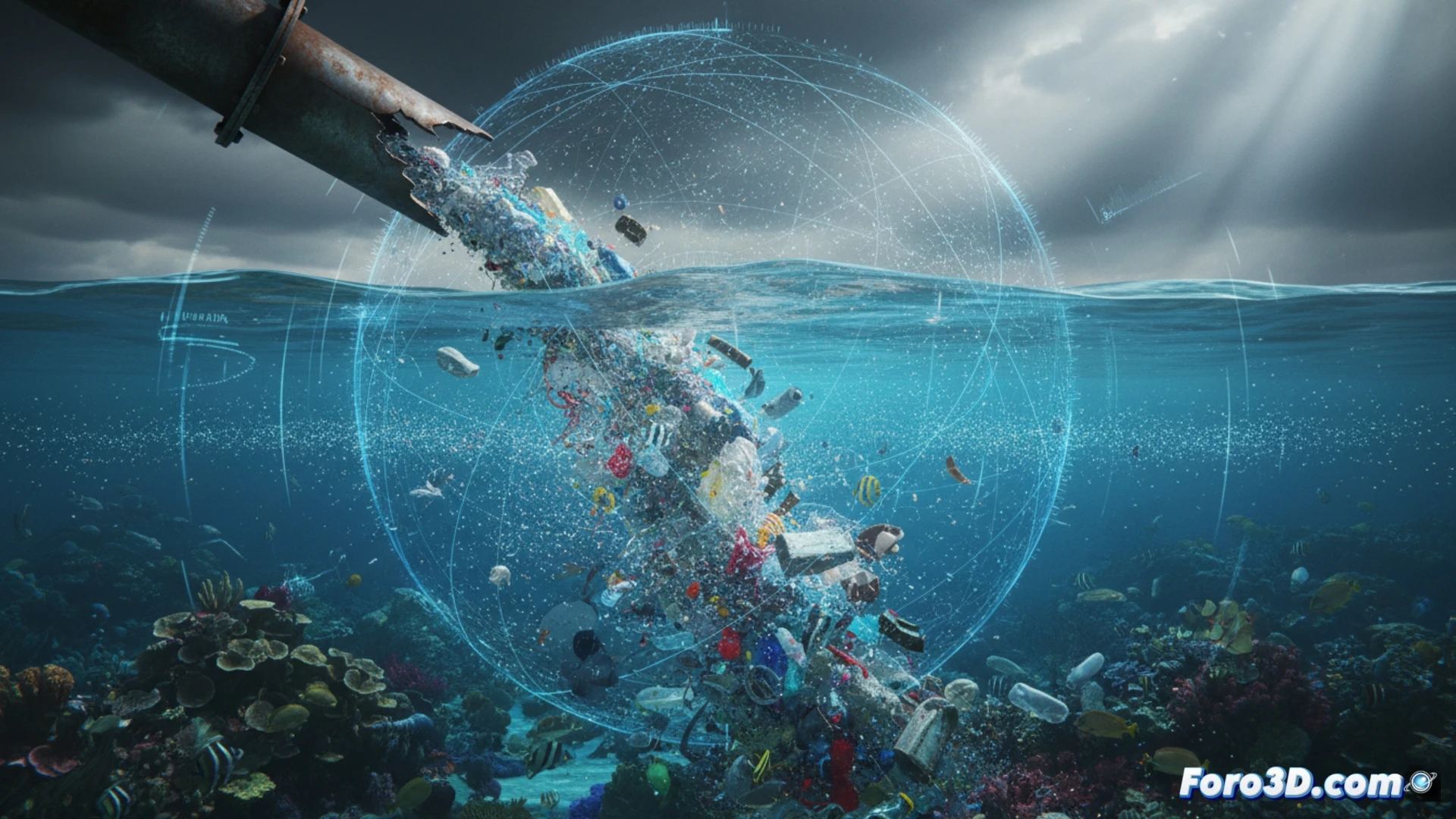
Particle Simulation and Dispersion in 3D Environments 🌊
The first technical step is to model the base fluid (river or aquifer) with a simplified fluid dynamics system. On top of this, we implement a particle emitter representing the leak point. Each particle has physical properties such as mass, buoyancy (for low-density plastics), and initial velocity. To visualize accumulation, we apply a color gradient based on concentration: from light blue (low density) to intense red (critical stagnation points). The simulation must include geometric obstacles like rocks or riverbed curves, where particles accumulate, replicating the waste plugs that affect local wildlife. A 30-second real-time timeline can represent months of contamination.
The Aesthetics of Disaster: Awareness Through Contrast 🎨
Beyond the technique, the visual representation must be impactful. The temporal before/after comparison is fundamental: a photorealistic render of the healthy ecosystem versus the same model with accumulated particles and waste textures. Concentration maps, overlaid as a semi-transparent layer on the terrain, show the geographic extent of the catastrophe. Including models of affected wildlife (trapped fish or entangled birds) humanizes the scientific data. The ultimate goal is not just to simulate, but to generate an immersive experience that raises awareness about the urgency of stopping industrial plastic leaks.
How the progression of microplastic leaks in a marine ecosystem can be modeled in 3D to visualize its long-term impact on the food chain.
(PS: Simulating catastrophes is fun until your computer melts down and you become the catastrophe.)