Collisions between vessels and marine fauna are one of the main threats to species such as the bottlenose dolphin or the humpback whale. Recently, the sighting of a cetacean with a deep cut on its back, consistent with a propeller impact, has reopened the debate on maritime traffic. From the field of scientific visualization, three-dimensional modeling becomes a key forensic tool to document the biomechanics of the injury and understand the kinematics of the accident.
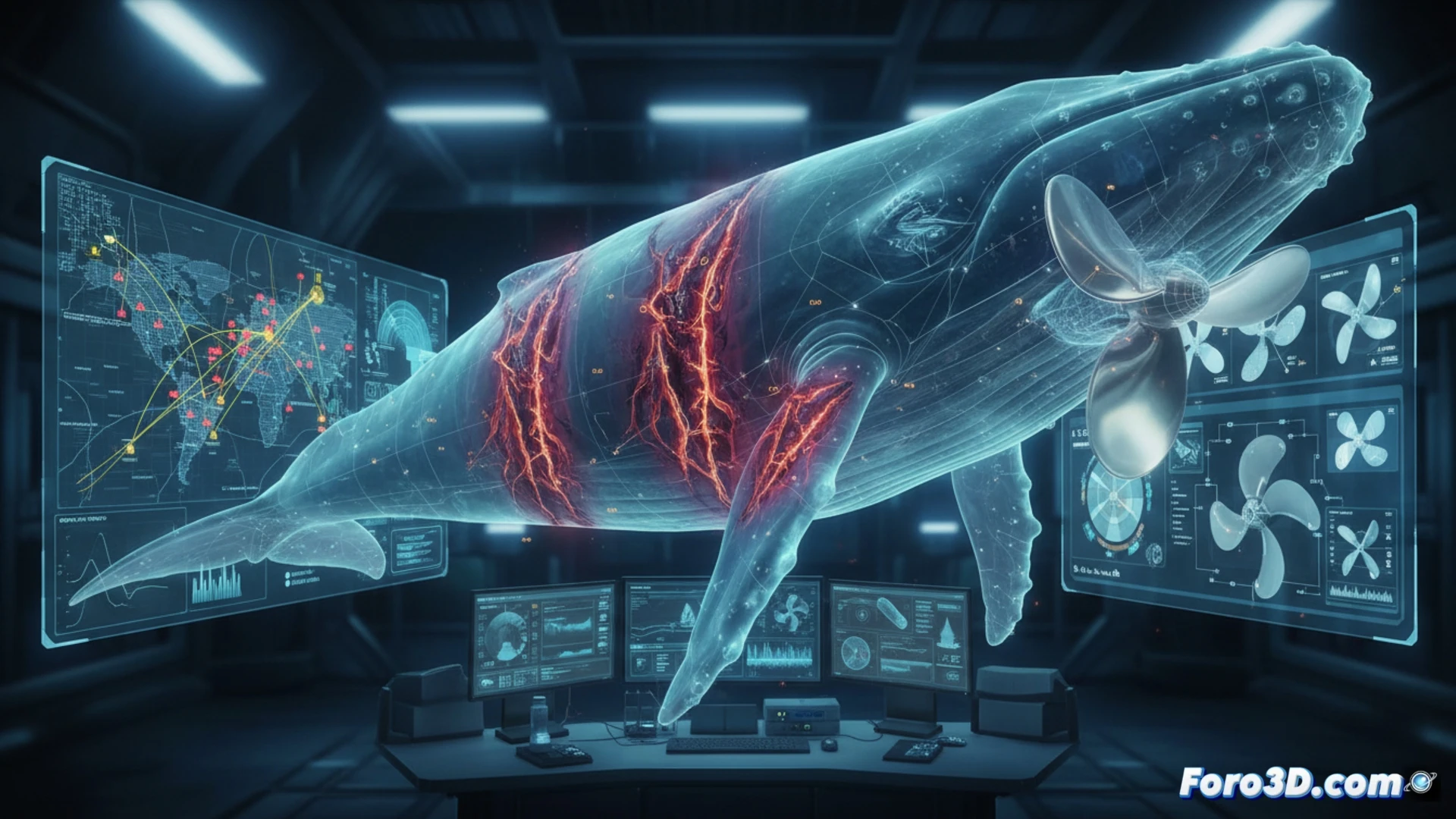
Photogrammetry and biomechanical simulation of the collision 🐋
The technical process begins with aerial photogrammetry using drones, capturing dozens of images of the wound from multiple angles. These images are processed in 3D reconstruction software (such as Agisoft Metashape or RealityCapture) to generate a high-resolution polygonal mesh of the damaged area. Subsequently, this mesh is integrated into a complete anatomical model of the cetacean, including muscle and skeletal layers. Finite element simulation allows recreating the propeller's trajectory, calculating the impact force, cut depth, and tear pattern. This digital forensic analysis helps biologists determine the vessel's speed and angle of attack, crucial data for drafting navigation protocols in marine sanctuaries.
Beyond the data: empathy and visual awareness 💙
The value of these models transcends academic research. By rendering the wound in an interactive virtual environment, science communicators can show the general public the vulnerability of these animals to propellers spinning at thousands of revolutions per minute. Visualizing torn tissue in a realistic 3D model generates an emotional impact that a flat photograph cannot achieve. Thus, scientific visualization not only quantifies the damage but humanizes the statistic, driving speed reduction campaigns in sighting areas and promoting the design of encapsulated propellers. In this case, 3D technology becomes a bridge between the coldness of data and the urgency of conservation.
What technique would you use to represent years of social bonds in an animation? 🐬