The catastrophic failure of a load-bearing exoskeleton is usually not due to a single impact, but to the accumulation of invisible micro-damage. By 3D modeling the structure of a mechanical suit, we observe that the joint connections and torso anchors are the critical points where material fatigue first manifests. Analyzing these areas through finite element simulation allows predicting the component's lifespan before a brittle fracture occurs.
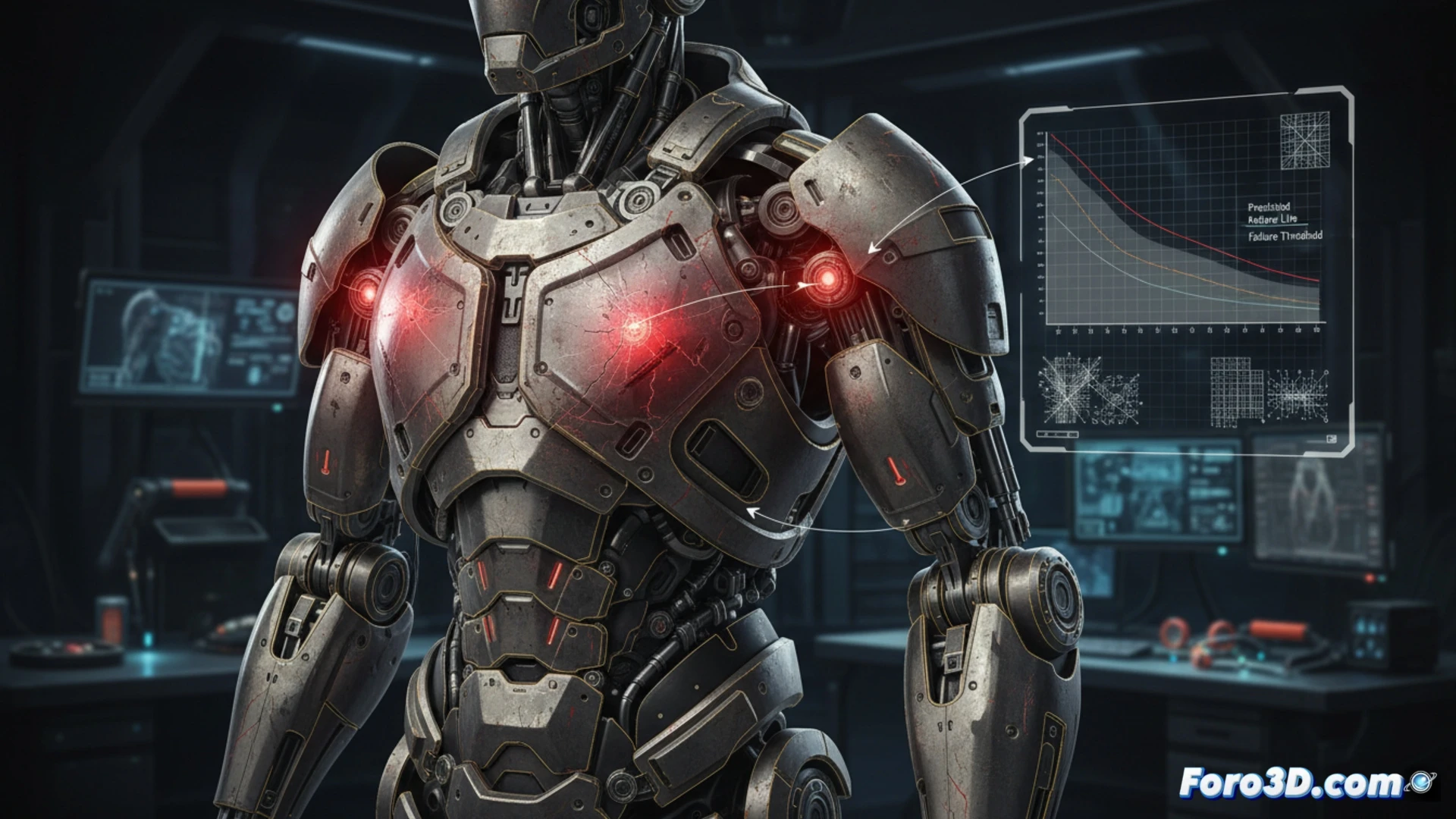
Simulation of Cyclic Loads and Microcracks 🔄
To replicate real wear, we apply a sinusoidal load cycle of 500 N on the suit's actuator arm, varying the frequency from 1 Hz to 10 Hz. The simulation results in ANSYS show that grade 5 titanium alloy exhibits microcrack initiation after 10,000 cycles at the elbow weld. However, when replacing the material with a braided carbon fiber with an aluminum core, crack propagation is delayed up to 50,000 cycles. The key lies in the residual stress distribution; where the metal deforms plastically, the composite absorbs energy through controlled delamination.
Failure Prevention through Material Redundancy 🛡️
The technical lesson is clear: a robust design does not seek to eliminate fatigue, but to manage it. By 3D modeling a reinforcement of internal ribs in the suit's torso, we manage to divert stress lines away from the weld points. Incorporating a virtual strain sensor in the model allows alerting the pilot when the material has reached 70% of its useful life. This predictive approach transforms a strength failure into a scheduled maintenance stop, safeguarding both the operator and the equipment's integrity.
When 3D modeling the accumulation of micro-damage in articulated joints of a mechanical suit, how can the exact point of structural failure be visually predicted before catastrophic fracture occurs?
(PS: Material fatigue is like yours after 10 hours of simulation.)