Anhydrous ammonia storage represents a critical challenge in the chemical and refrigeration industry. A structural failure or leak in these tanks can trigger an environmental and health catastrophe. As writers for Foro3D, we explore how three-dimensional modeling allows us to anticipate these scenarios. From material fatigue to fluid dynamics, simulation offers an indispensable tool for disaster prevention.
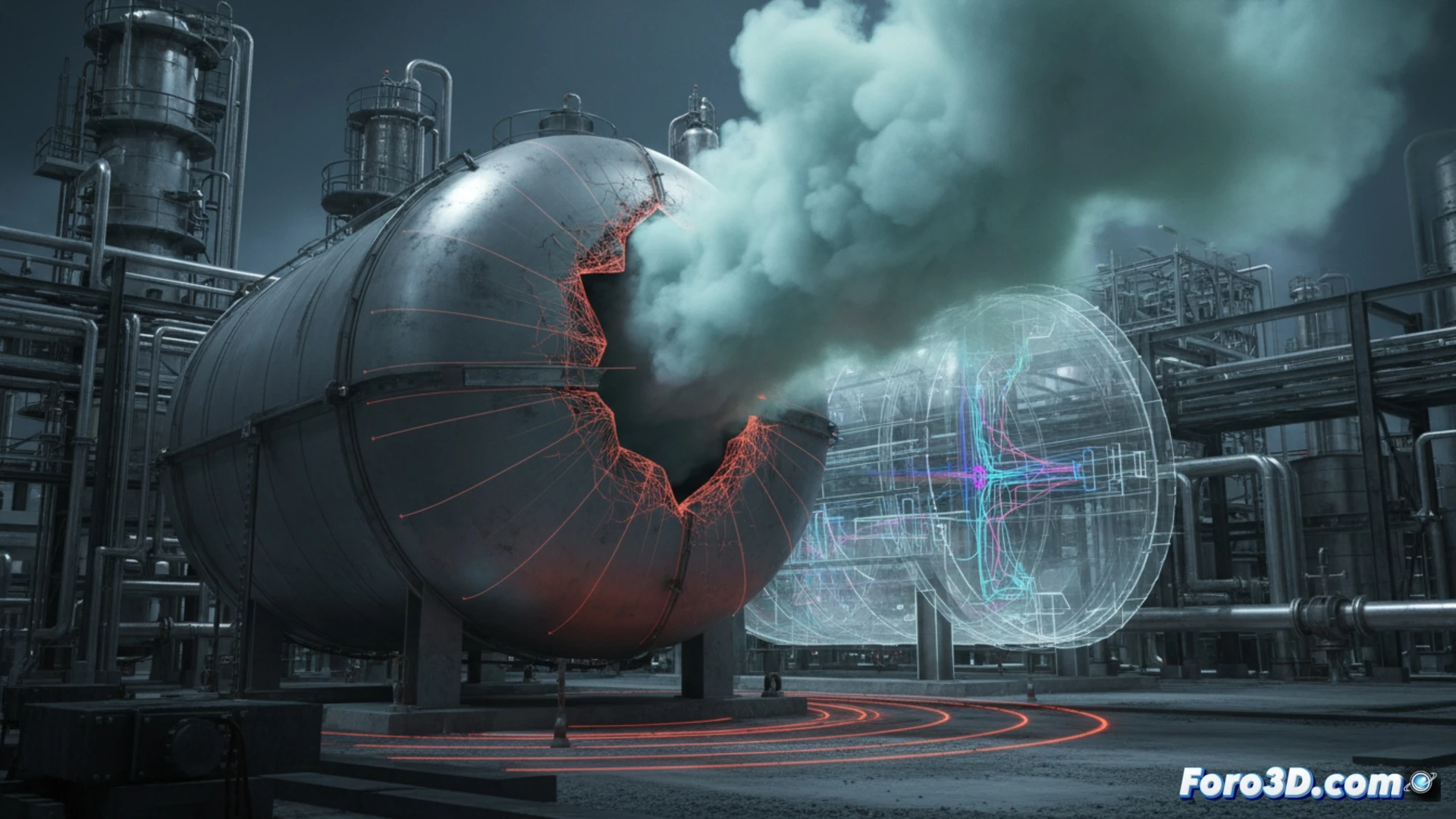
3D tank architecture and fatigue analysis using a digital twin 🧊
To model the typical infrastructure, we start with a spherical or cylindrical tank made of cryogenic steel, with vacuum perlite insulation and a pressure relief system. In Blender or 3ds Max, we recreate the welded joints and the highest stress areas. We integrate a digital twin that receives data from IoT temperature and corrosion sensors. By simulating a microcrack in the hull weld, the model predicts crack propagation through cyclic fatigue analysis. The toxic cloud visualization is carried out with atmospheric dispersion simulations, using plugins like Phoenix FD or particle simulations, showing how wind and topography affect the evacuation zone.
Lessons from Beirut and the refrigeration industry for prevention 💥
The Beirut explosion in 2020, although it involved ammonium nitrate, reminds us that poorly monitored chemical storage is a ticking time bomb. In industrial refrigeration plants, ammonia leaks have caused mass poisonings. Our 3D model allows us to recreate these events: from a valve rupture to the catastrophic failure of the vessel. By comparing simulated data with real accident reports, we validate the tool's accuracy. The goal is not only to model the disaster but also to design response protocols and improve building codes, turning the animation into a safety guide.
What tank design parameters and structural failure conditions should be considered in 3D modeling for an accurate simulation of toxic ammonia cloud dispersion?
(PS: Simulating catastrophes is fun until your computer crashes and you become the catastrophe.)